// NATURE NEWS — SPAZIO & SCIENZA
GPCR antagonism via rewiring of receptor trafficking and degradation
Nature
(2026) Cite this article
G-protein-coupled receptors (GPCRs) represent one of the most important yet incompletely addressed classes of therapeutic targets1. Here we report a strategy for functional GPCR antagonism through bispecific antibody-mediated endocytosis and lysosomal degradation. GPCR–TfR1 targeting chimeras (GTACs) achieve potent and selective downregulation of multiple GPCRs, including BILF1, RXFP1 and CCR6—viral, cancer and immune targets that have been difficult to drug2,3,4. GTACs lead to complete inhibition of receptor signalling, including constitutive signalling, with more than one to two orders of magnitude greater potency than conventional antibody antagonists. Using protein engineering and multicolour live-cell imaging, we establish a context-dependent degrader design and explain the cellular mechanisms, with broad relevance for degrader technology. The GTAC platform establishes induced endocytosis and rewiring protein trafficking as a model for therapeutic GPCR modulation.
G-protein-coupled receptors (GPCRs) comprise the largest receptor family, with more than 800 members that have essential roles in physiology and disease1. Although about one-third of FDA-approved drugs target GPCRs1, therapeutic success is disproportionately concentrated within a small subset—particularly biogenic amine receptors—while many peptide-binding receptors, lipid receptors, orphan receptors and sensory receptors remain underexplored5.
Current GPCR inhibitors function by competing with ligands or stabilizing inactive receptor conformations6, but these mechanisms can be hindered by difficulty in developing sufficiently high-affinity competitive antagonists7 or by ligand-independent, constitutive signalling3. These challenges are often greater for peptide- and protein-binding GPCRs, in which autocrine or paracrine signalling, together with high affinity and local concentrations of ligands, can reduce the effectiveness of competitive inhibition4. Moreover, biologic antagonists are often difficult to engineer because the functional binding pockets are buried within the receptors7. These challenges underscore the need for alternative mechanisms of GPCR modulation.
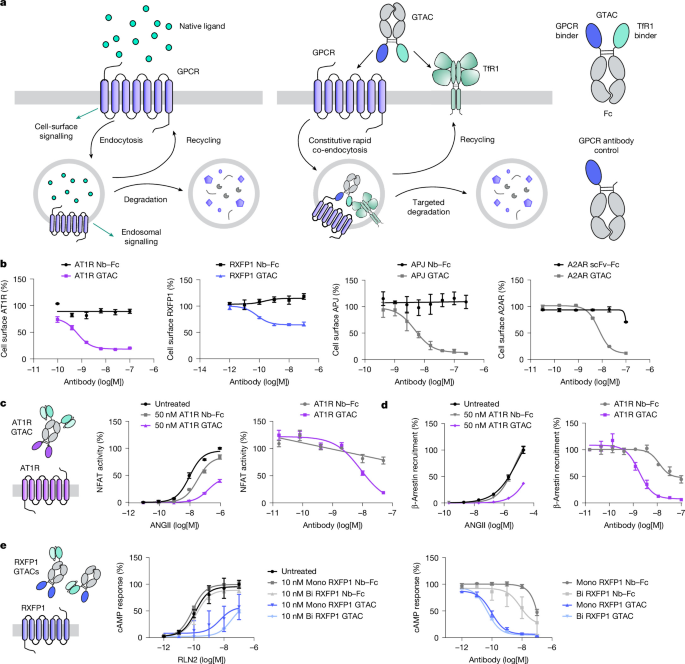
Endogenous GPCR signalling is dynamically regulated by endolysosomal trafficking, in which internalization, recycling and degradation are tightly coupled to ligand binding, intracellular phosphorylation and β-arrestin recruitment8. Building on this biology, we proposed that induced proximity to an internalizing receptor could synthetically trigger GPCR endocytosis and lysosomal delivery to silence receptor signalling (Fig. 1a).
a, Schematic of native and engineered GPCR trafficking (left). Native agonists typically induce GPCR internalization, followed by recycling or degradation. GTACs direct GPCRs for degradation by leveraging rapid, constitutive TfR1-mediated internalization (middle). GTAC design (right): bifunctional antibody with GPCR-binding domains and TfR1-binding domains fused to an Fc. The control antibody lacks TfR1-binding domains. b, Cell-surface GPCR levels (anti-FLAG flow cytometry) after treatment with GTACs or control antibodies. Cell-surface AT1R levels in FLAG–AT1R–GFP+ TfR1+ Expi293 cells after 6 h treatment; cell-surface RXFP1 levels in FLAG–RXFP1+ TfR1+ Expi293 cells after 2 h treatment; cell-surface APJ levels in FLAG–APJ+ TfR1+ HEK293T cells after 2 h treatment; and cell-surface A2AR levels in FLAG–A2AR+ TfR1+ Expi293 cells after 6 h treatment. Data represent mean ± s.d. from n = 3 replicates. c, NFAT-luciferase activation in FLAG–AT1R+ TfR1+ NFAT-Luc+ Expi293 cells, after 2 h pretreatment with 50 nM (left) or varying concentrations (right) of AT1R GTAC or Nb–Fc, followed by 4 h stimulation with varying concentrations (left) or 9 nM (right) ANGII. Data represent mean ± s.d. from n = 4 biological replicates. d, β-Arrestin recruitment in FLAG–AT1R–Tango+ TfR1+ HTLA cells (luminescence) after pretreatment for 2 h