// NATURE NEWS — SPAZIO & SCIENZA
γδ T cell receptor dependencies define a unique immunosurveillance modality
Nature
(2026) Cite this article
γδ T cells are one of three lymphocyte lineages that utilize gene rearrangement to diversify their antigen receptors. Nonetheless, the cells’ classification has remained uncertain, complicating our ability to understand the basis for their evolutionary conservation. Whereas many γδ T cells display hallmarks of adaptive immunity, others, including those in barrier tissues, make rapid, reportedly T cell receptor-independent responses that phenocopy innate immune cells1. Here we address this paradox and show that the phenotypes of tissue-intrinsic γδ T cells, including their rapid, innate-like responsiveness to tissue stress and carcinogenesis, acutely depend on the γδ T cell receptor (TCRγδ). Those dependencies emphasize the unique biology of γδ T cells and of the immunosurveillance modalities they mediate, with their clinical deployment evidently requiring environments conducive to TCRγδ signalling.
In seeking to broaden the reach of immunotherapy, much interest is focused on immunosurveillance by human γδ T cells, particularly those that are enriched in tissues housing solid tumours or metastases2,3,4. Indeed, frequencies and activation states of human, tissue-associated γδ T cells commonly segregate with favourable patient outcomes5,6,7,8,9.
Some such γδ T cells manifest adaptive immunity, with durably expanded clones expressing diverse TCRγδ receptors1,10,11,12 that recognize self-encoded proteins qualitatively altered and/or overexpressed on infected or transformed cells1,12. Conversely, several γδ T cell subsets, including those intrinsic to tissues, manifest innate immunity by using cytokine and natural killer receptors (NKRs) to respond rapidly and non-clonally to stress-induced alarmins1,13,14,15,16. Indeed, functional, tissue-associated γδ T cells in human breast cancers lacked overt clonal expansions5. Moreover, several immunopathologies in mouse originate in IL-17-producing γδ T cells responding rapidly to IL-1β and IL-23 released within damaged tissues, seemingly independent of the T cell receptor (TCR)16,17,18.
In addressing whether γδ T cells are adaptive or innate, it has been hypothesized that TCRγδ may, during the cells’ development, licence them to function thereafter as innate immune cells15. Indeed, mouse epidermal and intestinal γδ T cells and their human colonic counterparts display TCR-dependent repertoire selection by tissue-specific, epithelial, butyrophilin-like (BTNL) molecules19,20,21,22, the importance of which is inferred from human disease associations of BTNL polymorphisms22,23.
Following development, sustained BTNL activity is required for some part of the steady-state phenotypes of epidermal and intestinal intraepithelial γδ T cells19,24. Nonetheless, to our knowledge, a real-time requirement for TCRγδ has not been investigated, particularly for myriad γδ T cells that are BTNL-independent—for example, human Vδ1+ cells and mouse Vγ6+ and Vγ4+ cells, which exist in several tissues and for which strong TCR engagement reportedly antagonizes the cells’ development25. Here we demonstrate that acute TCR ablation alters the steady-state phenotypes of all BTNL-dependent and BTNL-independent γδ T cell subsets that we examined and profoundly impairs the responses to inflammatory agents and cancers that are the hallmarks of γδ T cell biology in vivo. Thus, immunosurveillance by γδ T cells is unique, which is likely to be pertinent to the cells’ evolutionary conservation.
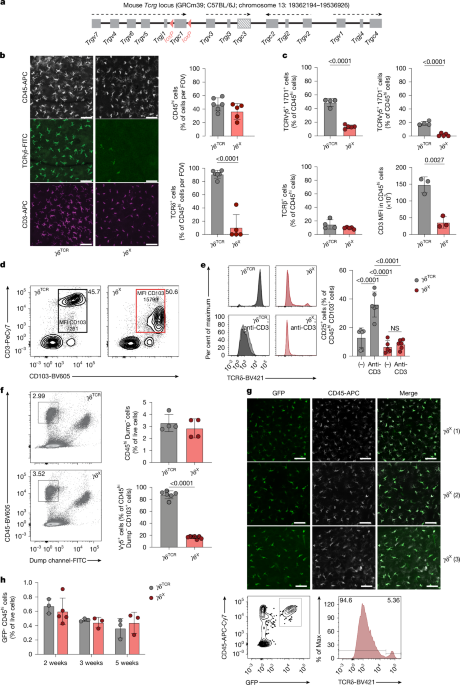
To assess any real-time requirement for TCRγδ in vivo, we focussed on mouse tissue-intrinsic γδ T cells because they are broadly considered to be innate. They include two BTNL-selected, IFNγ-skewed subsets: TCRVγ5-expressing dendritic epidermal T cells (DETCs) and TCRVγ7-expressing intestinal intraepithelial lymphocytes (IELs), the latter being conserved in humans; as well as IL-17-skewed subepithelial TCRVγ6+ and TCRVγ4+ cells, which are found in many tissues including the