// NATURE NEWS — SPAZIO & SCIENZA
Evolution of terrestrial anatomy revealed by a derived stem tetrapod
Nature
(2026) Cite this article
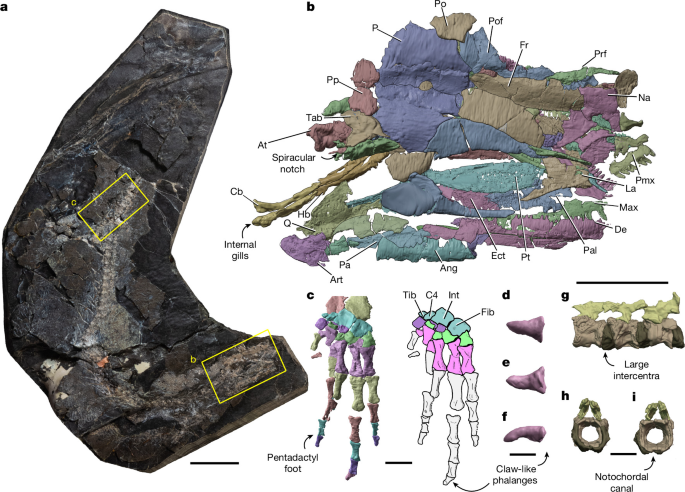
Tetrapods (limbed vertebrates) include lissamphibians and amniotes, and now comprise half of all vertebrate species, with particular importance on land. Limbs first appeared in stem tetrapods by the Late Devonian, 365 million years ago1,2,3,4,5. However, many taxa either have limbs with fin-like functional anatomy or have secondarily lost them, raising questions about the ecological context and early evolution of the tetrapod limb6. Here we provide considerable new data on the enigmatic Early Carboniferous Westlothiana lizziae, widely cited as the earliest terrestrially adapted stem amniote7,8. We find unexpected plesiomorphies of the skull roof, palate, braincase and mandible, alongside aquatic adaptations, including an ossified internal gill skeleton and extensive denticles on the palate and mandible. These traits return Westlothiana as a stem tetrapod in our phylogenetic analyses, demonstrating that terrestrial adaptations such as an amniote-like pedal formula, loss of fin-like forelimb function and superficially claw-like terminal phalanges evolved in a mosaic fashion, and that these traits evolved in a transitional, amphibious context before the origin of the tetrapod crown group. Our findings reinforce recent suggestions of a taxonomically inclusive tetrapod-stem lineage, but also illuminate substantial gaps in anatomical knowledge, especially for small-bodied taxa, that obstruct our understanding of early tetrapod evolution.
This is a preview of subscription content, access via your institution
Access Nature and 54 other Nature Portfolio journals
Get Nature+, our best-value online-access subscription
Prices may be subject to local taxes which are calculated during checkout
Files related to the phylogenetic dataset are available as supplementary files and stored on OSF at https://osf.io.xnm6t. Reconstructions and anatomical information of NMS G.1990.72.1 Computed tomography data and 3D models are available on Morphosource: individual elements, https://www.morphosource.org/concern/media/000672184; skull reconstruction, https://www.morphosource.org/concern/media/000736020.
Nexus scripts for Bayesian phylogenetic analyses and R code for conducting ancestral state reconstruction are stored with OSF at https://osf.io/xnm6t.
Ahlberg, P. E. Elginerpeton pancheni and the earliest tetrapod clade. Nature 373, 420–425 (1995).
Article
ADS
CAS
Google Scholar