// ARS TECHNICA — SPAZIO & SCIENZA
Artificial cell manages a few rounds of cell division
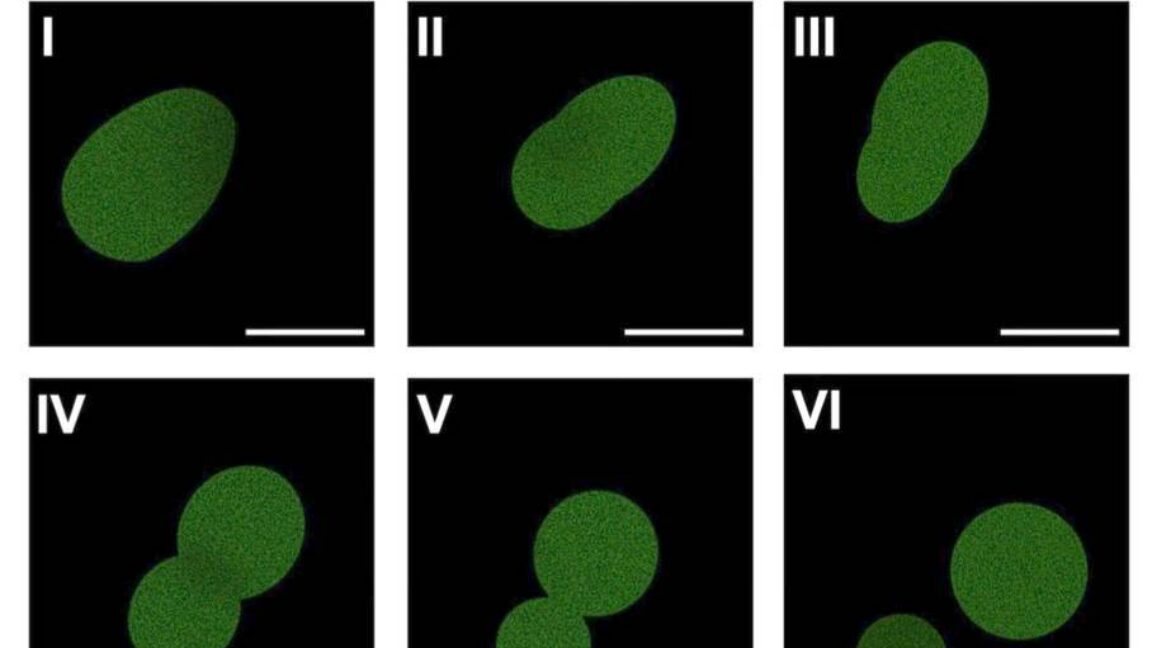
It only works for a few divisions thanks to a lot of added materials.
Understanding the origin of life requires addressing a collection of overlapping scientific questions. We’ve made a lot of progress toward explaining how simple chemicals present on an early Earth built the complex molecules used by life and how some of those chemicals built the first genetic/catalytic molecules. But we’re much further from understanding a key conundrum: How did membranes end up surrounding the first cells?
It’s relatively easy to make membranes spontaneously form in water, and they’ll enclose anything dissolved in that water, including nucleic acids. But the membranes then cut their interior off from everything else in the solution. Any interesting chemical reactions enclosed there would eat through the raw materials and grind to a halt.
Now, a lab at the University of Minnesota has announced that it has developed a simplified system in which a membrane encloses some genetic material but can continually import new materials supplied to it. The system also spontaneously divides, producing a few generations of “offspring” before things start failing. It’s still extremely dependent upon human intervention, but it might provide a new avenue to explore questions about the origin of life and what a truly minimalistic form of life might look like.
The work was done by a team led by Kate Adamala, and it hasn’t yet undergone peer review (a draft manuscript has been posted online). It mostly involved putting together pieces of biological systems described or developed by other researchers and wrapping them in a membrane. Many of these pieces originated in viruses, which are often notable for having stripped-down versions of systems that are far more elaborate in cells.
For example, the system used to copy the DNA of what Adamala is calling a “SpudCell” is derived from a virus that infects bacteria called Phi29. A different research group had already demonstrated that DNA encoding the proteins this virus uses to copy its DNA can be placed inside a membrane, where it would replicate its own DNA. So the researchers adapted this to their own system, which spreads roughly 90,000 bases of DNA across seven separate circular DNA molecules.
One limitation of the SpudCell is that it has no way to ensure that, when the cells divide, each offspring receives copies of all seven of these molecules. Instead, the system simply makes a bunch of copies to increase the probability that some of them will end up in each of the offspring. It doesn’t entirely work; after five generations of divisions, the majority of the SpudCells are missing at least one of the seven molecules of its genome.
The system for copying parts of the genome into RNA for protein production comes from a virus called T7. This has become a workhouse of molecular biology—you can order up T7 RNA polymerase online and have it shipped to you on ice. In this case, the gene encoding T7 RNA polymerase was added to the SpudCell genome, and it was made by those artificial cells.
The last element needed here is the translation of RNAs into proteins. And here, the researchers simply purified the translation machinery and supplied it to the SpudCells. They relied on a system developed by a team at the University of Tokyo, which added a tag to every protein required for translation and purified them using the tags. The Minnesota team simply purified these proteins and fed them into the system.
That feeding was quite literal. For small, simple molecules, the researchers simply inserted a gene that encodes a pore protein into the SpudCell genome. This allowed small molecules and ions to diffuse into and out of the SpudCell. As long as the cells were placed in a solution with sufficient levels of these materials, the interior of the SpudCell would have decent concentrations of all of these.