// NATURE NEWS — SPAZIO & SCIENZA
AI biohazard hype must not divert attention from the real risks we face now
Saskia Popescu is an assistant professor of epidemiology at the University of Maryland School of Medicine, Baltimore, Maryland, USA, and chief executive of the Global Health Security Network.
Search author on:
PubMed
Google Scholar
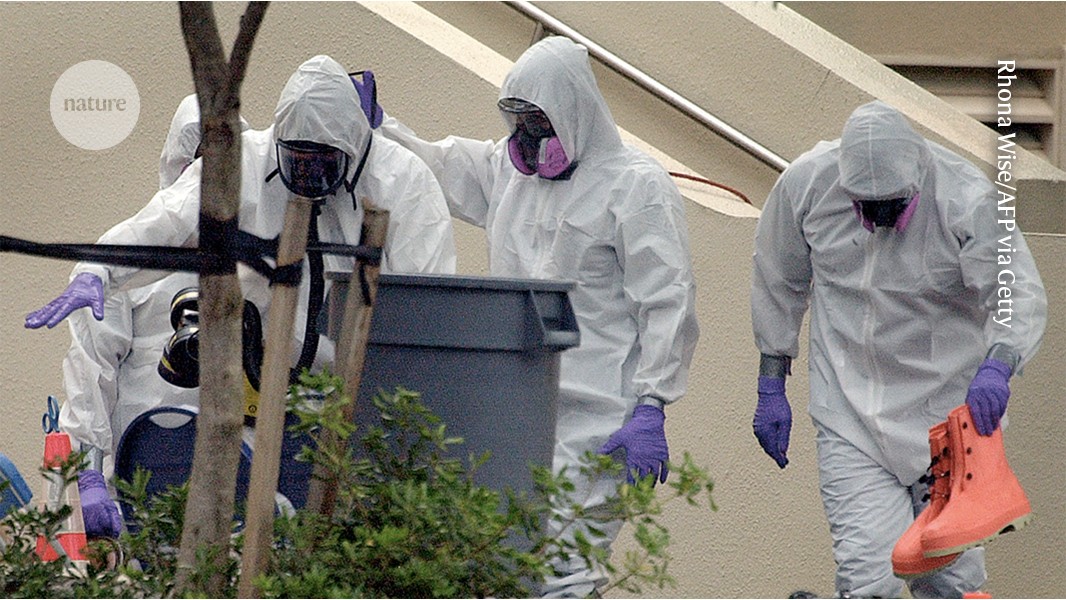
FBI agents are decontaminated after leaving a media outlet in Florida, which was the target of an anthrax attack in 2001. Credit: Rhona Wise/AFP via Getty
With the world focused on the risks of artificial intelligence, I can’t help but think of the profound vulnerability the United States faced 25 years ago. In 2001, against the backdrop of the 11 September terrorist attacks, the nation experienced its first bioterrorist attack in decades — anthrax (Bacillus anthracis) spores sent as a white powder to media outlets in Florida and New York, as well as to the offices of public officials in Washington DC.
AI can design viruses, toxins and other bioweapons. How worried should we be?
It quickly became clear that the 22 cases of pulmonary anthrax identified — which led to 5 deaths — were not naturally occurring but a result of a nefarious actor1. The FBI found that the spores might have originated in a US Army laboratory, although the perpetrator was never convicted. The main suspect, microbiologist Bruce Ivins, died before charges were brought.
Amid a chaotic storm of panic, poor communication, clunky coordination across government agencies and public clamouring for preventive medicines, the attacks, code-named Amerithrax, exposed a disconnect between years spent preparing for bioterrorism and what happens when reality strikes.
And I know that the country is no better prepared today. Worse, attention paid to one threat is coming at the expense of others. Policymakers, researchers and the public are distracting themselves from the most pressing risks by focusing on overhyped biohazards, such as those designed by AI, when all these risks deserve attention.
Here, I outline what the priorities should be: stronger and agile safeguards on biomaterials and equipment, along with sustained and coordinated governance.
Access to powerful analytical equipment has become more widespread and cheaper since 2001. Benchtop DNA synthesizers enable researchers to produce stretches of DNA and RNA in their own labs rather than ordering them from commercial providers. Fully automated, remotely controlled wet labs (cloud labs) have streamlined the process for bringing bio-based products to market2.