// NATURE NEWS — SPAZIO & SCIENZA
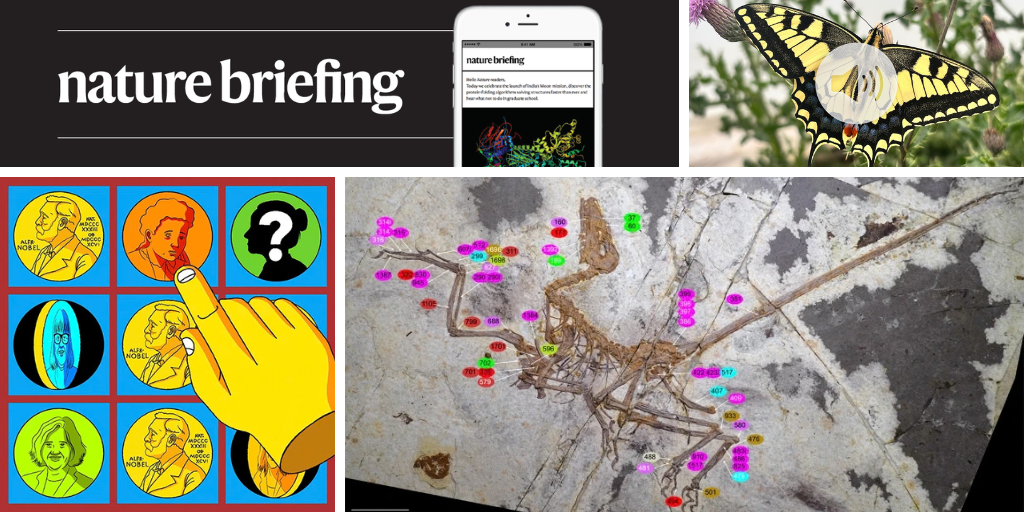
Daily briefing: Can you name every female Nobel laureate?
Search author on:
PubMed
Google Scholar
Hello Nature readers, would you like to get this Briefing in your inbox free every day? Sign up here.
The academies that award the Nobel prizes have applied themselves to doing a better job of recognizing the accomplishments of female scientists. But men still dominate the 125-year history of the awards. As we set up the tenterhooks for the first of the prize announcements on Monday, here’s a game to test your expertise: can you name the women who have won a science Nobel prize?
The Norellraptor barsboldi fossil shows traces of feathers on its fore and hind limbs as well as at the end of its tail. Credit: Xuri Wang et al./Nat. Commun.
The discovery of a complete fossil of a feathered dinosaur species adds to evidence that birds evolved the ability to fly several times rather than through a single lineage. The newly described species belongs to a group of dinosaurs called microraptorines, which are closely related to birds. Researchers found that several flight-related adaptations in microraptorines also evolved in the bird lineage Avialae. But these adaptations did not develop in the same order in the two groups and “thus could not be considered the expression of a shared developmental regime”, the researchers write.
Cancer researchers are excited about ‘cancer interception’ — a technique in which people at high risk are treated to prevent cancer from ever developing. A combination of early-detection techniques and interception in pancreatic cancer is “going to be the breakthrough strategy that really changes survival”, says surgeon and researcher Diane Simeone. The approval of the landmark pancreatic-cancer drug daraxonrasib (Rasonque), which disarms cancer-causing proteins, could be key to an interception approach.
‘Agentic’ and ‘vibe coding’ are among a slew of terms about artificial intelligence that have been added to the online version of the venerable Merriam-Webster dictionary. The entries, which also include tech phrases such as ‘prompt engineering’, are notable for the advanced knowledge needed to understand them, say scholars. “This particular batch, more than any other that I’ve seen, really does feel like it’s a meta-commentary on language,” says Peter Sokolowski, a lexicographer at Merriam-Webster. The sophistication of these entries reflects non-specialists’ expanded access to highly technical terms, he says.
‘Anthropocene’ has become useful shorthand for humanity’s footprint on Earth — we even have a Briefing newsletter named after it. But it’s not an official geological epoch, after the idea was rejected in 2024. Now, some scholars say that there are unpublished documents showing that the proposal’s rejection was illegitimate, and that the rationale for the decision was never adequately explained. Researchers involved in the vote maintain that the process was fair and point to a technical explanation for the proposal’s rejection published last month in an issue of Nature Reviews Earth & Environment that focused on the debate.
Reference: Nature Reviews Earth & Environment comment or read the whole focus issue
“If you see hate speech online, take it almost as your duty to disagree,” says psychologist Mirta Galesic. “Just say ‘I disagree’. Don’t feel pressured to have an elaborate argument.” The goal, she says, is to highlight widespread, moderate social norms — so ask your friends to chime in and disagree, too. That advice is the result of research including an analysis of more than a million Twitter/X posts made between 2015 and 2018. It found that excessive arguing, getting hostile, or using ‘us-versus-them’ rhetoric only drives toxicity.