// NATURE NEWS — SPAZIO & SCIENZA
Daily briefing: The sky as you’ve never seen it — the month’s best science images
Search author on:
PubMed
Google Scholar
Hello Nature readers, would you like to get this Briefing in your inbox free every day? Sign up here.
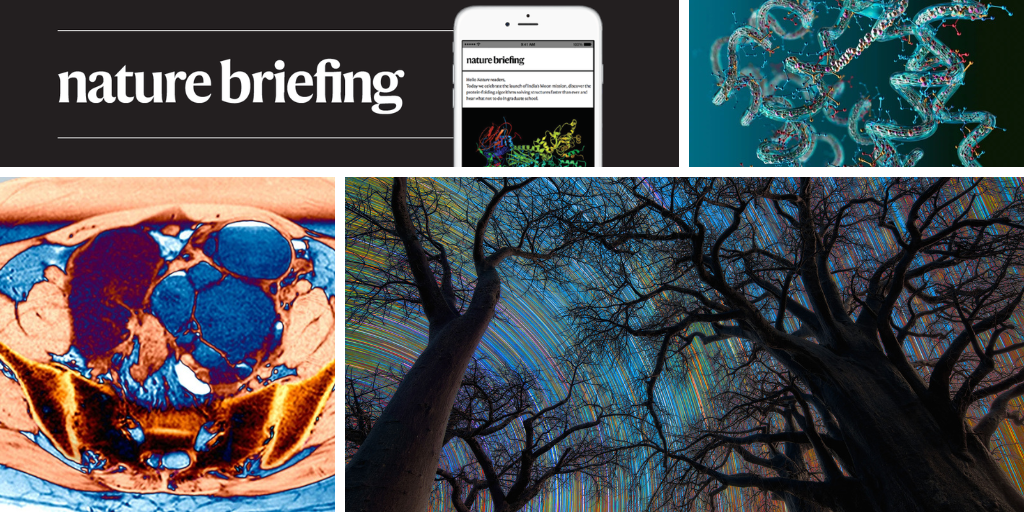
This psychedelic snap, titled Botswana Star Trail, was this year’s winner in the Skyscapes category of the ZWO Astronomy Photographer of the Year competition. Photographer Stefano Pellegrini stacked up 340 separate exposures from an August night in 2025 to reveal the sky’s motion over the country’s Nxai Pan National Park from under a canopy of baobab trees (Adansonia spp.).
See more of the month’s sharpest science shots, selected by Nature’s photo team.
A watermarking system developed by researchers at Google DeepMind could soon be used to indicate proteins that have been designed by artificial intelligence. This hidden signature involves weaving a faint statistical tell into both the amino-acid sequence and 3D shape of computer-designed proteins — without noticeably compromising their function. The approach could distinguish AI-generated proteins from their natural counterparts in biological databases. But this molecular stamp is removable, meaning that it’s best viewed as one tool in a layered framework for guarding against biological threats, says biosecurity researcher Tessa Alexanian.
Scientists have developed a ‘speech clock’ that can predict how well a person is ageing based on their vocal characteristics, such as pitch and talking speed. The team used the clock to calculate the ‘speech age gap’ of individuals: the difference between their age as predicted by the speech clock and their chronological age. Larger gaps were associated with cognitive issues, such as those associated with dementia, which suggests the tool could be used to determine whether a person is ageing faster than expected.
A tweaked form of niclosamide, a drug used to treat parasitic infections, has eased some of the symptoms of the chronic condition endometriosis in mice. Researchers gave the modified drug to mice that had been prompted to grow endometrial-like lesions and found that the animals’ sensitivity to pain decreased. The mice also developed fewer and smaller lesions, and had fewer disease-causing macrophages than did mice not given the drug. If replicated in people, the results could provide a “breakthrough” in endometriosis treatment, says reproductive biologist and study co-author Kanako Hayashi.
Last month, this video took home the top prize at this year’s Small World in Motion competition — and was featured as an Image of the Week in this newsletter. But some researchers have raised concerns that the clip depicts features that are biologically implausible and might have been hallucinated by an artificial-intelligence tool. Optical engineer Ning Xu, who won the competition, wrote on LinkedIn that AI was not used to generate any imagery, but was used in post-production to enhance the image, adding colour to clearly distinguish between structures of similar appearance. (Nature | 5 min read) (Ning Xu/Nikon Small World)
In central Kenya, the spread of the invasive prickly pear cactus (Opuntia stricta) is forcing pastoralists to move in search of habitable land for their livestock. In Uganda, farmers face a similar struggle with lantana (Lantana camara), or kayukiyuki. The disruption that invasive plant species cause across Africa can build gradually, researchers say, bolstered by factors such as drought and poverty. But efforts to eradicate the plants once they’ve taken hold are often expensive and unrealistic, and their role in displacement receives little attention.
The treatment of tuberculosis (TB) can’t advance on the promise of new drugs alone, argues epidemiologist Ana Cehovin. Researchers should simultaneously work to understand how to preserve those we already have before resistance renders them useless. For TB drugs to have a lasting impact, scientists should combine genomic and clinical evidence to better u