// ARS TECHNICA — MOBILE & WEB
When the ability to smell goes away
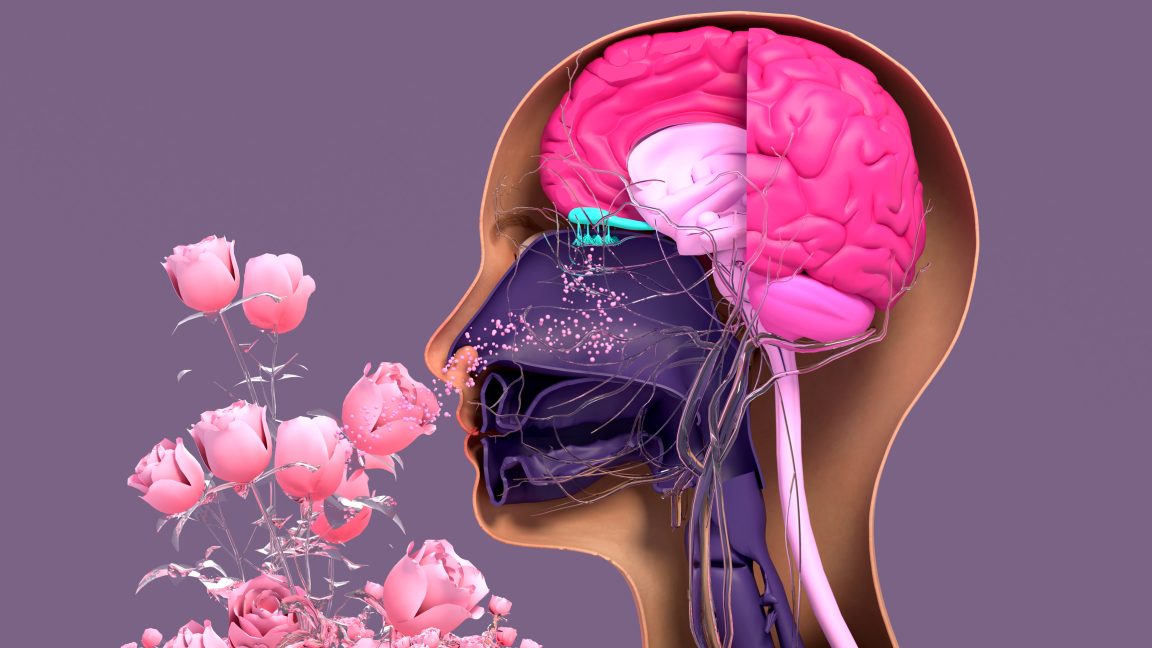
Disturbances in this critical sense are often linked to problems with brain health.
About 14 years ago, Chrissi Kelly lost her sense of smell. She had traveled to the Czech Republic to visit family and caught some virus. Months later, when she still couldn’t smell, she made the rounds to doctors, including her general practitioner and an ear, nose and throat specialist, trying to find answers.
She was diagnosed with anosmia (smell loss), and like many patients with her condition, was told she’d have to learn to live with it. But for her, the loss was catastrophic. “After about six months of complete loss, I was just climbing the walls, and I did not feel like myself anymore,” she says.
Researchers estimate that up to 22 percent of the population lives with smell impairments, like hyposmia (partial smell loss) or anosmia (complete smell loss). And many others live with smell disorders like phantosmia, in which a person picks up phantom smells, or parosmia, where typically pleasant scents like coffee or shampoo begin to register as highly unpleasant (think feces or vomit). Yet the conditions have been poorly understood, underdiagnosed and often minimized by clinicians.
The pandemic changed that. Covid brought unprecedented attention—and research interest — to the sense of smell. There have been 780 million reported cases of Covid-19 since December 2019 (and many more unreported), according to the World Health Organization, and smell loss is a well-known symptom. In one 2023 survey published in the journal Laryngoscope, 60 percent of individuals with Covid experienced smell loss, most temporarily, but some over the longer term.
With Covid causing millions of noses worldwide to malfunction at roughly the same time, the virus spurred newfound appreciation for, and research into, this critical sense. As scientists learn more about the way that the sense of smell operates, evidence is mounting that smell is deeply tied not only to quality of life but also to brain health.
In the 19th century, French brain researcher Paul Broca argued that humans had traded a keen sense of smell for higher intellect, labeling olfaction “the bestial sense.” His ideas led to decades of scientific neglect. Modern research has proved him wrong. Smell enriches life and directs our behavior. It helps parents and children to bond, warns us of environmental dangers, and anchors emotional memory. “Humans are actually quite good at smelling,” says Swedish psychologist Jonas Olofsson, author of The Forgotten Sense: The New Science of Smell and the Extraordinary Power of the Nose.
We smell by detecting airborne molecules that bind to specialized receptors in the nasal cavity. Millions of olfactory neurons in the upper nose detect these odorants, then send electrical impulses via the olfactory bulbs, which create a sensory map in the brain—basically, a system to identify, distinguish, and remember scents. Unlike vision or hearing, smell directly signals brain areas responsible for emotion (the amygdala) and memory (the hippocampus), which could be why smells can strongly trigger memories.
Furthermore, the olfactory bulbs are now known to be among the few brain regions that create new neurons during adulthood. This is thought to help the brain deal with constantly changing environments. The olfactory bulbs are also the most vulnerable part of the brain—a potential entry site for viruses, bacteria, toxins and perhaps even microplastics.
After losing her sense of smell, Kelly searched for insight and commiseration. Finding neither, she founded two nonprofit patient groups. Along the way, she also became a community scientist, co-publishing more than 30 academic papers with researchers.