// NATURE NEWS — SPAZIO & SCIENZA
Big dogs age faster than little ones — rogue ‘jumping genes’ might be to blame
Heidi Ledford reports for Nature from Seattle, Washington.
Search author on:
PubMed
Google Scholar
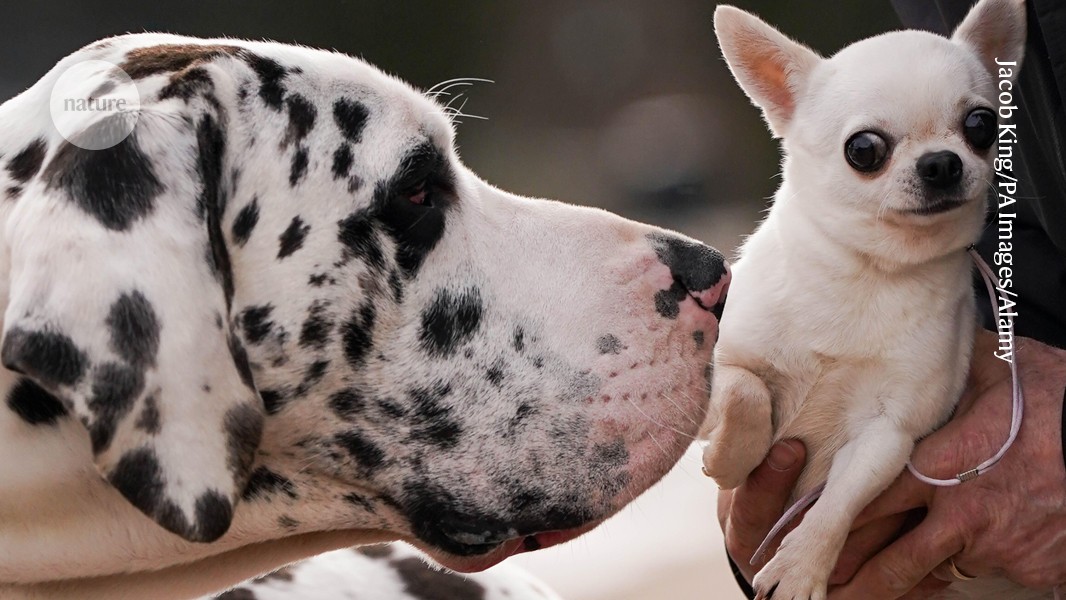
Just you wait: big dogs tend to age more quickly than small ones, which might be attributed to differences in the chemical tagging of the genome.Credit: Jacob King/PA Images/Alamy
A chihuahua might be at a disadvantage in paw-to-paw combat with a Great Dane, but being little has its benefits: a sweeping analysis of dog breeds has found that small pooches tend to age more slowly than large ones, and big dogs might have rogue ‘jumping genes’ that hop around the genome to blame.
The study1, which encompassed nearly 900 dogs representing about 120 breeds, found that ageing in dogs is accompanied by changes in certain chemical groups added onto DNA that can control gene activity. These marks on DNA are part of a cell’s epigenome, and the loss or gain of these groups is sometimes used as a biological marker of ageing.
Big dogs tended to accumulate epigenetic changes at a faster rate than small dogs, the study found. And male dogs amassed them faster than female dogs, even if the male dogs had been neutered at a young age.
“It’s fascinating,” says Borbála Turcsán, who studies dog cognition and behaviour at Eötvös Loránd University in Budapest, and was not involved in the study. “It provides a molecular background for something we also observe at a behavioural level.”
Some of the largest dog breeds, such as Irish wolfhounds, live an average of ten years or less. In contrast, Brianah McCoy, who studies ageing at the University of North Carolina at Chapel Hill, recalls her grandmother’s pet chihuahua: “That dog lived for like 20 years,” McCoy says. “And she was not nice.”
McCoy, then working at Arizona State University in Tempe, and her colleagues are members of the Dog Aging Project, which, so far, has enrolled about 55,000 participants. Some of their loyal humans periodically fill out surveys about their pet’s health and environment and submit blood samples.
To learn more about how breed and sex affect ageing in dogs, the team analysed the placement of chemical tags called methyl groups on DNA in 894 dogs, and combined this with genetic sequencing and other data.