// SPACE.COM — SPAZIO & SCIENZA
Astronomers detect most distant supermassive black hole-powered blazar ever: a cosmic beacon from the dawn of time
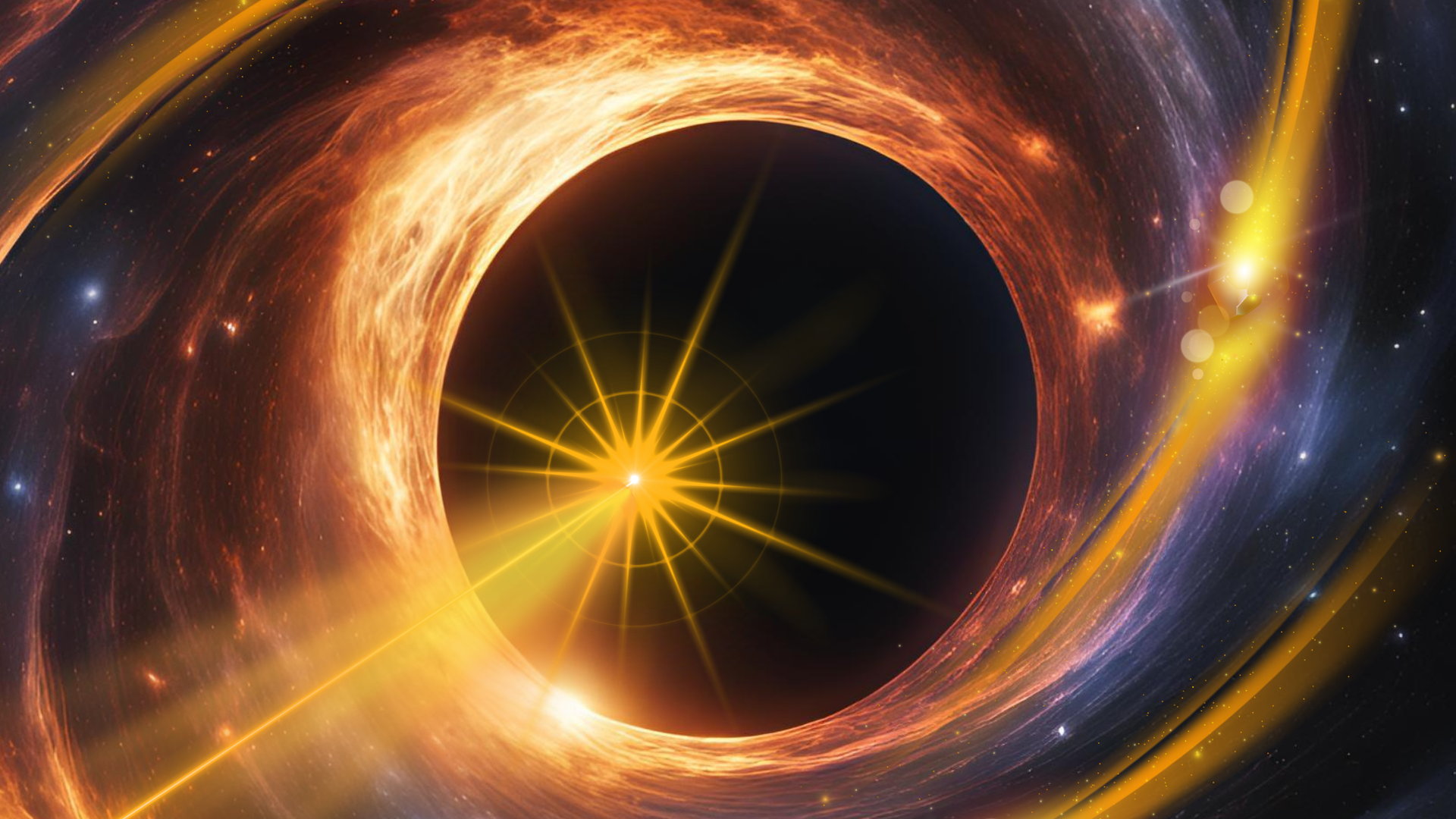
"Around 11 billion years ago, the universe experienced a period of peak activity known as the 'Cosmic noon,' characterized by an intense rate of star and galaxy formation."
When you purchase through links on our site, we may earn an affiliate commission. Here’s how it works.
Astronomers have discovered the most distant and earliest blazar, comprised of an erupting supermassive black hole aiming its plasma jets directly at Earth.
Blazars occur when supermassive black holes are surrounded by vast amounts of gas and dust that they feed on, in regions called active galactic nuclei (AGNs). The immense gravity of these cosmic titans causes the surrounding gas and dust to glow brightly, meaning that AGNs can outshine the combined light of every star in the galaxies that house them. But that isn't all; matter that isn't feasted upon is channeled to the poles of the black hole, from where it is blasted out as twin jets of plasma moving at near-light speed.
These events are called quasars, but when the jets are directed straight down our line of sight, the quasar is classified as a blazar. Light from this high-energy blazar, designated Blazar OP 313, has been travelling to Earth for 8 billion years, meaning it is seen as it was just 5 billion years after the Big Bang during a crucial transitional phase in cosmic history.
"Around 11 billion years ago, the universe experienced a period of peak activity known as the 'cosmic noon,' characterised by an intense rate of star and galaxy formation," research team member Axel Arbet-Engels said in a statement."When this phase of intense activity slowed down and galaxies began to evolve and mature, the universe entered a calmer phase, which continues to this day."
Cosmic noon marked the period during which OP 313 emitted its powerful burst of very high-energy photons in the form of gamma-rays.
That emission was first observed in December 2023, with astronomers following up on the discovery with the Large-Sized Telescope (LST-1) prototype and the Major Atmospheric Gamma-ray Imaging Cherenkov (MAGIC) telescope, both of which are located at the Roque de los Muchachos Observatory, La Palma, Spain.
This revealed high-energy gamma-rays originating 8 billion light-years away. The analysis of these gamma-rays revealed how the supermassive black hole at the heart of this blazar is acting as a cosmic particle accelerator.
As these gamma rays traversed the cosmos, they interacted with the total accumulated radiation from all the stars, galaxies, and other AGNs throughout cosmic history, known as the extragalactic background (EBL).