// SPACE.COM — SPAZIO & SCIENZA
A faint glow from the early universe could help solve the mystery of dark energy
"This is a completely new technique for probing the cosmos."
When you purchase through links on our site, we may earn an affiliate commission. Here’s how it works.
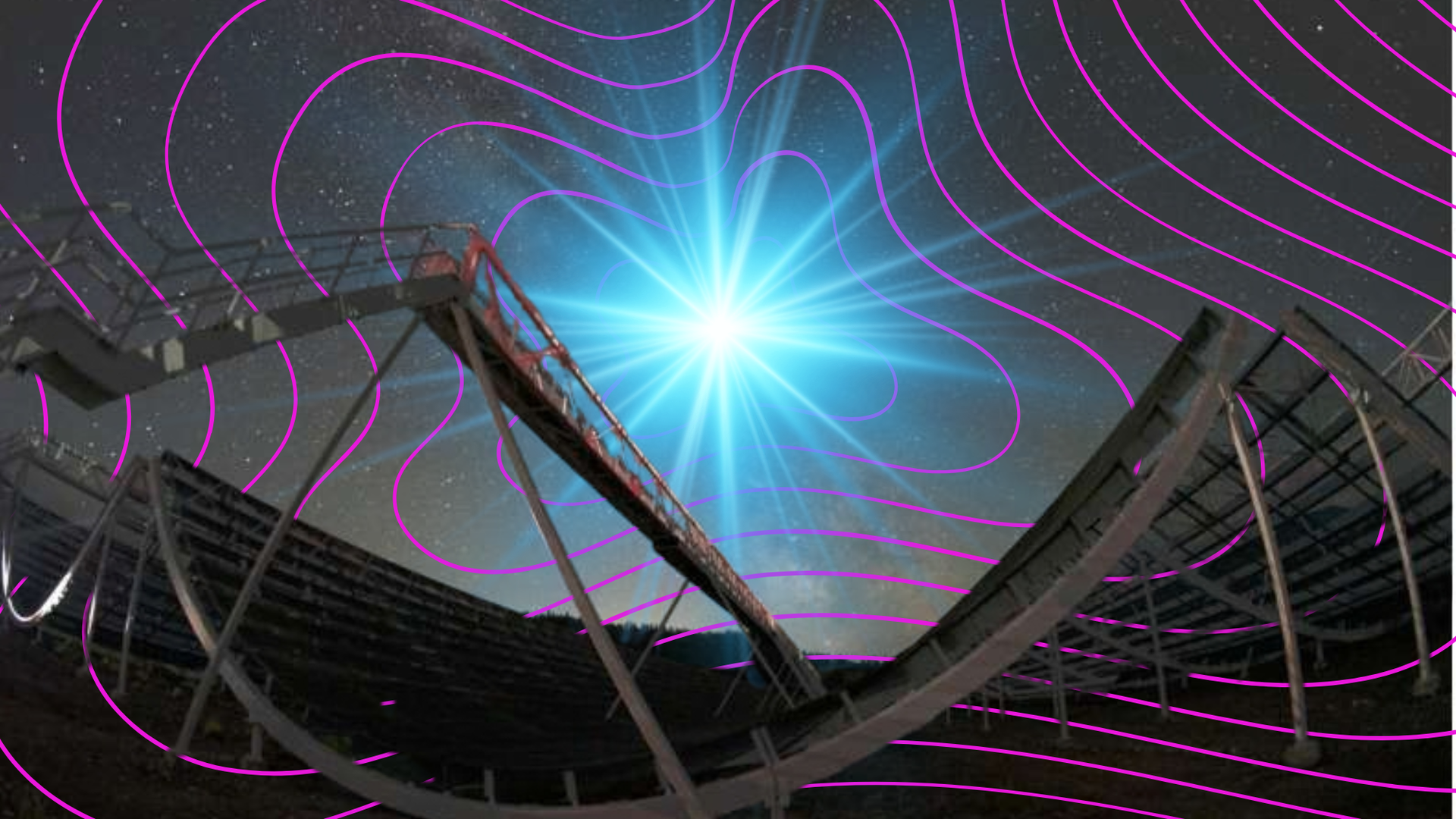
Hydrogen may be the most common element in the cosmos, but scientists could use it to do something unique: uncover the nature of dark energy, the mysterious force driving the accelerating expansion of the universe.This new line of dark energy investigation comes from the fact that researchers have determined that the CHIME (Canadian Hydrogen Intensity Mapping Experiment) project can detect the faint radio glow of hydrogen from the universe's distant past.
Not only does this represent a faster and much less expensive way to investigate dark energy, but it is a major milestone for CHIME. The instrument was specifically devised to investigate dark energy and its pervasive influence.
"This is a completely new technique for probing the cosmos, delivered by an instrument that was conceived and built by Canadians," CHIME principal investigator Mark Halpern of the University of British Columbia said in a statement. "It's a bold new step in the global cosmology program and a Canadian success story."
Dark energy is the mysterious force that is accelerating the expansion of the universe. It is so problematic for scientists because it started acting on the fabric of space only after the expansion triggered by the Big Bang had halted.
That's akin to pushing a child on a swing, watching it stop, and then seeing the swing start up again without a push. And, not only that, but the swing starts oscillating faster and faster. Consider scientists akin to very worried parents, who would really like to know where this ghostly push came from and how it is going to proceed.
Just as, if the push on the swing continues, the child could end up in the bushes, or in orbit, the strengthening of dark energy could result in the cold death of the cosmos, or even a "Big Rip" scenario that sees space shredded. Alternatively, if it weakens and allows gravity to reassert dominance, then the universe could collapse back in on itself, resulting in a "Big Crunch" ending that sees the cosmos compressed back into a singularity, as it was at the beginning of time.
Dark energy is now the dominant element of the universe, accounting for 68% of the universe's matter-energy budget. It's little wonder that scientists are very keen to know what this mysterious force is.
So how can hydrogen help the investigation of dark energy?