// ITS FOSS — LINUX & OPEN SOURCE
openEuler Wants Linux to Treat an Entire AI Cluster Like One Single Machine
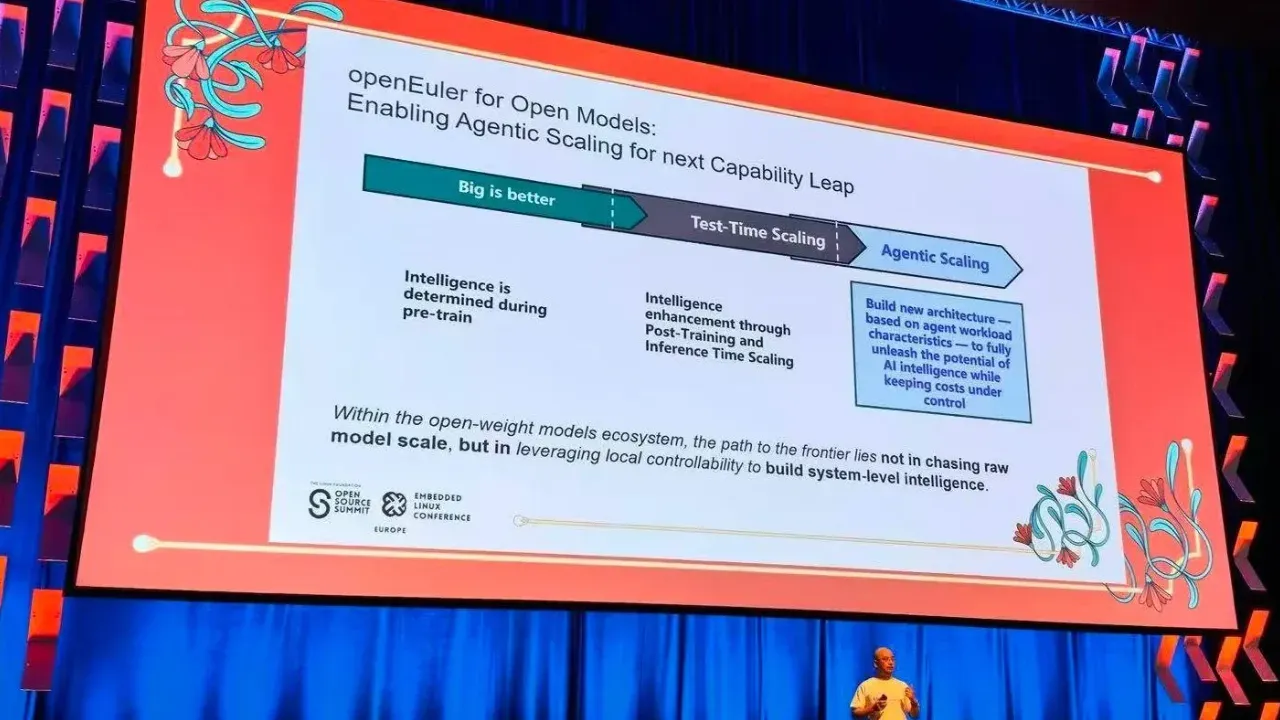
For most of its life, Linux has been built around one simple assumption. There's a box; it has CPUs, memory, and devices, and the kernel manages them. Clusters exist, of course, but they've mostly been a problem for the layers above the OS, i.e., schedulers, orchestrators, distributed frameworks.
AI infrastructure wants more. Today's training and inference setups bind dozens of CPUs, NPUs, GPUs, and memory pools so tightly together that they behave less like a group of servers and more like a single but very large computer. And then come AI agents, which don't just run a model but spin up tools, sandboxes, and long-running sessions on the fly.
That was the core of the keynote Xinwei Hu, Chairman of the openEuler Technical Committee, gave at Open Source Summit Europe 2026 in Prague.
Let's see how openEuler is innovating Linux around agentic scaling.
openEuler's keynote slide describes the shift as moving "beyond the box," from a single host to a SuperPoD. A SuperPoD is a tightly interconnected system where compute, memory, and accelerators across many nodes are linked and expected to work as one pool of resources.
That creates trouble the classic OS was never designed for. Memory you need may sit on another node, a fault on one machine can ripple into others, and moving data between hosts and accelerators becomes a bottleneck. And somebody has to manage the whole thing.
Hu grouped openEuler's goals for this into three buckets: ease of use, reliability, and performance.
The ease-of-use goal is ambitious. openEuler wants runtimes and SDKs that work out of the box on SuperPoD hardware, and system administration that is assisted by an agent, so that you can manage a SuperPoD "like a single server."
Reliability is of upmost importance here. According to Hu, openEuler can notify other nodes of a node failure with a latency of 500 ms or less, and can notify individual threads when shared memory develops a fault. It also aims to isolate faults so they don't spread across processes on the same host or across nodes. There's also "fault storm suppression," a fast response to remote memory faults so that a flood of SEA errors doesn't hang the system.
On performance, the Hu's keynote cites two figures. UMDK, which openEuler describes as a unified heterogeneous interconnect infrastructure for SuperPoDs, cuts RPC latency by 20%. An asynchronous pipeline plus unified memory addressing cuts RH2D (Remote Host-to-Device) latency in KV cache operations by 20%.