// NATURE NEWS — SPAZIO & SCIENZA
Evidence for multi-Li+ clustering in lithium-ion battery electrolytes
Nature
volume 658, pages 636–642 (2026) Cite this article
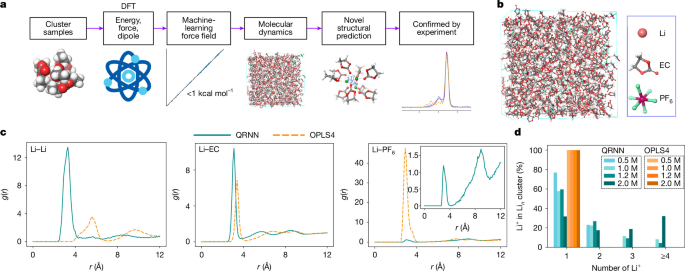
In lithium-ion batteries, the bulk solvation structure of the electrolyte is a major determinant of the physical and electrochemical properties of the cell, for example, conductivity, viscosity, salt dissociation and subsequent reactivity, the electrochemical stability window (and thus solid electrolyte interphase formation), and the composition of the electrochemical double layer1,2,3. However, elucidation of this structure at an atomic level of detail has been challenging to accomplish via a purely experimental approach. Here we combine machine-learning-enabled atomistic simulations4,5,6,7,8,9,10,11,12,13,14,15,16, nuclear magnetic resonance spectroscopy, electrochemical data3,17,18,19,20 and quantum-chemical calculations to reveal previously unstudied multi-Li+ complexes without bound anions that are uniquely facile for reduction. This insight explains the success of empirically chosen ethylene-carbonate-containing solvent mixtures and provides a foundation for the rational design of improved electrolytes. Furthermore, our machine-learning force-field-based lithium-ion-battery electrolyte simulations accurately reproduce a wide range of condensed-phase experiments3,21,22,23,24, despite being parameterized to only quantum-chemical gas-phase cluster calculations, and hence provide a compelling demonstration that machine-learning force-field-based models developed from first principles can robustly represent a complex chemical system to atomic resolution.
Over the past 10 years there has been intense interest in carrying out molecular dynamics simulations of lithium-ion battery (LIB) electrolytes, which in principle can yield a complete picture of electrolyte structure and dynamics. However, traditional molecular mechanics force fields, such as those used successfully for biomolecular simulation of protein–ligand binding25,26,27, may not be well suited to describing the complexities of LIB chemistry. Specifically, the physical chemistry of Li+ solvation and dynamics in concentrated, polar organic electrolytes is vastly different from that of aqueous biomolecular species. Ab initio molecular dynamics (AIMD) approaches are an alternative, but suffer from severe limitations in the system sizes, simulation timescales and accuracy of the density functional theory (DFT) functional that can be accessed28,29.
The past decade has seen the creation and evolution of a methodology for constructing force fields for complex chemical systems, which holds the promise of replicating the accuracy of high-level ab initio quantum chemistry, while reducing the cost of energy evaluation per configuration of atoms by many orders of magnitude4,5,6,7. These methods are based on the use of machine-learning force fields (MLFFs), which are parameterized to reproduce quantum-chemical relative energies for a large and diverse training set, for example, clusters taken from force-field simulations7,8,9,10,11,12 or directly from periodic electronic structure calculations13,14,15,16. The computational cost of the MLFF is two to three orders of magnitude more expensive per energy evaluation than a traditional pairwise additive molecular mechanics force field, such as optimized potentials for liquid simulations-4 (OPLS4)26; however, it is still many orders of magnitude less expensive than a purely quantum-chemical approach as embodied in AIMD.
In an initial study of LIB electrolytes with a high-dimensional, charge-recursive neural network (QRNN) MLFF, molecular complexes containing multiple Li+ ions at short distances (as small as 3 Å) were observed without direct coordination with counterions9. In the present work, we report a detailed theoretical analysis of refined MLFF electrolyte model based on QRNN, coupled with comparison with solid-state nuclear magnetic resonance (ssNMR) spectroscopy. These results strongly support the computational discovery of multi-Li+ species e