// NATURE NEWS — SPAZIO & SCIENZA
Global conservation area coverage substantially exceeds current estimates
Nature
(2026) Cite this article
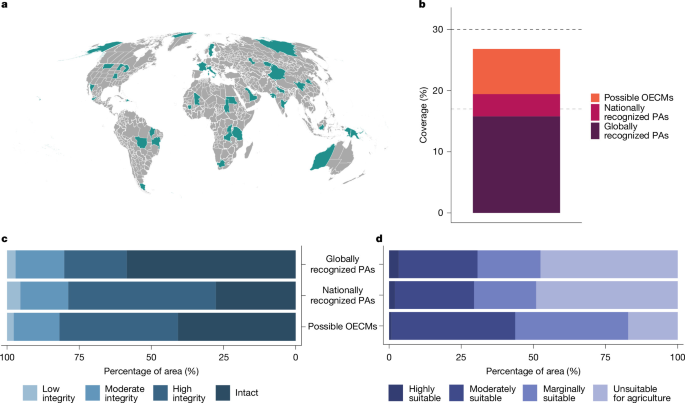
Conservation areas are critical for tackling the global environmental crisis1. These sites are reported as covering 18.5% of the terrestrial realm2 and governments have committed through Global Biodiversity Framework Target 3 to increase this to at least 30% by 2030 (ref. 3). There are concerns that this potential near-doubling of conservation area coverage will negatively affect vulnerable people and over-stretch conservation resources4. However, nationally available datasets indicate that more conservation areas exist than are reflected in global figures5,6,7. We evaluated progress towards the area component of Target 3 using a globally representative sample across 25 countries and territories that incorporated these national datasets8. Extrapolating from this sample, we show that conservation areas likely already cover 26.81% of the terrestrial realm. We may be much closer to achieving 30% terrestrial coverage than previously thought. However, we also show that the extra land does not substantially address gaps in ecological representativeness, indicating that solely meeting the area component of Target 3 will do little to solve continuing global biodiversity loss. More focus and resources are needed to achieve the other components of the target, using a more strategic and inclusive approach to fill present gaps and produce equitable and effective conservation area networks.
Conservation areas, geographical spaces where human use and access are often limited1, are widely adopted to reduce biodiversity loss, with 18.5% of the terrestrial realm now formally recognized for conservation2. Most of this conserved land is designated in protected areas (PAs), such as national parks and nature reserves2. More recently, governments have begun to formally recognize other effective area-based conservation measures (OECMs), a conservation area type that does not need to have conservation as its primary objective9. It is expected that many OECMs will be governed by private actors, Indigenous Peoples or local communities. In 2022, the 195 government signatories to the Convention on Biological Diversity agreed to increase PA and OECM global coverage to at least 30% by 2030 (ref. 3) (known as 30 × 30). This commitment is part of Target 3 of the Kunming-Montreal Global Biodiversity Framework (GBF), which also states these sites should be effectively managed, equitably governed, ecologically representative and well-connected3.
The coverage component of GBF Target 3 is considered by some as controversial4. Proponents argue that at least 30% of the planet needs to be conserved to prevent major biodiversity loss10,11. Others highlight potential social, equity and food security impacts12,13 and in some places the possible entrenching of top-down approaches led by governments and international donors14,15,16. There are also concerns that over-focusing on percentage coverage risks spreading conservation funds more thinly, perpetuating present under-resourcing of PAs17 and undermining implementation and management effectiveness4,18. Conservation scientists are also concerned about repeating past mistakes, as present PA systems are generally fragmented and under-represent ecosystems with high economic value19,20,21. Target 3 and the broader GBF take these issues into account, but concerns remain about whether they will be given appropriate attention during implementation.
Present official coverage statistics indicate that meeting Target 3 will require conserving an extra 11.5% (15.5 million km2) of the terrestrial realm2. Coverage statistics are derived from the World Database on Protected and Conserved Areas (WDPCA), available through the Protected Planet website2. This database tracks the implementation of Target 3, providing the headline indicator for the target. However, these official statistics chiefly comprise state-governed PAs because most nations only recently began to recogni