// NATURE NEWS — SPAZIO & SCIENZA
Parity-dependent coupling of molecular spin chains to a superconductor
Nature
volume 658, pages 617–622 (2026) Cite this article
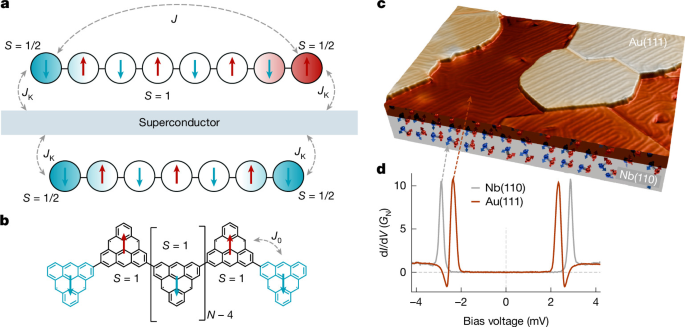
Collective behaviour in quantum materials can produce excitations carrying only a fraction of the quantum numbers of their constituents. A notable case occurs in chains of spin-1 units1, in which a topological gap protects the interior of the chain, whereas spin-1/2 states, half the spin of the units that form it, emerge at the ends2. In short chains, these fractional edge spins couple to each other and their topological protection makes them attractive for hybrid spin–superconductor devices. Whether such fractionalization survives the proximity of a superconducting condensate, however, remains an open question. Here we grow molecular Haldane chains of antiferromagnetically coupled spin-1 triangulene units on a proximitized Au(111)/Nb(110) surface and resolve a parity-dependent coupling of their spin-1/2 edge states to the superconductor by scanning tunnelling spectroscopy. Odd-length chains host Yu–Shiba–Rusinov (YSR) bound states inside the superconducting gap, originating from a global S = 1 ground state, whereas even-length chains form an S = 0 ground state decoupled from the superconductor. A two-site model attributes this alternation to the sign and strength of inter-edge interactions, independently confirmed by extra-gap spin excitations in tunnelling spectra. Many-body spin excitations of the S = 1 chain are also detected, decoupled from the superconductor by the much larger Haldane gap. The length-tunable coupling of the edge spins to superconductors opens a route towards molecular spin qubits based on π-conjugated carbon architectures.
This is a preview of subscription content, access via your institution
Access Nature and 54 other Nature Portfolio journals
Get Nature+, our best-value online-access subscription
Prices may be subject to local taxes which are calculated during checkout
All data that support the plots in this paper and other findings of this study are available from the corresponding author. Data analysis was done with WsXM54 and SpectraFox55.
Haldane, F. D. M. Nonlinear field theory of large-spin Heisenberg antiferromagnets: semiclassically quantized solitons of the one-dimensional easy-axis Néel state. Phys. Rev. Lett. 50, 1153–1156 https://doi.org/10.1103/PhysRevLett.50.1153 (1983).
Article
ADS
MathSciNet
Google Scholar
Affleck, I., Kennedy, T., Lieb, E. H. & Tasaki, H. Rigorous results on valence-bond ground states in antiferromagnets. Phys. Rev. Lett. 59, 799 https://doi.org/10.1103/PhysRevLett.59.799 (1987).