// NATURE NEWS — SPAZIO & SCIENZA
Divergent genomic evolution in astrocytomas and oligodendrogliomas
Nature
(2026) Cite this article
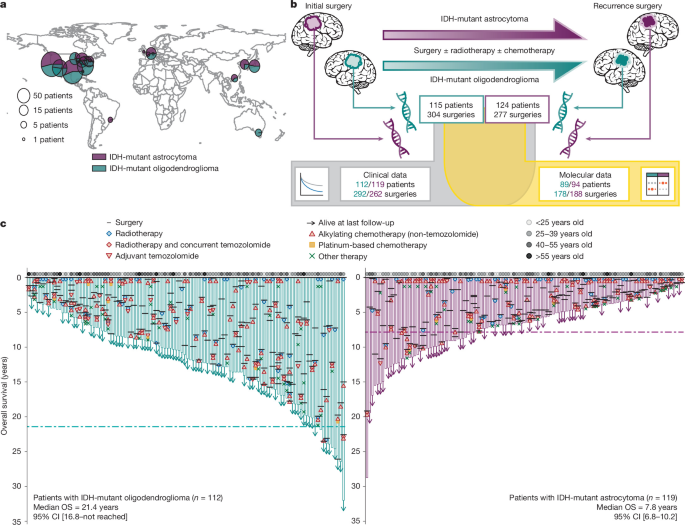
Astrocytomas and oligodendrogliomas are isocitrate dehydrogenase (IDH)-mutant gliomas that most commonly arise in adults under the age of 50 and exhibit variable responses to treatment1,2,3. To understand the genetic drivers of disease progression, here we used whole-genome and whole-exome sequencing to characterize longitudinally collected tumour specimens from 183 patients with IDH-mutant glioma. Samples were collected through the Glioma Longitudinal Analysis (GLASS) Consortium4. Most primary surgery samples were classified as grade 2 on the basis of histology (73% for astrocytomas and 93% for oligodendrogliomas). We validated known genomic markers of tumour progression, including hypermutation and homozygous deletion of CDKN2A or CDKN2B (hereafter, CDKN2A/B)5, and discovered genetic alterations that distinguish between the evolutionary trajectories of astrocytomas and those of oligodendrogliomas. Mutations in phosphatidylinositol 3-kinase (PI3K) and NOTCH1 were newly acquired in recurrent oligodendrogliomas, regardless of treatment, and were associated with an increased tumour mutational burden. In recurrent astrocytomas, however, again irrespective of treatment, acquired focal oncogene amplifications and CDKN2A/B homozygous deletions were associated with an increase in chromosomal imbalances, which converged with markers of chromosomal instability such as chromothripsis and whole-genome doubling. In both types of IDH-mutant glioma, we observed a convergence of acquired alterations, genome-wide changes and worse patient outcomes, suggesting that treatment-refractory clones were being selected. Treatment with temozolomide was associated with the mutational signatures SBS11 and SBS119 in both tumour types, whereas the radiotherapy-associated ID8 signature increased in astrocytomas specifically. We show that the genomes of oligodendrogliomas and astrocytomas adapt to the selective pressures of tumour progression and treatment in distinct ways, suggesting that oligodendrogliomas and astrocytomas differ in their responses to treatment-induced DNA damage.
Isocitrate dehydrogenase (IDH)-mutant gliomas, named for gain-of-function mutations in the metabolic-enzyme genes IDH1 and IDH2, are the most common primary malignant brain tumours in adults under the age of 501,2. The 2021 World Health Organization (WHO) classification for tumours of the central nervous system (CNS) stratifies IDH-mutant gliomas into two clinically and molecularly distinct types: (1) IDH-mutant oligodendrogliomas (WHO grades 2–3), characterized by the combined loss of chromosome arms 1p and 19q; and (2) IDH-mutant astrocytomas (WHO grades 2–4), which lack the 1p/19q codeletion6. Oligodendrogliomas are also characterized by mutations in the TERT promoter, whereas astrocytomas instead prominently feature mutations in TP53 and ATRX7. The primary treatment for patients with an IDH-mutant glioma combines surgical debulking, alkylating chemotherapy and ionizing radiation; less aggressive tumours (WHO grade 2) might be treated with just surgical debulking8. Despite these therapies, virtually all IDH-mutant gliomas develop resistance to treatment, which results in tumour recurrence9. Because IDH-mutant gliomas are usually diagnosed in young to middle-aged individuals2, the ubiquitous emergence of treatment resistance results in a disproportionate number of life years lost3. Various molecular responses to treatment have been reported, including alkylating-agent-induced hypermutation10 and radiation-associated CDKN2A/B homozygous deletions11, but it is unknown whether treatment-associated molecular responses exist that are specific to the individual IDH-mutant glioma types.
The Glioma Longitudinal Analysis (GLASS) Consortium4 seeks to advance researchers’ understanding of how gliomas respond to treatment through genomic characterization of glioma tumours over time12,13. Longitudinal profiling studies from th