// NATURE NEWS — SPAZIO & SCIENZA
Intrinsic physicochemical activity at microplastic–water interfaces
Nature
volume 658, pages 650–657 (2026) Cite this article
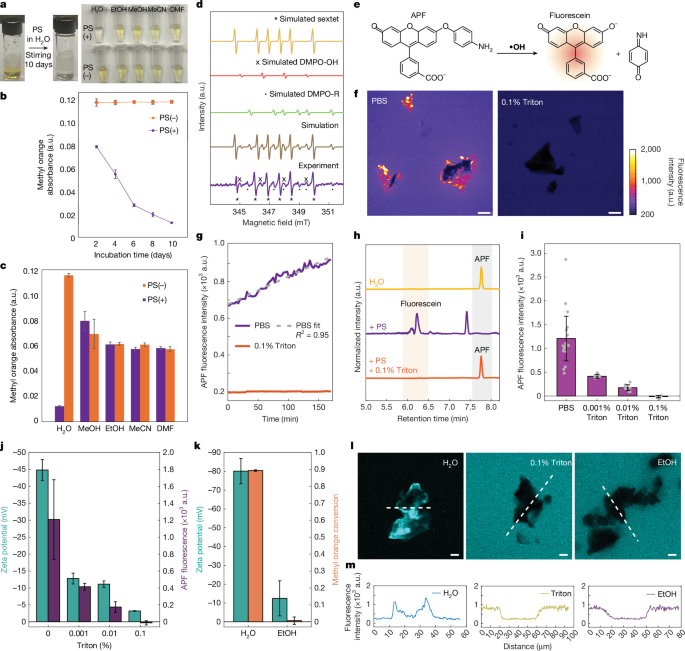
Plastics have become an integral part of our modern society, largely because they are generally regarded as chemically inert under normal circumstances. However, plastics fragmented into microplastics (less than 5 mm in size) have recently raised significant public concerns, and have been detected widely across ecosystems and human tissues with increasing environmental and health risks1,2,3,4,5. Here we show that commodity microplastics exhibit intrinsic physicochemical activity in water, manifested by the spontaneous generation of reactive oxygen species that increases with interfacial hydrophobicity and strongly correlates with interfacial electrostatics. Ab initio calculations support these observations and reveal that hydroxide oxidation becomes energetically more favourable at increasingly hydrophobic microplastic–water interfaces through the combined effects of partial solvation and electrostatics. These interfacial properties and the resulting oxidative chemistry have direct implications for biomolecular adsorption, protein aggregation, and even cellular damage. Together, our findings challenge the prevailing paradigm of plastic inertness, identify a possibly overlooked mechanism for the detrimental effects of microplastics on health and the environment, and contribute to a fundamental understanding of the structure–activity relationship of interfacial water, which may inform the design of safer and more sustainable plastic materials.
Commodity plastics are valued for their durability, chemical resistance and broad utility. Polyethylene (PE), polypropylene (PP), polystyrene (PS), polyvinyl chloride (PVC), poly(methyl methacrylate) (PMMA) and polyethylene terephthalate (PET) are widely used across many industries. Their extensive use rests in part on the prevailing view that plastics are largely inert under ordinary conditions and therefore safe for general use. In particular, polyolefins such as PP and PE, composed of only non-polar hydrocarbon chains, are known for their durability and chemical resistance.
Apart from their bulk form, however, plastics also exist as micro- and nanoplastics (MNPs), which are raising public concerns with their presence detected in almost every corner of our world1, and even inside human bodies2. Mounting evidence suggests that micro- and nanoplastics can impose adverse health consequences on biological systems, inducing stress, inflammation and cytotoxicity in various model systems from cells to higher organisms4,6. Human epidemiological studies further reveal a surprisingly high correlation of exposure to micro- and nanoplastics with reproductive damage7, cardiovascular problems3, neurological diseases5, inflammatory bowel disease8 and cancer9, raising broad concerns about their health consequences. Although the molecular mechanisms remain elusive and are probably multifactorial, plastic composition, particle morphology and shape, and surface functionalization all have a role in how microplastics interact with biological systems and induce toxicity10.
The presumed chemical inertness of bulk plastics needs to be reconciled with the toxicity of their fragmented microscale forms. Plastics in nature are in constant contact with water, organic matter and air, making the plastics–environment interface a potentially important but underappreciated determinant. Moreover, the prevailing notion of plastic inertness largely derives from their behaviour as bulk materials. Fragmentation into microplastics greatly increases the surface-to-volume ratio, potentially amplifying any plastic–environment interfacial activity and endowing microplastics with emergent activity that is inconsequential in the bulk state.
Motivated by these considerations, we sought to test the prevailing paradigm of plastic inertness by investigating their interfaces with the environment. Using a suite of complementary analytical techniques