// TOM'S HARDWARE US — HARDWARE & GADGET
Russian chipmakers demo homegrown RISC-V and Arm chips with retro games
Russia's homegrown chipmaking continues apace despite sanctions.
When you purchase through links on our site, we may earn an affiliate commission. Here’s how it works.
Geopolitics and sanctions have mostly cut off the Russian public from Western hardware — at least officially. In recent ages, the country's homegrown chip designs are Arm, RISC-V, and Elbrus architectures. A handful of interesting designs were on display at the Microelectronics 26 (ME26) forum in Sochi, using retro gaming as a demonstration point. A couple of years back, the government even issued an order to create a high-end gaming console, albeit with relatively little success. The result of that initiative didn't appear to be on display at the event.
На выставке МЭ26 в Сочи показывали сразу несколько игровых применений русских процессоров
Байкал: консоль и визитка на Ушке BE-U1000
Элвис: полноценная приставка на Гиперком У (бывш. СКИФ)
МЦСТ: «игровые» ПК на Эльбрусах
Не серьёзно, но занимательно
#riscv #innoru #pureru https://t.co/QGlRTMnvLROctober 11, 2026
The report comes from Dmitrii Kuznetsov, a RISC-V and Rust enthusiast who displayed photos from the event. The first units on display use Baikal Electronics' BE-U1000 microcontroller. According to our digging, the chip packs a CPU with three CloudBear cores (32-bit RISC-V) — two BR-350s clocked at 200 MHz, along with a BM-310 at 100 MHz.
Given the microcontroller nature, embedded resources are intentionally sparse, with 256 KB of flash and 192 KB of SRAM — though there's support for external flash. A host of I/O interfaces, including USB 2.0, I2C, I2S, UARTs, and 48 GPIO lines, round out the 10x10 mm QFN-88 package. These parts are seemingly aimed at robotics, automation, IoT, sensors, and similar applications.
There was a business card-sized controller-and-console on display with a BE-U1000 chip, along with an "Ushka" console styled like the original NES (with matching controllers). The game on display appears to be Chip 'n Dale: Rescue Rangers.
Next up, there's the Elvis Hypercom-U, a SoC packing four Arm Cortex-A53 CPU cores at up to 1.2 GHz, dual ELcore-50 DSPs, a PowerVR GE8300 GPU, and dedicated video, image, and navigation processing blocks. The main silicon can be paired with up to 8 GB of LPDDR4, and supports USB 3.0, Gigabit Ethernet, Wi-Fi, and Bluetooth connectivity, and HDMI output.
This product is apparently aimed at multimedia, navigation, SBCs, and smart cameras. At the show, a board with the Hypercom-U was shown playing the original Super Mario as a demonstration.
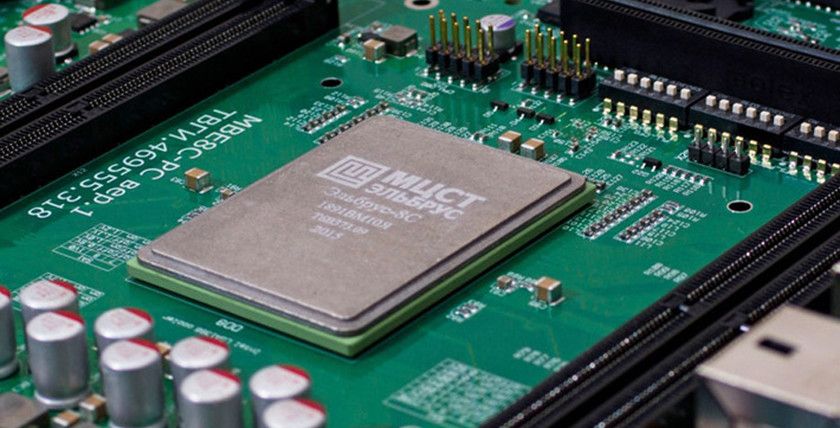
Finally, there were MCST's Elbrus-based PCs, though the tweeter offered few details on which were on display. For context, Elbrus is a Russian-developed chip architecture, often poised as the basis for high-end desktop and server applications.