// SPACE.COM — SPAZIO & SCIENZA
Did a giant object collide with Earth to form the moon?
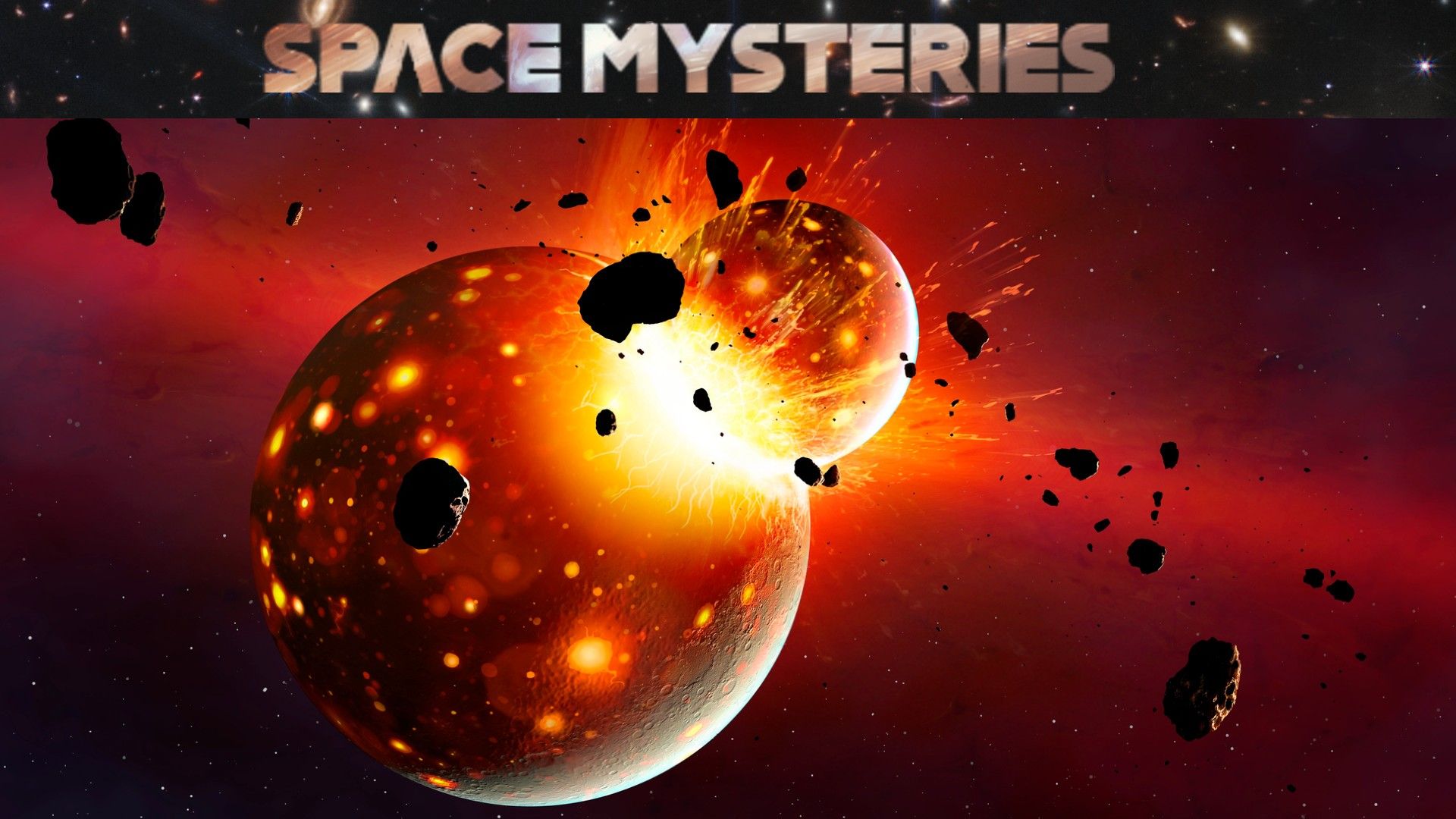
The popularity of the giant-impact hypothesis can be attributed to the multiple lines of evidence supporting the impact scenario.
When you purchase through links on our site, we may earn an affiliate commission. Here’s how it works.
For as long as humans have watched the night sky, we have wondered about the moon, pondering everything from its alien appearance to its influence over phenomena on Earth such as ocean tides, climate stability, and even the natural rhythms of many organisms.
Among the many questions we have about Earth's lone natural satellite, one remains preeminent: what are the moon's origins, and how long has it orbited Earth?
Today, the leading theory among astronomers is that deep in our planet's past — perhaps within roughly the first 100 million years of solar system history — Earth collided with a planet-sized object, creating the moon within a period that may have been as short as just a few hours. Known as the giant-impact hypothesis, this proposed event involves a hypothetical Mars-sized protoplanet astronomers call Theia. The material ejected into orbit by the powerful impact in question would have accumulated afterward, forming the moon that we observe today.
The evolution of this striking solution to one of the moon's most enduring mysteries goes back to 1946, when geologist Reginald Aldworth Daly was among the first to suggest that an impact event might explain the formation of the moon.
Before Daly, scientists had been leaning toward theories that involved Earth's rapid spin billions of years ago, when each day may have at one time lasted as little as 2 or 3 hours. Decades later in the 1970s, researchers William Hartmann and Donald Davis developed their own models involving collisions of large bodies left over from planetary formation, which could collide with younger planets.
Building on such ideas, other researchers went on to propose similar scenarios between the early Earth and a Mars-sized object. Early in the following decade, the concept eventually claimed its place as the leading lunar-formation process during a landmark conference held in Kona, Hawaii, in 1984.
The popularity of the giant-impact hypothesis can be attributed to the multiple lines of evidence supporting the impact scenario. For instance, researchers have long recognized the similar stable-isotope ratios between both moon rocks and those from Earth, strongly suggesting a link between their origins.
Additionally, the unusually high angular momentum (or spin) of the Earth-moon system, when compared to observations of other rocky planets, also could be explained as one of the effects of a massive collision.