// SPACE.COM — SPAZIO & SCIENZA
Could the secret to black hole formation be locked away in this record-breaking ancient quasar?
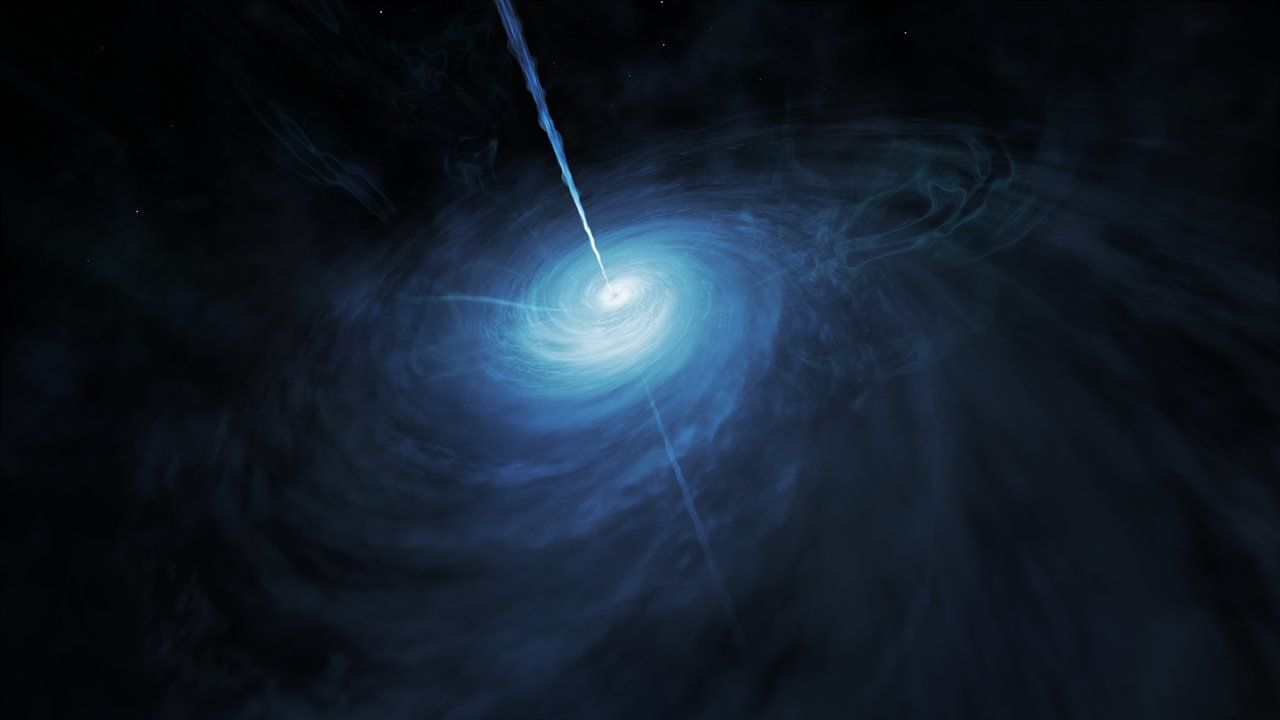
The quasar existed 12.9 billion years ago and shows that supermassive black holes were able to age rapidly in the early universe.
When you purchase through links on our site, we may earn an affiliate commission. Here’s how it works.
A faraway fluctuating quasar has been seen dimming and brightening by an extraordinary amount, changes in luminosity equivalent to 2 trillion times the brightness of the sun . It is the first time that a flickering quasar has been seen in the early universe, this one dating back 12.9 billion years – just around 900 million years after the Big Bang.
Quasars are the extremely active supermassive black holes at the heart of some galaxies, furiously feeding on gas that is being shoveled towards their maw, and growing as a result of this voracious feeding. As the gas circles the black hole's event horizon – the point beyond which nothing can escape the black hole – it grows hot as a result of friction, leading to the gas shining brightly. Additionally, magnetic fields can whip away some of the charged particles in the gas, blasting them away from the supermassive black hole in the form of powerful and bright jets. As such, quasars are some of the brightest objects in the universe.
More than a million quasars have been found across the universe, but only around 200 of these have been found existing in the first billion years after the Big Bang. While most quasars flicker, they usually do so by relatively modest amounts, and such flickering had not been seen in a quasar in the first billion years of cosmic history, until now.
"People have known that quasars in the nearby universe can flicker," Gene Leung of the Kavli Institute for Astrophysics and Space Research at the Massachusetts Institute of Technology (MIT) Kavli Institute for Astrophysics and Space Research, said in a statement. "The flickering comes from fluctuations in the way the gas is being fed into the black hole, and how the quasar flickers tells us something about the structure of a black hole's accretion disk and the kind of 'bites' that the black hole is eating."The quasar in question is pumping out energy equivalent to the luminosity of 12 trillion suns, and its light fluctuates by about 20%, or 2 trillion times the luminosity of our sun, a quite remarkable amount indicative of how fast this black hole is growing.Even so, the quasar is so distant that it is still extremely faint, so detecting these huge fluctuations wasn't easy. Not only has the light traveled a long way for a long time, but the expansion of the universe has also stretched the wavelength of that light to longer, redder wavelengths, a phenomenon called "redshift."
Leung and his MIT colleague Anna-Christina Eilers led a team that found the elusive flickering quasar after searching the archives of NASA's now-defunct NEOWISE (Near-Earth Object Wide-field Infrared Survey Explorer) mission. NEOWISE scanned the whole sky for about 14 years, searching for hazardous asteroids, but also capturing a lot going on in the background sky.The redshift of the quasar's light also lowered the frequency of the fluctuations. Flickering that might have taken place on timescales of days when the light left this quasar was redshifted to months by the time this light reached us. That is why NEOWISE's many years of data were invaluable."We saw the quasar flickering randomly over the 14-year period, much like a candle's flame flickers without a fixed pattern," said Leung.The flickering of the quasar at different wavelengths is connected to variations in the temperature of the gas swirling around this black hole. The closer the gas is to the black hole, the hotter it is. From this, Leung's team could deduce that the gas had settled into a very flat, pancake-shaped accretion disk around the black hole.
For an older quasar, this wouldn't be a surprise, but for such a young quasar, it is potentially revelatory. That's because supermassive black holes grow messily, and the cloud of infalling gas