// NATURE NEWS — SPAZIO & SCIENZA
Multimodal precision diagnostics in clinical xenotransplantation
Nature
volume 658, pages 883–896 (2026) Cite this article
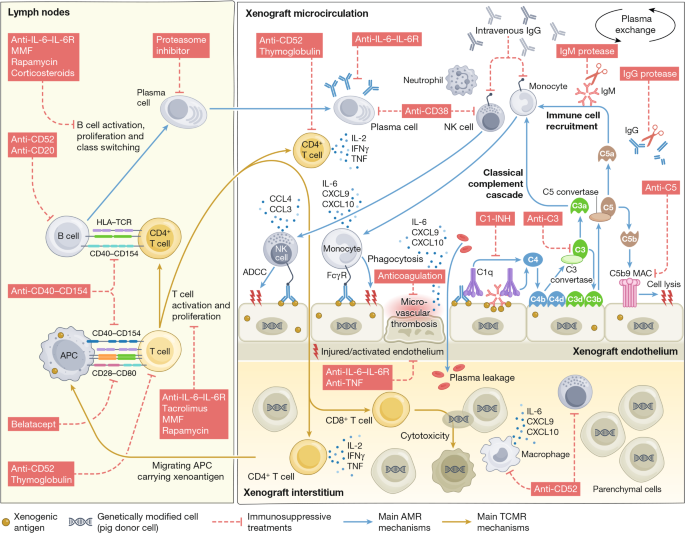
Recent breakthroughs in pig-to-human xenotransplantation have successfully prevented hyperacute rejection of kidney, heart, liver and lung xenografts, marking a milestone long considered a critical barrier. However, these major advances also brought new challenges into focus, as immune-mediated graft injuries including antibody-mediated rejection, T cell-mediated rejection and innate immune activation have been observed in most xenotransplantation procedures to date. Detection and management of these injuries remain a critical bottleneck, as conventional histopathology and standard clinical monitoring lack the sensitivity required to identify subclinical injury early enough to guide timely intervention. This diagnostic gap underscores an urgent need for the development of advanced, multimodal precision diagnostic frameworks to enhance immune surveillance, which will be essential for standardizing clinical protocols and enabling pathogenesis-driven therapeutic intervention. This approach will inform both immunosuppressive regimens and future gene editing strategies aimed at engineering rejection-resistant porcine organs, ultimately prolonging graft survival. Broad adoption of such an integrative strategy will be essential to transition xenotransplantation from an experimental intervention into a safe, scalable and patient-centred clinical therapy. In this Review, we synthesize recent progress in xenotransplantation and position multimodal precision diagnostics as a pivotal strategy to address the remaining immunological and clinical barriers to widespread clinical implementation.
This is a preview of subscription content, access via your institution
Access Nature and 54 other Nature Portfolio journals
Get Nature+, our best-value online-access subscription
Prices may be subject to local taxes which are calculated during checkout
GBD 2021 Diseases and Injuries Collaborators. Global incidence, prevalence, years lived with disability (YLDs), disability-adjusted life-years (DALYs), and healthy life expectancy (HALE) for 371 diseases and injuries in 204 countries and territories and 811 subnational locations, 1990-2021: a systematic analysis for the Global Burden of Disease Study 2021. Lancet 403, 2133–2161 https://doi.org/10.1016/S0140-6736(24)00757-8 (2024).
GBD 2021 Forecasting Collaborators. Burden of disease scenarios for 204 countries and territories, 2022-2050: a forecasting analysis for the Global Burden of Disease Study 2021. Lancet 403, 2204–2256 https://doi.org/10.1016/S0140-6736(24)00685-8 (2024).
Anderson, D. J. & Locke, J. E. Progress towards solving the donor organ shortage. Nat. Rev. Nephrol. 19, 83–84 https://doi.org/10.1038/s41581-022-00664-y (2023).
Article
PubMed Central
Google Scholar