// NATURE NEWS — SPAZIO & SCIENZA
Persistent neuronal stress signalling underlies Angelman syndrome phenotypes
Nature
(2026) Cite this article
Angelman syndrome is a severe neurodevelopmental disorder caused by the loss of UBE3A, a gene that encodes an E3 ubiquitin ligase1,2. The mechanisms that underlie Angelman syndrome are not well understood, and in particular, the link between UBE3A substrates and disease phenotypes remains uncertain3. Here, using gain- and loss-of-function mutations in UBE3A4,5 along with unbiased proteomics, we show that asparagine synthetase (ASNS) is a target of UBE3A. We find that ASNS protein abundance is increased in the brains of Ube3a-null mice and in human neurons6. Genetic correction of ASNS overabundance rescues microcephaly and many behavioural deficits. Detailed molecular analyses show that ASNS overabundance activates stress signalling and causes a global reduction in neuronal protein synthesis. Our results suggest that loss of UBE3A traps neurons in a state of persistent stress and stunts neuronal growth during developmentally sensitive periods. Moreover, our results indicate that targeting ASNS and the stress response could hold therapeutic potential in Angelman syndrome.
Angelman syndrome (AS) occurs in 1:20,000 births and is characterized by intellectual disability, developmental delay, epilepsy, microcephaly, dysmorphic facial features and a unique behavioural profile1,2. It is caused by deletion or mutation of the maternally inherited copy of UBE3A, a gene also linked to mood disorders7,8, autism4,5,7 and cancer9,10. It is widely accepted that phenotypes in AS arise due to the dysregulation of UBE3A substrates during development. However, although numerous substrates have been proposed3, establishing their link to AS phenotypes has proved difficult, limiting researchers’ mechanistic understanding of this disorder.
UBE3A is the founding member of the HECT (homologous to E6-AP C terminus) domain family of E3 ubiquitin ligases, all of which have a conserved HECT domain that contains the necessary biochemical machinery to accept activated ubiquitin from E2 enzymes and to transfer it to target proteins9. UBE3A expression is imprinted specifically in neurons such that only the maternally inherited allele is expressed, with the paternal allele being epigenetically silenced11. This imprinting mechanism, along with many disease-related phenotypes, is conserved in AS model mice that lack a maternal copy of Ube3a (Ube3am−/p+)12. These phenotypes include motor and behavioural deficits, and microcephaly, the most prominent neuroanatomical deficit in AS13. Microcephaly is not present at birth in mice but is acquired postnatally, driven by a failure of neuronal growth that results in shorter and simplified dendritic arbors and smaller-diameter axons14,15.
The integrated stress response (ISR) is a conserved pathway that helps maintain cellular homeostasis in response to noxious stimuli, including proteotoxic stress, nutrient deprivation, viral infection and oxidative stress16. These stimuli are sensed by four specialized kinases (PERK, GCN2, PKR and HRI) that converge on phosphorylation of the α-subunit of eukaryotic translation initiation factor 2 (p-eIF2α) to suppress global protein synthesis and initiate compensatory transcription programs. Asparagine synthetase (ASNS) is a conserved metabolic enzyme that is induced by the ATF4 transcription factor in response to amino acid deprivation17. ASNS catalyses the ATP-dependent synthesis of asparagine and glutamate from aspartate and glutamine, but its role in neuronal development remains poorly understood.
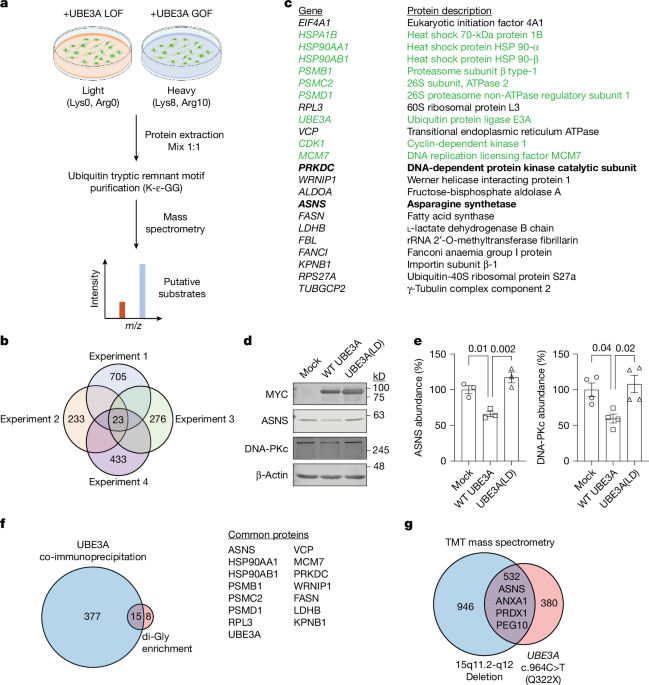
To identify substrates of UBE3A, we used cell lines expressing gain-of-function (GOF) and loss-of-function (LOF) mutants4,5 and subjected them to stable isotype labelling by amino acids in cell culture (SILAC), tryptic remnant immunoaffinity enrichment (di-Gly purification) and mass spectrometry18 (Fig. 1a). We performed this experiment in quadruplicate and identified proteins whose ubiquitination levels were enriched by at le