// NATURE NEWS — SPAZIO & SCIENZA
Structural basis for protocadherin-1 recognition by New World hantaviruses
Nature
(2026) Cite this article
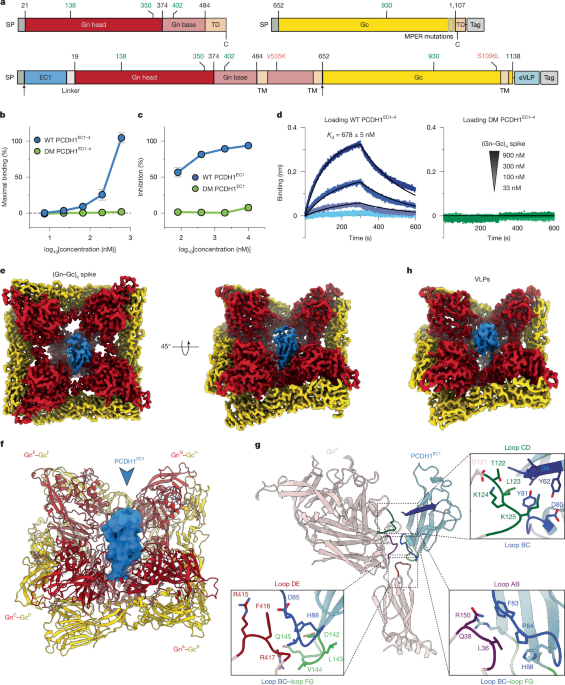
Hantaviruses are rodent-borne pathogens that cause severe human disease for which no approved therapeutics are available. New World hantaviruses, including Andes virus (ANDV), use the cell-surface receptor protocadherin-1 (PCDH1) to enter host cells1. However, the structural basis of this interaction remains unclear. Here we describe the structure of PCDH1 bound to the ANDV spike at near-atomic resolution. PCDH1 asymmetrically engages a deep central pocket formed by four Gn protomers in the spike, explaining why only intact viral particles or soluble tetramers recognize it. Mutagenesis identified three Gn loops that shape the receptor-binding site and afford the transfer of PCDH1 binding from New World to Old World glycoproteins. Structural and functional analyses of four neutralizing antibodies revealed that they block receptor binding through two distinct mechanisms—occluding access to the PCDH1-binding site or sterically preventing receptor engagement. Together, these findings define the structural determinants of hantavirus–receptor recognition, reveal how a virus can mask its receptor-binding site by recessing it in a surface depression and how antibodies can counter this strategy, and provide a framework for the design of antiviral therapeutics targeting the hantavirus spike.
Hantaviruses are a large and globally distributed family of viruses associated with severe zoonotic disease in humans. The New World hantaviruses (NWHs) ANDV and Sin Nombre virus (SNV) cause hantavirus cardiopulmonary syndrome (HCPS) in South and North America, respectively, with high case-fatality rates that can approach 40%. Cardiogenic shock and respiratory failure are hallmarks of HCPS. Old World hantaviruses (OWHs) are endemic in Europe and Asia or globally distributed in some cases (Seoul virus (SEOV)). The OWH Hantaan virus (HTNV), Puumala virus (PUUV) and Dobrava-Belgrade virus (DOBV) are associated with severe zoonotic disease and considerable mortality. Although hantaviruses are typically transmitted to humans through inhalation of aerosolized excreta from infected rodents, ANDV appears uniquely capable of human-to-human transmission2,3, raising its global public health significance and epidemic potential. This risk was underscored by the recent ANDV outbreak on a cruise ship departing Ushuaia, Argentina4. No US Food and Drug Administration (FDA)- or European Medicines Agency (EMA)-approved medical countermeasures are available to prevent or treat hantaviral infections.
Hantavirus glycoprotein spikes are formed by two glycoproteins, Gn and Gc, which are organized into a partial lattice at the surface of the virion. Each spike consists of four Gn molecules that form a central stabilizing core surrounded by four Gc molecules at the periphery. Gc mediates the interspike contacts that stabilize the lattice. Gn consists of a head (GnH) and a base (GnB) domain. GnH is exposed at the viral surface and is thought to participate in receptor binding, whereas GnB is buried within the spike and mediates most of the intraspike interactions. Gc consists of three domains that drive membrane fusion. At neutral pH, GnH interacts with Gc, forming a pre-fusion complex that prevents premature fusion. After exposure to acidic pH, the Gn–Gc complex dissociates, allowing Gc to insert three hydrophobic loops into the host cell membrane and undergo conformational rearrangements that drive fusion of viral and cellular membranes. Structural studies have reported the structures of GnH, GnB, Gc, the GnH–Gc complex and the Gn–Gc spike from several hantaviruses5,6,7,8,9,10.
Understanding how hantaviruses recognize their cellular receptors is a critical step toward the rational development of therapies and vaccines. Previous studies have identified several cell-surface molecules as candidate entry host factors, including integrins β1–3 (refs. 11,12,13,14), decay accelerating factor (DAF, encoded by CD55)15,