// TOM'S HARDWARE US — HARDWARE & GADGET
The original Apple iPod debuted 25 years ago today
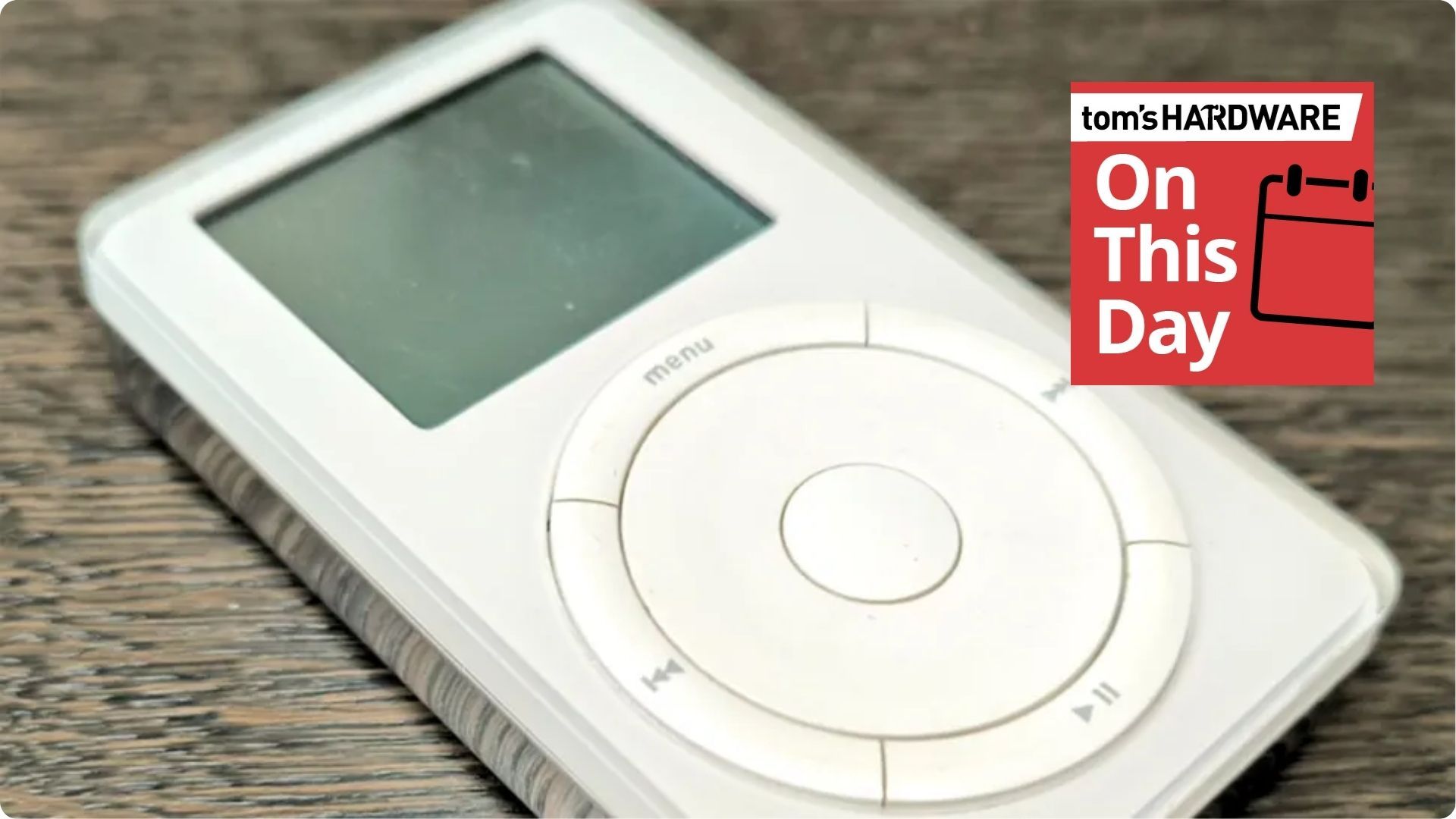
The chunky little original iPod packed a 1.8-inch Toshiba HDD, and used FireWire because the USB of the era was too slow and didn't offer charging.
When you purchase through links on our site, we may earn an affiliate commission. Here’s how it works.
On this day in 2001, Apple CEO Steve Jobs unveiled the original iPod. He began the presentation by teasing “a breakthrough digital device that’s not a Mac.” Ultimately, the iPod that was revealed that day became a pocket-sized digital music player phenomenon, and would be many gadget fans' favorite always-carry device before smartphones matured enough to make such things redundant. The key claim iPod launched with was that it could put your entire music library in your pocket for $399.
In October 2001, when the iPod launched, Steve Jobs had successfully steered Apple beyond the beige into the Mac OS X era, with iBooks and iMacs well established. A revival of the Cupertino company's fortunes was well underway, with these iDevices doing well among consumers – at a difficult time, not long after the dot-com bubble burst.
Jobs predicted that the “Mac could become the center of your digital lifestyle.” It would do so as a hub uniting digital cameras, digital camcorders, DVD players – and the portable music player. Apple decided to go down this avenue as everyone loves music and it’s a huge target market, without a market leader, reasoned the CEO.
Small companies like Creative and Sonic Blue, and the much larger Sony, already had portable digital music players, acknowledged Jobs. However, “none of them has really found the recipe yet, for digital music,” he told the crowd at the iPod unveiling. At the time of Apple’s iPod announcement, there were four mainstream portable digital music solutions: CD players, MP3 CD players, flash players, and hard disk-based jukebox players. Jobs saw that last one as the optimal choice for market entry.
After this long preamble, the iPod was introduced as an MP3 music player, offering CD-quality sound, capable of playing all the popular formats of the time (MP3, WAV, AIFF). Its 5GB capacity meant that it could hold 1,000 songs. Specifically, that meant 1,000 typical pop-song length MP3s at 160Kbps. “For most people it’s their entire music library,” enthused Jobs.
The Apple CEO then sketched out three big claims that would make the iPod a winner. First, its ultra-portable form factor made it desirable. This aspect of the design was aided by Toshiba’s newest ultra-compact and ultra-thin hard drive at 1.8 inches in diameter and 0.2 inches thick. The actual device would be the size of a deck of cards – 2.4 x 4 x 0.78 inches, with a weight of 6.5 ounces, “lighter than most cell phones.”
Despite its compact size, the iPod offered advanced features like 20-minute skip protection, fast file transfers, and charging via a single FireWire 400 cable. The iPod was heralded as the “first and only music player with FireWire.” The connection was fast enough to transfer an entire CD to the device “in five to 10 seconds,” according to Jobs’ presentation. The USB connections of the same era would keep you waiting around five minutes for the same single CD of MP3s data transfer to complete, it was claimed. To fill the iPod (1,000 songs), it was estimated it would only take 10 minutes vs. five hours for a USB digital music player.
Get Tom's Hardware's best news and in-depth reviews, straight to your inbox.