// SPACE.COM — SPAZIO & SCIENZA
'Stupendously large black holes' aren't a major component of dark matter, study finds
When you purchase through links on our site, we may earn an affiliate commission. Here’s how it works.
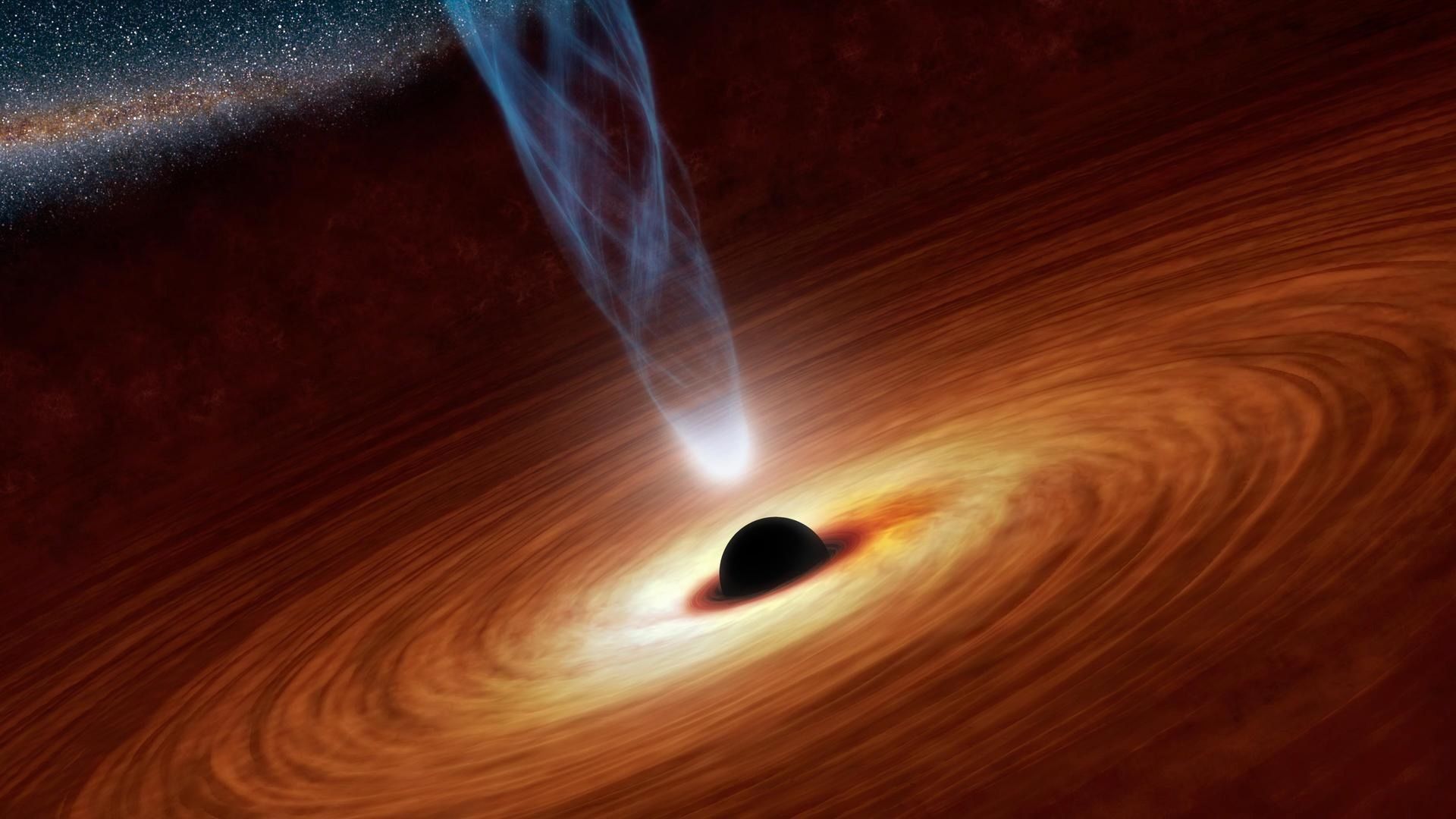
Black holes more massive than entire galaxies are not a major component of the mysterious dark matter that's thought to make up most of the matter in the cosmos, a new study finds.
For decades, to explain why galaxies do not spin apart at the speeds at which they whirl, scientists have suggested the existence of an unseen substance known as dark matter, whose gravitational pull helps keep galaxies together. Dark matter is thought to make up about five-sixths of all matter in the universe.
Much remains unknown about dark matter, however — including whether or not it actually exists. Black holes make good potential contenders for dark matter, since they are extremely massive and are difficult to spot in the dark depths of space.
In the new study, researchers investigated whether dark matter could be made of "stupendously large black holes," ones with masses greater than 100 billion times the mass of the sun. Stupendously large black holes greater than 1 million billion to 10 million billion suns in mass would be heavier than entire galaxies.
So far, astronomers have not detected any stupendously large black holes — currently, the largest black hole known may weigh about 36 billion suns. Since researchers have not seen any even after looking at many galaxies, the new study noted they cannot make up all of dark matter — but team members wondered if the exotic objects still might constitute a significant portion of the puzzling substance.
Often, dark matter is thought of "as a fine dust spread everywhere," study co-author Christopher Gerlach, a theoretical physicist at the Mainz Institute for Theoretical Physics in Germany, told Space.com. However, if dark matter is packed into a handful of gigantic objects such as stupendously large black holes, "the universe becomes grainy on very large scales. And we can check that."
Specifically, the scientists analyzed the light from the dawn of the universe, study co-author Yann Gouttenoire, a theoretical physicist at the Mainz Institute for Theoretical Physics, told Space.com.
For the first 380,000 years after the Big Bang, the cosmos was filled with a hot plasma in which light was trapped. Eventually, the expansion of the universe let the cosmos cool enough for the plasma to largely dissipate and form atoms. This in turn let light shine freely, "and that light is still arriving today," Gerlach explained. "We call it the cosmic microwave background, a snapshot of the infant universe covering the whole sky."
The temperature of the cosmic microwave background "varies from place to place by about one part in 100,000," study co-author Antonio Iovino, a theoretical physicist at New York University, Abu Dhabi, in the United Arab Emirates, told Space.com. "That pattern tells us how matter was spread back then."