// ARS TECHNICA — MOBILE & WEB
Apple iPhone Duo review: Two screens, two experiences, two thousand dollars
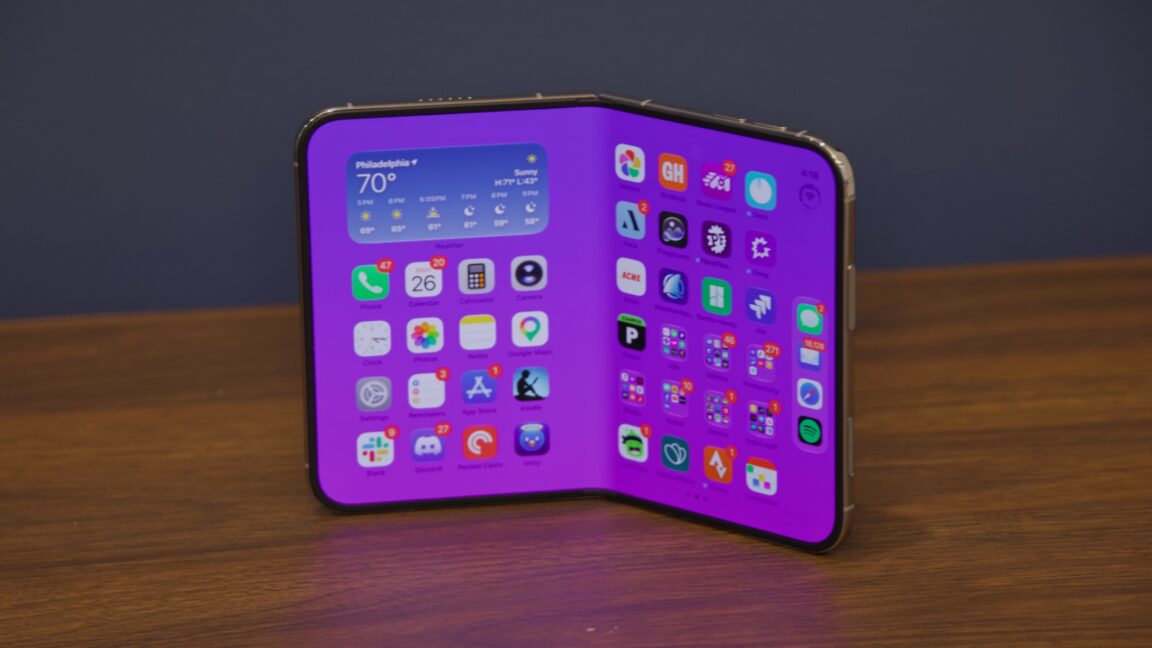
I respect Apple’s first crack at a foldable phone, but I’m not sure I like it.
I understand the appeal of foldable phones—they let manufacturers keep expanding screen sizes while still producing devices that can reasonably fit in a pocket. In practice, though, every foldable Android phone I’ve seen in public has had a ridiculously visible seam between the two halves of the screen, often with what looks like delamination from the underlying surface, giving the display an ugly, bubbly appearance.
Back when Android phones began shipping with bigger and bigger screens and the iPhone was stuck at a miserly four inches, I was jealous. But I’ve never looked at anyone using a chunky, fragile-looking foldable phone in public and pined for Apple’s take on the idea.
Nevertheless, that take has arrived, in the form of the iPhone Duo. This $1,999-and-up foldable is the biggest change to the iPhone in years, with both hardware and software updates that dramatically change how you interact with the device.
Like most Apple products, it looks and feels solid, and Apple has managed to engineer its way around at least some of the problems that have bedeviled other foldables (in particular, it has wrangled the between-screen crease so close to invisibility that I rarely thought about it while using the phone unfolded).
But like most first-generation Apple products, it has some odd rough edges and costs more than most people will want to spend. Some aspects of its design feel like steps backward from the standard iPhone design, as exemplified by the current iPhone 17 and iPhone 18 Pro.
The result is something that is technically impressive but not always enjoyable to use. As a little iPad, it’s surprisingly good. As an iPhone, though, I struggle to think of a single way I prefer it to a regular old iPhone.
The iPhone Duo is the first iPhone I’ve used in a long time that comes with a learning curve. It’s the first time since 2018’s iPhone X that a hardware update has fundamentally changed how you interact with the software.
For the first day or two, I found this pretty off-putting. I kept losing track of the iPad-style button-mounted Touch ID sensor and flipping the phone around with the camera upside down. When fully opened, the phone acts like an iPad: It’s orientation-agnostic, and it will work in portrait or landscape, regardless of which end is up. But in its folded one-handed mode, the Duo still has a right-side-up and an upside-down just like any iPhone, and it took a couple of days of retraining my muscle memory before I was consistently pulling it out of my pocket and looking at it the right way without thinking about it.
When folded up, the iPhone Duo has a more compact footprint than Apple’s other phones and a screen that’s both shorter and wider. The titanium frame looks and feels a lot like last year’s iPhone Air, which plenty of people (us included) pegged as a half-step toward a foldable design. The outer screen looks and feels like a typical glassy iPhone screen, and the “back” of the phone where the camera is (the only quadrant of the phone that isn’t a screen) uses familiar-looking and -feeling Ceramic Shield glass.