// ARS TECHNICA — MODA & SOCIETÀ
Cadillac Escalade IQ review: Huge battery, huge range, huge SUV
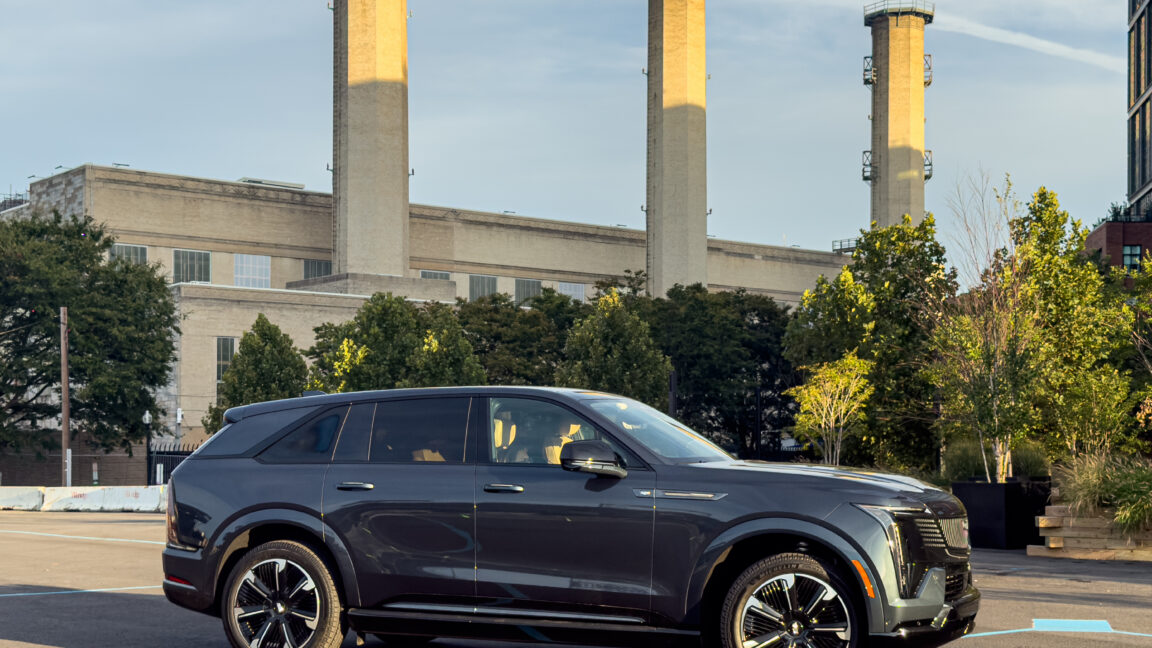
With more than 200 kWh, this luxury three-row can go 460 miles on a charge.
“Please have at least 125 miles of range left when we pick it up.” That request from the people who look after the Cadillac press cars wasn’t going to be hard to honor. The electric Escalade IQ arrived with an indicated range of 440 miles (708 km), and with a full week of work to squeeze in, getting anywhere close to needing to recharge it seemed unlikely. With more than 200 kWh of lithium-ion battery between its axles, range is one thing the big electric Caddy needn’t worry about.
Designed and debuted during a time of greater EV optimism, the Escalade is Cadillac’s statement that swapping out a V8 for a pair of powerful electric motors is no compromise to its ambitions, even if the brand’s future will now include a mix of electric and combustion cars beyond 2030. It shares a battery pack and much else with other full-size GM EVs we’ve tested: the Chevrolet Silverado EV, the GMC Sierra EV, and of course the divisive Hummer EVs. And like those trucks and SUVs, the Escalade is large and heavy—just small enough to fit into a standard parking space, with a curb weight sufficient to push it into the Class 3 truck category.
So, the side mirrors are flat, and there’s no formal EPA range—Cadillac says it achieves 460 miles (740 km) on the EPA test cycle—but there are plenty of airbags, even though the 9,046 lb (4,103 kg) curb weight does not require them. Yes, you did read that right, it does weigh 4 tons. And yes, the electric Escalade does weigh a third more than the last gas-powered one we tested.
However, it drives better. Like many a modern luxury EV, the Escalade IQ is held up by air suspension. Controlled by computers, air suspension is remarkably effective at concealing a car’s mass, although here it has been tuned for a rather floaty ride. In lesser electric SUVs—ones that weigh a mere 3 tons or less—you can often forget that curb weight entirely until it’s time to brake. Here, you just need to drive over something, like a recessed utility hole cover on the road, for the transient shock that makes its way into the cabin to remind you.
From behind the wheel, I find it slightly sobering, perhaps no bad thing when taking responsibility on the road. It’s easier to drive than one might expect, particularly at low speeds where the rear-wheel steering gives the car a shorter effective wheelbase than its actual 136.2 inches (3,460 mm). It might fill a parking space, but it’s not hard work getting it in or out. Forward visibility is good, but I found the passenger mirror less than completely effective and was glad for the blindspot monitoring camera that appeared when I used the turn signals, even if the camera quality was just the right side of potato.
At highway speeds, the rear wheels steer with the front wheels to effectively lengthen the wheelbase and thus increase straight-line stability. Nominal power and torque are 680 hp (505 kW) and 615 lb-ft (834 Nm), which you can increase to 750 hp (560 KW) and 785 lb-ft (1,064 Nm) with the V button on the steering wheel—this engages Velocity Max mode. It’s not ever going to ripple the tarmac like that electric Porsche Cayenne, but you can still hit 60 mph (97 km/h) from a standstill in less than 5 seconds should you need to.
Super Cruise is standard and works well on its premapped roads. The one-pedal driving calibration is, as always on GM EVs, very well-calibrated on its highest setting. It’s very effective for city driving, as you quickly adjust to its rate of deceleration to judge stops perfectly. There’s also a paddle on the steering wheel that will add regenerative braking on demand, should you wish to slow more but don’t feel like using the brake pedal.
The 460-mile range estimate is entirely believable, even with little attention given to driving efficiently. As you’ll note from the photos, on shorter trips the Escalade IQ reported efficiencies that wouldn’t be out of place in something like an Io