// ARS TECHNICA — MODA & SOCIETÀ
Turning a solar power system into its own backup
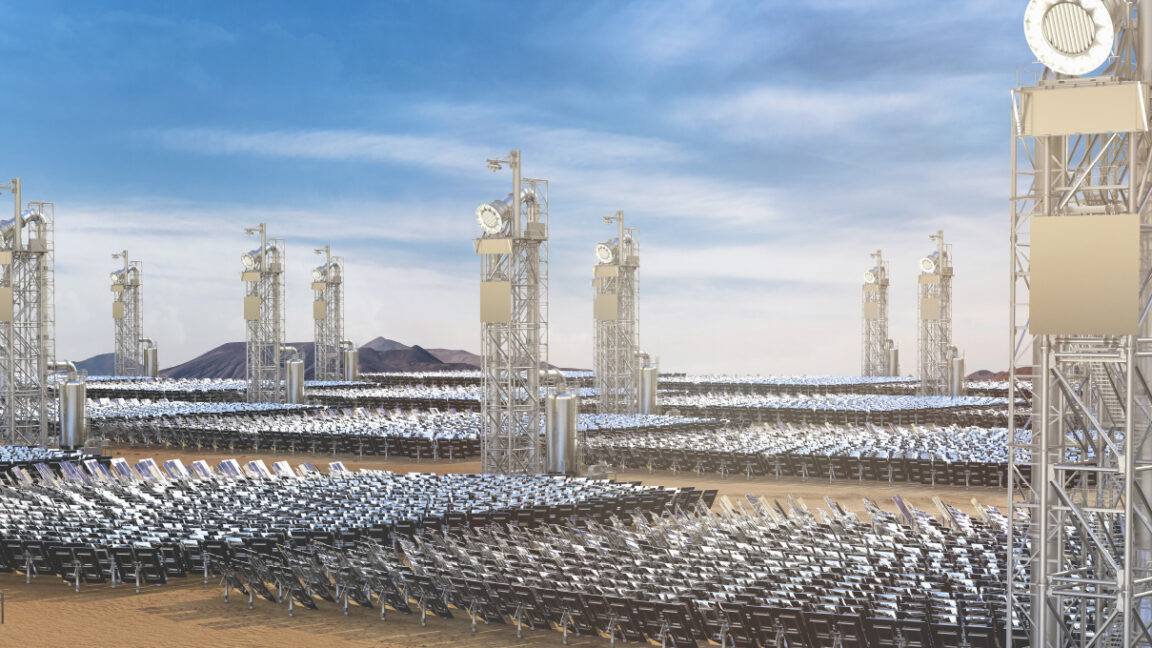
Plant design allows it to run on either stored solar heat or combustion.
Rather than directly converting photons into electricity, concentrated solar energy uses mirrors to turn sunlight into heat, which can then be used to drive traditional generating turbines. Up to about a decade ago, there was a case to be made that concentrated solar energy had a bright future, as improvements in heat storage had turned it into a way to generate power around the clock.
It wasn’t to be. While concentrated solar costs fell enough to compete with nuclear power, the price of photovoltaics plunged, making solar panels the cheapest source of power in most locations. Currently, if you have a good site to generate solar power, then the economics of PV panels are hard to beat.
That has left us needing to build a mixture of other facilities—typically batteries and natural gas facilities—to handle overnight needs or weather-driven shortfalls. But a small company is promising that it can help avoid the need to build a separate facility. Its version of concentrated solar is designed so that a fossil-fueled backup system shares most of the generating hardware with the solar side.
Concentrated solar, also called solar thermal, is pretty simple in principle. Most of the site is covered with heliostats, devices that incorporate mirrors and a motorized tracking system that can keep their focus on a single point as the Sun moves across the sky. The point of focus is in a tower, where sunlight heats a working fluid. The hot fluid can then be used to power a traditional steam turbine, or its heat can be stored and used to generate power overnight.
There are many potential variations, however: different working fluids and methods of heat storage, trough-shaped mirrors that eliminate the need for a tower, and so on. All of those variants are meant to reduce some of the issues inherent to solar thermal: lots of moving parts, potentially corrosive fluids, and so on. Those issues and the lack of standardization have helped ensure that the costs of these plants haven’t come close to keeping pace with photovoltaics.
Without any incentive to generate renewable power overnight, there hasn’t been any way for concentrated solar to compete. Construction of new plants has largely stopped, and a number of sources have simply stopped tracking the economics of it.
So it was a bit of a surprise to hear that India had contracted with a US-based startup called 247Solar to build and operate a small concentrated solar plant. While the plant will be extremely small (1 megawatt) and mix in photovoltaics, the company had a unique angle: The same hardware that is handling the solar thermal output can simply be run using fossil fuels if there is a significant shortfall in renewable generation.
“Our systems are their own backup,” said 247Solar’s Mark von Keszycki. “During times of low solar resource—long duration, bad weather, whatever the case may be—they’re able to burn a variety of fuels.”
To understand how this works, it’s best to step back and understand the entire system being built, which includes details about how the 247Solar team hopes to avoid some of the problems faced by other solar thermal systems and provide a great deal of flexibility in terms of how its systems get put to use.