// SPACE.COM — SPAZIO & SCIENZA
Astronauts deploy solar array on 100th US spacewalk by International Space Station crew members
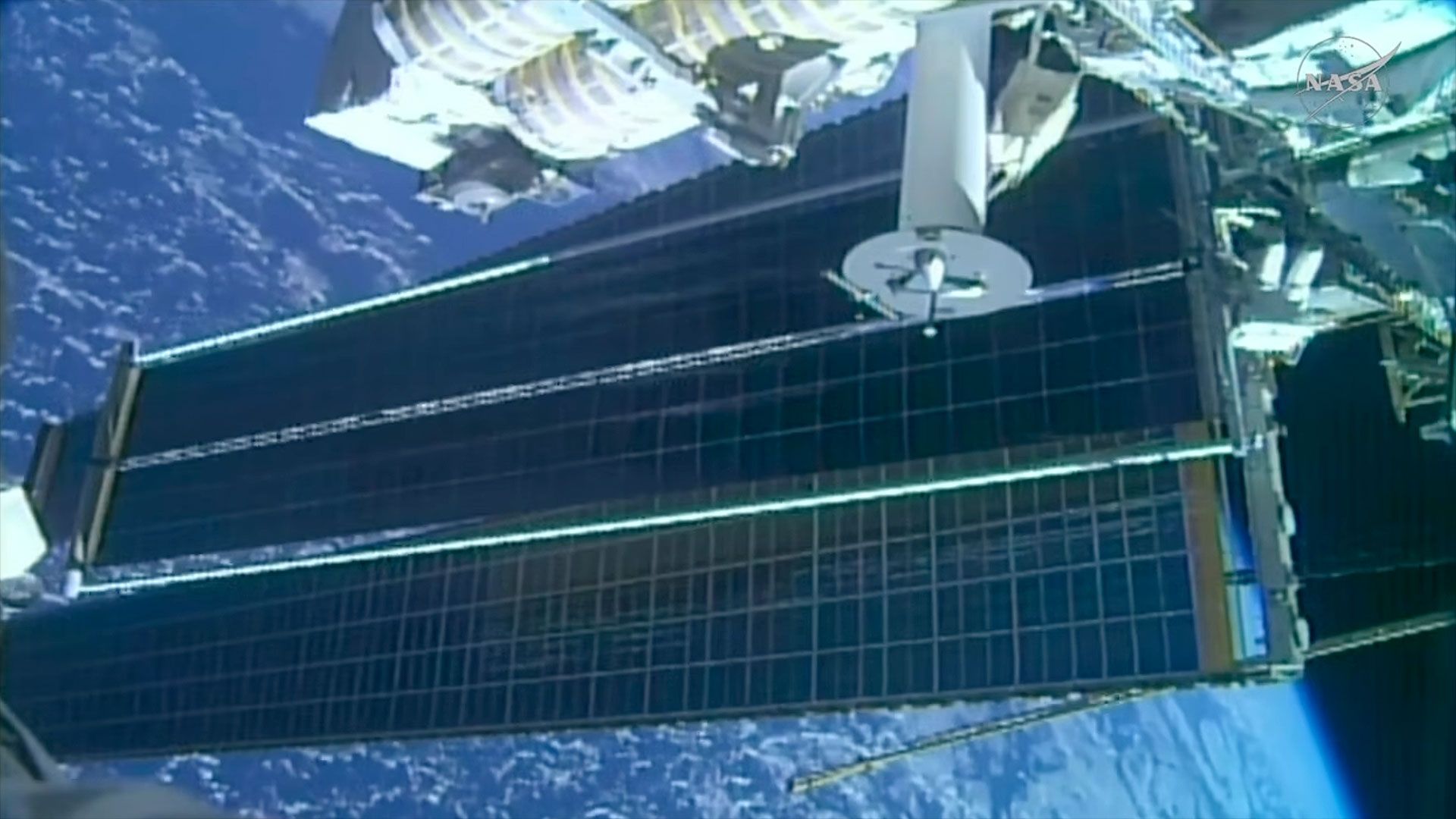
Anil Menon of NASA and Canadian Joshua Kutryk increased the space station's power supply on today's (Oct. 29) extravehicular activity.
When you purchase through links on our site, we may earn an affiliate commission. Here’s how it works.
Two astronauts successfully installed and deployed the second-to-last upgraded solar array for the International Space Station (ISS) during the 100th U.S. spacewalk from the orbiting outpost.
Anil Menon of NASA and Joshua Kutryk of the Canadian Space Agency (CSA), both ISS Expedition 75 crewmates, completed the 7-hour-and-11-minute extravehicular activity (EVA) at 3:08 p.m. EDT (1908 GMT) on Thursday (Oct. 29). The spacewalk began and ended inside the U.S. Quest airlock, with both astronauts wearing NASA's extravehicular mobility unit (EMU) spacesuits.
It was the first spacewalk by a Canadian astronaut since April 2019, when David Saint-Jacques ventured into the void with NASA's Anne McClain.
Once outside, Menon and Kutryk worked on unbolting the ISS roll-out solar array (iROSA) from a temporary stowage platform. The 10-by-2-by-4-foot (3-by-0.6-by-1.2-meter) rolled-up assembly was delivered to the space station inside the unpressurized trunk of SpaceX's Dragon cargo capsule earlier this month, on the company's 35th ISS resupply mission for NASA.
Menon then secured himself at the end of the Canadarm2 robotic arm and carried the 750-pound (340-kilogram) iROSA to the space station's port side, where he and Kutryk next installed it on the 2A electrical power channel. Kutryk made his way to the worksite along the station's backbone truss.
Using bolts to mount the IROSA in place and connecting its electrical cables to tie it into the station's power system (during a night pass, out of safety concerns), the array was ready to be extended. No motor was needed to deploy the iROSA to its 63-foot (19-m) length. The potential energy held by the assembly's rolled-up carbon composite booms was enough to fully unroll the panel.
"And we see the iROSA deploying now," reported Mission Control four hours and 23 minutes into the spacewalk.
About 12 minutes later, the array had fully extended, draping over about half of the larger but less capable legacy panel on the P4 truss. The station's eight original arrays are showing degraded power output as they have exceeded their 15-year design life. The iROSAs, when used in tandem with their older counterparts, have increased the station's power supply by 20% to 30%.