// NATURE NEWS — SPAZIO & SCIENZA
Bureaucratic incentives shaped effectiveness of the one-child policy in China
Nature
(2026) Cite this article
Empirical research so far largely suggests that population policies around the world do not explain a majority of the global fertility decline1,2,3,4,5,6,7,8,9,10. Notably, even China’s total fertility rate declined little after implementation of the one-child policy in 1979 and 1980, but fertility then fell sharply by more than one-third during the early 1990s. Here we show that strengthening bureaucratic incentives under China’s one vote veto policy, which strictly prohibited career advancement for adherence failure, was instrumental in more effective implementation of the one-child policy, and in its delayed impact on fertility. Using provincial variation in implementation timing, we find that the one vote veto explains nearly half of China’s total fertility rate decline during the 1990s, driving fertility below the replacement rate. Increases in use of intrauterine devices (the most prevalent form of modern contraception in China) that were recommended by local officials were particularly salient. Overall, our findings suggest that population policy, when more strictly enforced due to stronger bureaucratic incentives, made a greater contribution to low fertility in China than suggested by past research.
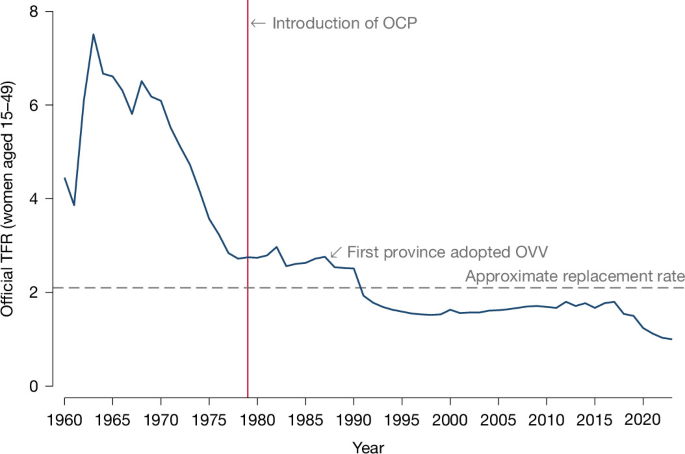
The one-child policy (OCP) is widely considered to be one of the most stringent public policies in modern global history11. However, China’s total fertility rate (TFR) declined very little following its implementation in 1979–1980 (Fig. 1). Although some past research suggests that the OCP effectively reduced fertility rates8,12, the policy’s rapid implementation across the country also makes disentangling its impact from secular fertility trends difficult. If the policy were in fact effective, China’s modest gradual decline in fertility throughout the 1980s implies that early enforcement was, at best, weak (Supplementary Note 1).
China’s TFR, sourced from the World Population Prospects 2024 by the UN Population Division62. The replacement rate is the fertility rate needed for a population to exactly reproduce itself from one generation to the next (without migration). Generally, this rate is roughly 2.1 children per woman in many higher-income countries, although it varies with a population’s mortality rates63,64.
By contrast, during the early 1990s China’s TFR fell abruptly by more than one-third, dropping below the replacement fertility rate. Here we study how strengthening bureaucratic incentives under the one vote veto (OVV) policy during the 1990s was instrumental to more effective implementation of the OCP, and was also responsible for the OCP’s delayed impact on fertility more than a decade later. Provincial and local governments are responsible for implementing central government policies such as the OCP and OVV (and possess autonomy within their jurisdictions), but the central government strongly influences subordinate provincial and local officials through the cadre evaluation system—the linchpin of bureaucratic control in China13,14,15,16 (Supplementary Note 2). Dating back to the Mao era, the cadre evaluation system is a multidimensional performance evaluation system used to rank local officials according to achievement of established policy goals (Supplementary Note 3). Importantly, performance evaluations through this system largely determine professional advancement among bureaucrats in China, and are therefore central to their career concerns13,14,15,17,18.
The OVV policy greatly strengthened cadre evaluation incentives to adhere to OCP targets; it strictly prohibited promotion within the Chinese bureaucratic system for the duration of a bureaucrat’s career in the event of adherence failure. Specifically, for local bureaucrats failing to achieve priority targets (in our case, population and family planning targets set by higher levels of government; OCP targets were the only priority targets when the OVV was introduced), a performance veto di