// NATURE NEWS — SPAZIO & SCIENZA
UNC13A splice correction rescues synaptic dysfunction induced by TDP-43 loss
Nature
(2026) Cite this article
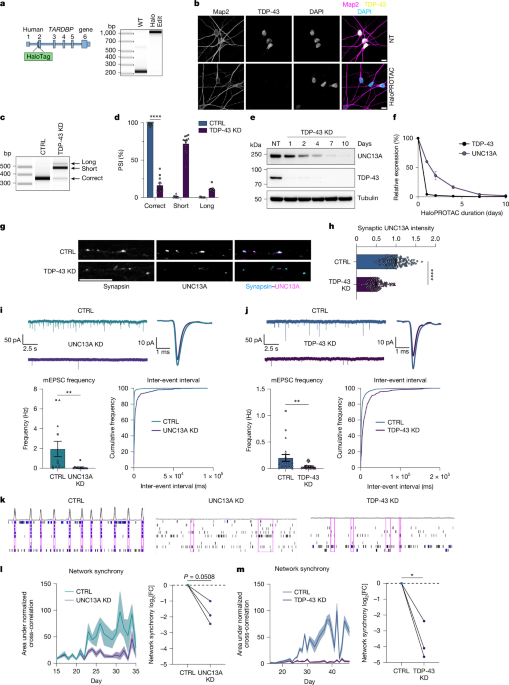
TDP-43 nuclear depletion is a defining pathological feature of amyotrophic lateral sclerosis and frontotemporal dementia that induces widespread cryptic splicing defects in hundreds of transcripts1,2,3,4,5,6,7,8. Despite this, whether TDP-43 loss affects synaptic function has remained unclear. Here we show that TDP-43 loss induces a predegenerative state in which neurons remain structurally intact but suffer a substantial breakdown in synaptic communication. Genetic correction of a single cryptic splicing event in UNC13A was sufficient to rescue these deficits. We developed splice-switching antisense oligonucleotides that correct UNC13A cryptic splicing in human cortical and spinal motor neurons and in a humanized mouse model. In human neurons this intervention restored spontaneous and evoked synaptic vesicle release, release probability at individual synapses and wider network synchrony. Together, this establishes UNC13A splice correction as a mechanistically defined and genetically validated therapeutic strategy relevant to roughly 97% of patients with amyotrophic lateral sclerosis and roughly 50% of patients with frontotemporal dementia with TDP-43 pathology.
Amyotrophic lateral sclerosis (ALS) is a rapidly progressive and fatal neurodegenerative condition. Recently, antisense oligonucleotides (ASOs) targeting SOD1 and FUS have shown early promise in clinical trials9,10, but these approaches only benefit patients with SOD1 and FUS mutations—less than 3% of patients with ALS—leaving an urgent need for therapies for the remaining roughly 97% of patients with ALS. A common feature of all non-FUS and non-SOD1 ALS is the aggregation of TAR DNA binding protein-43 (TDP-43) in neurons1,2, a finding also observed in roughly 50% of both frontotemporal dementia (FTD) and Alzheimer’s disease2,11. However, no therapies that directly target TDP-43 are available, leaving the underlying nuclear loss of function (LoF) unaddressed. TDP-43 is an RNA-binding protein that is normally located in the nucleus and has crucial roles in the regulation of RNA splicing12,13. Cytoplasmic mislocalization of TDP-43 induces a nuclear LoF resulting in cryptic exon inclusion, cryptic alternative polyadenylation and/or exon skipping in some mature messenger RNA (mRNA) transcripts3. These events occur in hundreds of transcripts, including genes with crucial neuronal functions, such as STMN2, UNC13A and KCNQ2 (refs. 4,5,6,7,8). Whereas the impact of STMN2 mis-splicing on axonal regeneration and KCNQ2 exon skipping on intrinsic excitability has been studied, the direct impact of TDP-43 LoF on synaptic function has not been addressed.
Genome-wide association studies (GWAS) have shown that single-nucleotide polymorphisms (SNPs) located within and proximal to a cryptic exon in UNC13A increase the risk of developing ALS and accelerate disease progression14,15,16. Under normal physiological conditions, these risk SNPs do not induce inclusion of the UNC13A cryptic exon, but after TDP-43 LoF, risk SNPs exacerbate cryptic exon inclusion leading to increased loss of functional RNA transcripts and protein6,7. UNC13A is a presynaptic protein that is required at the active zone to properly dock and prime synaptic vesicles for fusion with the plasma membrane17. Genetic deletion of Unc13a in mice leads to a roughly 90% reduction in spontaneous and evoked glutamatergic excitatory synaptic transmission18,19,20. Although the UNC13A genetic association strongly implicates this event in ALS pathogenesis, the contribution of TDP-43 LoF to synaptic dysfunction and the role of UNC13A cryptic splicing—particularly in the context of many mis-splicing events in other synaptic transcripts—is unaddressed. Resolving these outstanding questions is crucial for establishing whether correcting UNC13A splicing represents a viable therapeutic approach for restoring normal neuronal function.
Here we report that TDP-43 loss in mature