// NATURE NEWS — SPAZIO & SCIENZA
Non-halogen aqueous electrolytes for four-electron iodine conversion
Nature
volume 659, pages 372–377 (2026) Cite this article
Accessing reversible four-electron iodine redox chemistry in aqueous metal–iodine batteries offers a promising route towards high-energy aqueous energy storage, but has conventionally relied on highly concentrated, corrosive halogen-containing electrolytes to stabilize reactive hypervalent iodine cations through interhalogen complexation1,2,3,4,5,6,7,8,9. Here we show a kosmotropic anion–polar anion–nucleophilic species (Nuc) electrolyte framework that harnesses anionic chemistry to coordinate the interfacial microenvironment and molecular interactions, enabling reversible four-electron iodine conversion in halogen-free aqueous electrolytes. Polar anions establish a water-deficient, anion-enriched interfacial microenvironment, whereas kosmotropic anions regulate water–Nuc interactions to increase the availability of Nuc for stabilizing hypervalent iodine cations through Nuc–I+–Nuc halogen bonds. This electrolyte framework is validated across diverse Nuc and in both aqueous Zn–I2 and Al–I2 batteries. Moving beyond conventional interhalogen stabilization, these findings establish a distinct electrolyte chemistry framework and represent a mechanistic shift for reversible multi-electron iodine chemistry in aqueous environments.
The increasing integration of renewable energy calls for sustainable electrochemical energy storage systems beyond lithium-ion batteries1. Aqueous metal–iodine batteries offer a promising platform for large-scale energy storage by combining earth-abundant electrode materials, aqueous electrolytes and conversion-type iodine chemistry2,3. Unlike intercalation-type positive electrodes, iodine positive electrodes store charge by reversible valence-state changes, offering access to multi-electron redox chemistry with increased capacity and redox potential4. Most studies have focused on the two-electron I−/I0 redox couple, with a theoretical capacity of 211 mAh g−1 at a redox potential of 0.54 V versus the standard hydrogen electrode10. Extending iodine conversion to the successive I−/I0/I+ redox couples doubles the theoretical capacity to 422 mAh g−1 while introducing the I0/I+ redox process at a higher redox potential of 1.07 V versus the standard hydrogen electrode11. However, despite this potential, achieving reversible four-electron iodine conversion in aqueous environments remains a fundamental challenge3,7.
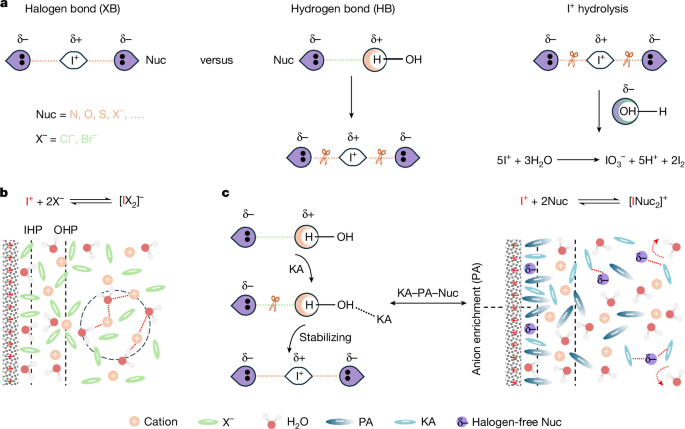
The crux of iodine conversion chemistry lies in interfacial reactions, where electrolyte composition and interfacial microenvironment govern reaction pathways. Electron-deficient I+ is strongly electrophilic and susceptible to nucleophilic attack by water, resulting in hydrolysis and poor reversibility in aqueous environments9,12. Previous studies have achieved four-electron iodine conversion in aqueous Zn–I2 and Al–I2 batteries by stabilizing reactive I+ through interhalogen complexes (for example, ICl2 or IBr2) in highly concentrated chloride- or bromide-containing electrolytes5,6,13. In these systems, electrophilic I+ coordinates with two nucleophilic halide ions (Cl− or Br−) through non-covalent interactions8,14. However, at water-enriched interfaces, hydration of nucleophilic species (Nuc) competes with these interactions and destabilizes I+ complexes (Fig. 1a). Highly concentrated, halogen-containing electrolytes mitigate this competition by reducing water activity and increasing halide availability, but their high salt contents and corrosivity constrain broader implementation (Fig. 1b and Supplementary Fig. 1), necessitating new electrolyte chemistry and a mechanistic framework that move beyond reliance on halogen-containing electrolytes and conventional interhalogen stabilization5,8.
a, The mechanism of the competition between halogen bond and hydrogen bond. b, The conventional interhalogen stabilization mechanism in highly concentrated, halogen-containing electrolytes. c, The KA–PA–Nuc framework levering a