// NATURE NEWS — SPAZIO & SCIENZA
Transient nuclear softening for zygotic gene activation in mice
Nature
(2026) Cite this article
Nuclei in early mammalian embryos undergo epigenetic reprogramming that enables the zygote to develop into a complete organism. Whereas changes in chromatin state during this critical transition period have been extensively studied1,2,3, changes in the nucleus that houses chromatin remain poorly understood. Here, using direct organelle capture and biophysical manipulation methods, we find that nuclei attain profound softness and plasticity during the two-cell embryonic stage in mice, facilitating major zygotic gene activation. The prominent nuclear deformability is attributable to the rapid clearance of lamin B1 from the nuclear envelope by the autophagy factor LC3. Nuclear stiffening by lamin B1 retention or its overloading results in incomplete activation of zygotic genes and impaired development. However, embryos that maintain nuclear deformability escape from this transcriptional interference. High-resolution microscopy and sequential three-dimensional fluorescence in situ hybridization analyses revealed an accumulation of active RNA polymerase II and coordinated positioning of key genomic loci near the deformable nuclear envelope. An engineered molecular tether that stiffens the nuclei restricts these nuclear activities and suppresses expression of key zygotic gene activation genes. Together, our study identifies a distinct physical nuclear state that embryos acquire at the beginning of life that supports the initiation of the zygotic transcription program.
The physical characteristics of the cell nucleus are extraordinarily diverse, exhibiting distinct shape and mechanical phenotypes across tissue types, physiological states and disease conditions. Fragile or misshapen nuclei are hallmarks of cancer, cardiomyopathy and premature ageing4,5. Nuclei in stem cells gradually stiffen during differentiation4,5,6,7. While these changes are widely recognized as consequences of altered nuclear composition and chromatin dynamics, they also influence genome organization and transcription8,9,10. Despite the importance, the physical state of the nucleus at the earliest stages of mammalian development, when life begins, remains unclear.
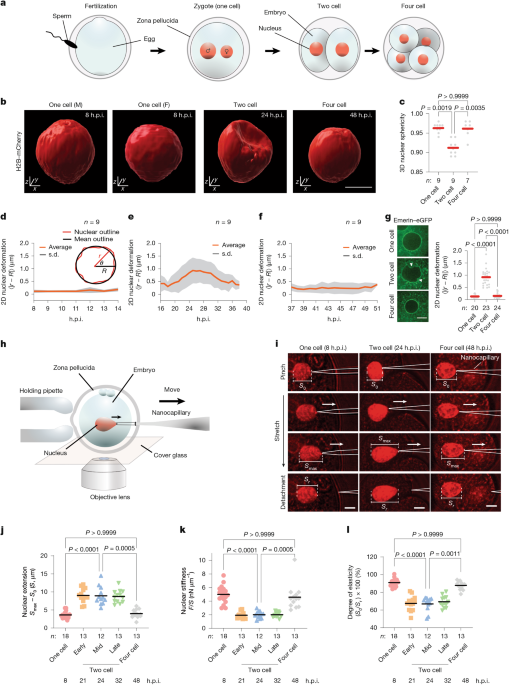
During the first few cleavages, nuclei undergo extensive epigenetic reprogramming, enabling the zygote to initiate a new developmental program. In mice, this transition occurs within the first approximately 48 h after fertilization and is associated with a surge in new transcript production, known as major zygotic gene activation (ZGA)11,12,13. Major ZGA occurs during the mid-to-late two-cell stage, and embryos that impair ZGA fail in subsequent development. Around the time of ZGA, chromatin exhibits distinct structural and biochemical changes accompanied by histone modifiers and transcription factors14,15. By contrast, whether the nucleus organizing chromatin undergoes any crucial changes that drive ZGA is not known. In somatic cells, nuclear shape and mechanics depend on lamins, which line the inner nuclear membrane16,17. Lamins are long-lived, enriched in eggs and are crucial for mammalian development18,19,20. Previous studies have documented that, of the two major types, A-type lamins exhibit cell-lineage-specific differential expression patterns, whereas B-type lamins are constitutively expressed throughout development16. However, their dynamics and transiency, as well as the underlying core regulatory mechanism, during the earliest embryonic stages are poorly understood. Likewise, how the nuclear lamina, which forms a structural meshwork, controls nuclear mechanics and genome dynamics during this critical transition is unknown. Investigating physical nuclear characteristics necessitates direct quantification and manipulation of their mechanical properties. However, achieving this without compromising cell viability poses a challenge.
To investigate physical nuclear properties, we first performed high-resolution confocal scanning of f