// SPACE.COM — SPAZIO & SCIENZA
How escaping gases ripped apart a comet and caused it to become thousands of times brighter
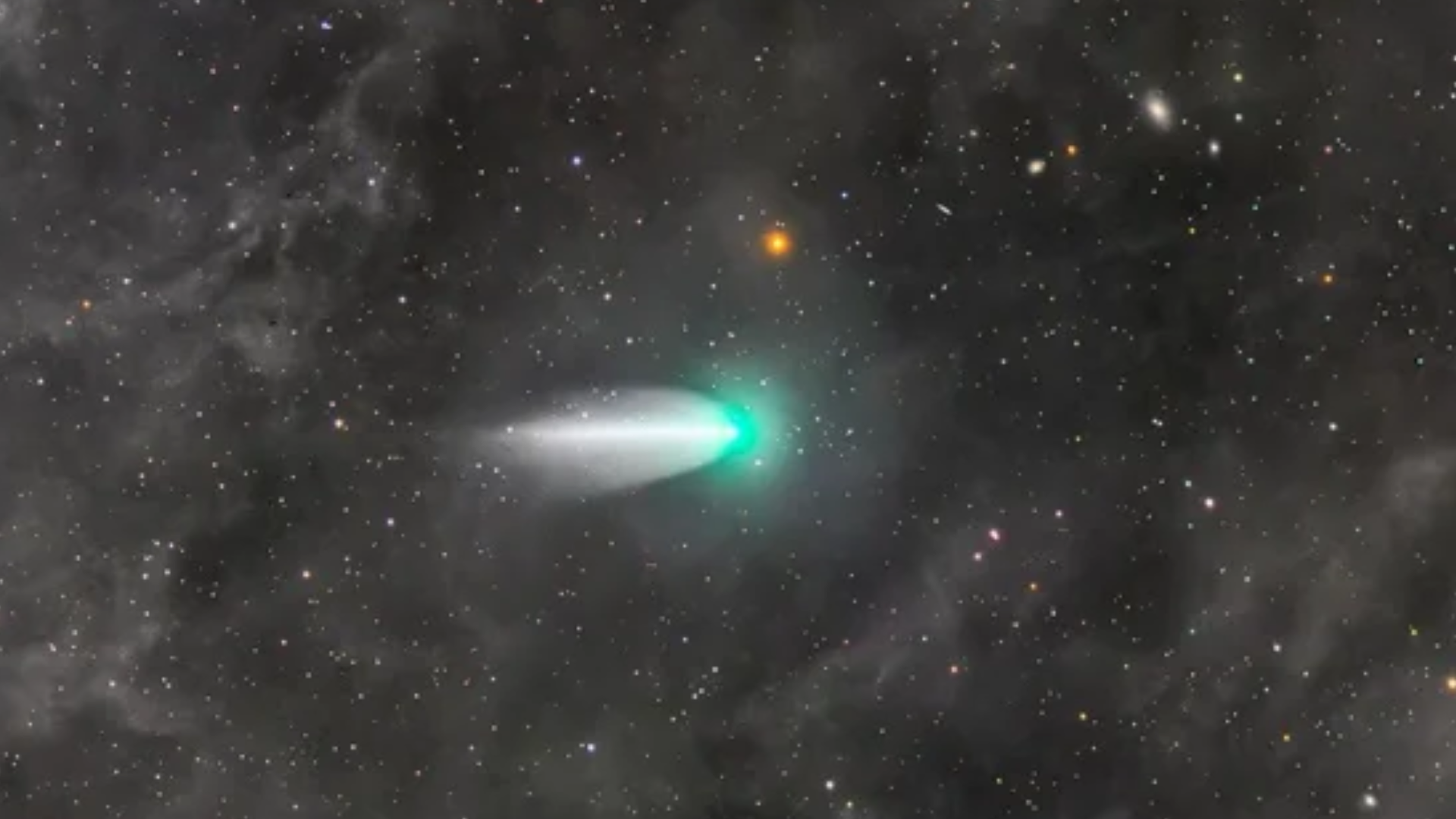
The dramatic brightening was caused by an outburst on the comet that dumped billions of pounds of dust into space.
When you purchase through links on our site, we may earn an affiliate commission. Here’s how it works.
A comet dazzled this summer as the sun’s heat caused ice beneath its surface to turn to gas and rip out through its surface, spewing hundreds of billions of pounds' worth of dust into space and causing the comet to brighten by thousands of times.
Comet 220P/McNaught was discovered by the prolific Australian comet discoverer Robert McNaught in 2004. It is a periodic comet, the 220th discovered, meaning that it comes back again and again on a regular basis – in 220P’s case, once every five-and-a-half years when it gets about as close to the sun as Mars. Other than that, 220P is fairly nondescript, usually languishing at a feeble brightness fainter than magnitude +15, out of reach of most amateur telescopes. There has been little else to say about the comet, until this year.
On June 14, as it headed towards perihelion – the closest point in its orbit to the sun, at a distance from our star of 1.5 times the distance between the Earth and the sun (known as an astronomical unit), 220P suddenly and without warning burst into life.
On 31 May, the comet was languishing at magnitude +17.39 (the higher the magnitude, the fainter an object is), but within less than 14 hours it had dramatically brightened to magnitude +11.05, bringing it into range for observation with small amateur telescopes. By June 2, 220P was up to magnitude +8.23 and was technically visible for a short while in 10x50 binoculars from a dark site, prompting amateur astronomers and astrophotographers to chase down this rare event.
By perihelion, the comet had faded back to magnitude +12, but more was to come. A second outburst began at the end of July, brightening from magnitude +14 on 28 July to magnitude 6.1 by 6 August.
Comets are often referred to as dirty snowballs, and beneath their dusty crust are ices made from various volatiles, including water, carbon dioxide and nitrogen. Solar heating, even at the distance of Mars, can cause these ices to rapidly sublimate into gases, and the pressure of the escaping gas rips the surface apart, spewing huge amounts of dust in to space.
Models based on observations of 220P’s outburst indicate that it spewed out between tens of billions and hundreds of billions of pounds’ worth of cometary dust that filled the comet’s coma, the diffuse 'atmosphere' that clings to the comet’s solid nucleus. The dust particles, which are just millionths of a meter across, expanded outwards from the comet at about 1,280 feet (390 meters) per second, scattering sunlight and causing the coma to substantially brighten.
"We have concluded that the comet detached localized parts of its crust, creating a dust-rich envelope that increased [the comet’s brightness by] 250 times in half a day," Josep M. Trigo-Rodríguez, of the Institut de Ciències de l’Espai and the Institute of Space Studies of Catalonia in Spain, said in a statement.