// TOM'S HARDWARE US — HARDWARE & GADGET
Anthropic says Claude Mythos Preview cut AMD MI355X onboarding from up to 12 months to around three days
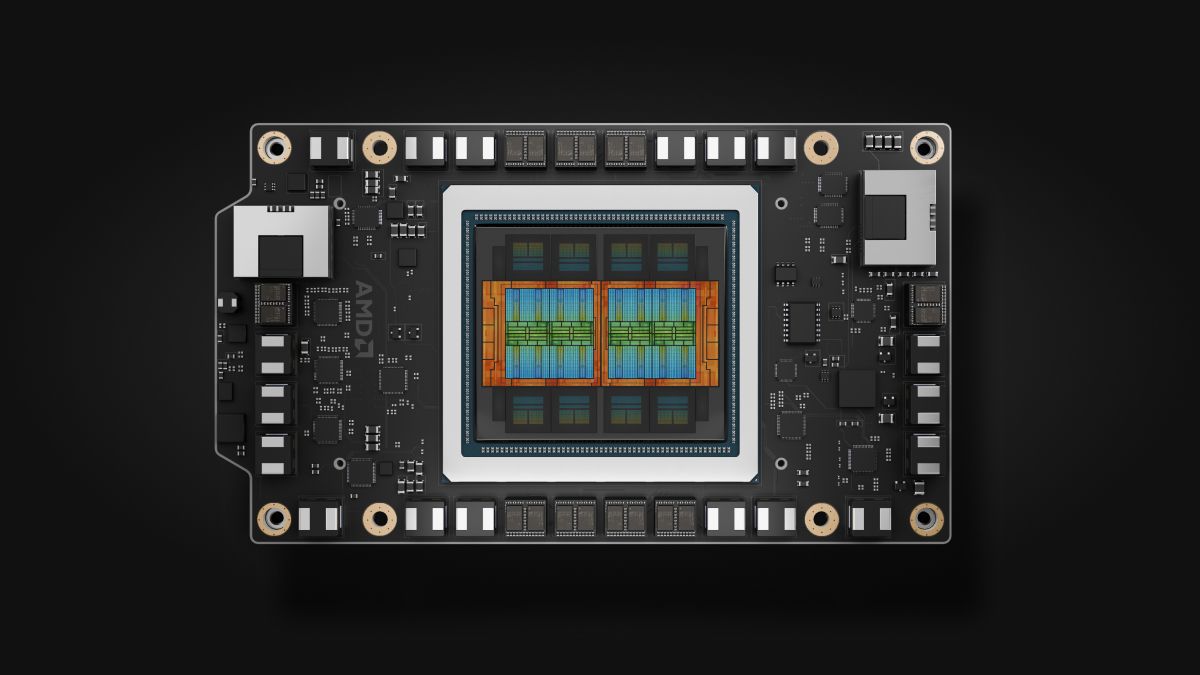
If AI can write the low-level code that ties models to Nvidia, CUDA matters less.
When you purchase through links on our site, we may earn an affiliate commission. Here’s how it works.
Anthropic told IPO investors that its Claude Mythos Preview model did the software work required to get its AI running on AMD’s GPUs in about three days, with “basically no human intervention,” a job it says used to take six to 12 months. The three days cover prompt processing for one Anthropic model on AMD MI355X GPUs “at a useful level of performance,” with Mythos porting or writing “almost 100% of the kernels.” That kind of low-level code, which ties an AI model to one company’s chips, has long been part of Nvidia’s CUDA moat, and an AI that can write it in days would suggest that moat is eroding.
Tom Brown, Anthropic’s co-founder and chief compute officer, made the time comparison, noting to investors that the original meant using a team of “dozens of engineers.” The company already runs its models on multiple kinds of chips — on GPUs from Nvidia and AMD, Google’s TPUs, and AWS Trainium — and its fleet is managed as “one fungible pool of compute.” Brown called the early multi-chip decision “an unconventional bet.” It may have been a wise one, given that Google’s TPUs can now natively run AI models built in PyTorch, and Meta uses them in production.
Anthropic's claim that the job used to take six to 12 months comes from past work, from its “historical experience bringing up new accelerators using traditional engineering approaches,” where tailoring the code to each hardware platform was a challenge. Removing that onboarding barrier could reduce things to a purchase decision, and Anthropic started working with AMD GPUs for the first time this year, with an agreement for up to 2 gigawatts now in place.
CUDA, Nvidia’s programming platform, is very mature at nearly two decades old. AMD has an equivalent, ROCm, with HIP as its programming layer. Code written for CUDA has to be transformed to work there, and AMD even built a tool called HIPify for the process. There is still a conversion cost to switching, and AMD’s vice president of AI software, Anush Elangovan, told EE Times in April that “Claude is better than HIPify because it has web search built in.”
AMD has been making the argument that AI can write this type of code since August of last year, presenting a research agent that fell short of human experts at the time. In September of that year, AMD CEO Lisa Su said on the Possible podcast that much of AI software is written in CUDA, which needs to be “translated to AMD,” and “a ton of that can now be done in software.”
Moving forward to July earlier this year, AMD’s senior vice president of AI, Vamsi Boppana, said its engineers were using AI models to generate GPU kernels, and Su said that when she asked whether her team was helping the Anthropic engineer working on the MI355X, she was told they didn’t need any help. Boppana said that in some cases, the resulting kernels were even “better than the most manually tuned versions.” Under its July agreement with Anthropic, AMD is also using Claude to optimize workloads for its Instinct GPUs and to speed up ROCm development.
At AMD’s Advancing AI event in July, OpenAI’s Philippe Tillet said that once OpenAI got its Helios racks, a single engineer confirmed everything worked within a few days, and that “agents are taking over our jobs, in a sense, as kernel engineers.” Before the event, AMD’s Andrew Dieckman, corporate vice president and general manager of the company’s data center GPU business, told reporters that he has had practically zero conversations with AMD’s customers about CUDA.
Published GEAK, an AI agent that writes GPU kernels; against 30 expert-written kernels it got 19 right, at 0.92 times the experts’ speed on average