// ARS TECHNICA — SPAZIO & SCIENZA
Voyager 1 at one light-day: Historian revisits Golden Record's forgotten details
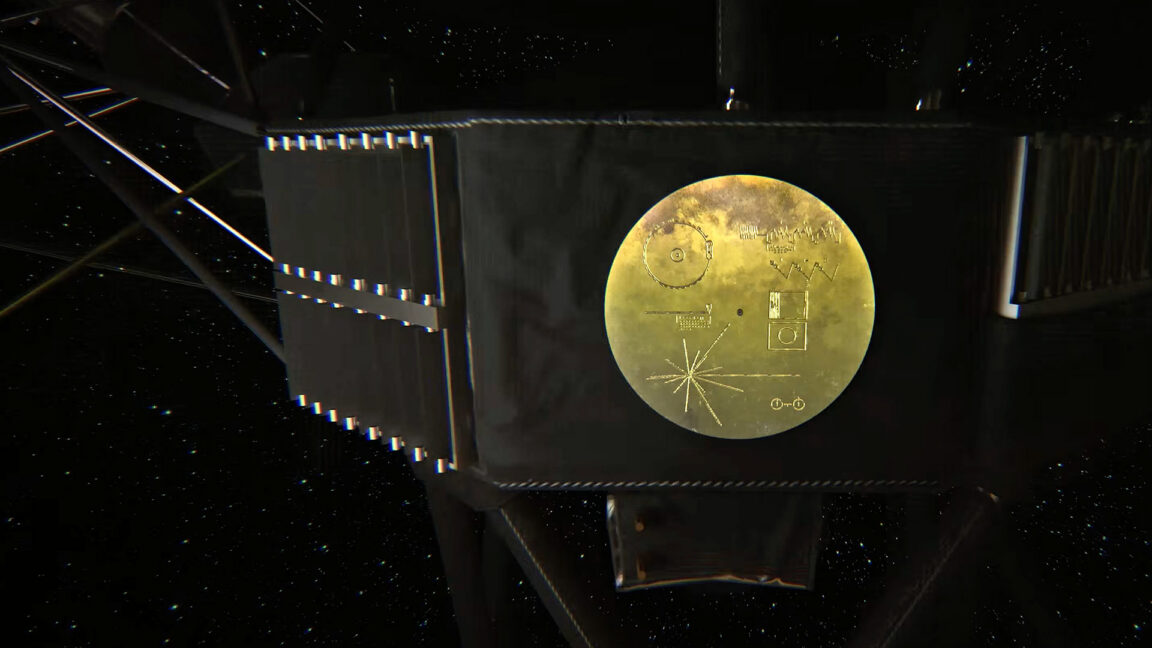
“They are pretty confident that it’s going to last a long, long, long time…”
In the one light-day that humanity’s most distant object has now traveled from Earth, there has been enough time for details about its creation—and what it left behind—to be discovered again.
Voyager 1, which left Earth in 1977 on an initial mission to fly by Jupiter and Saturn (as well as the latter’s moon Titan), crossed into interstellar space in 2012. Like its twin (Voyager 2), Voyager 1 carries a “commemorative phonograph record,” in part as a nod to the 100th anniversary of the recording medium and as a message from humanity to whoever (or whatever) encounters the spacecraft on its journey through outer space.
About those forgotten bits, ask Glen Swanson. While researching the history of the Golden Record, he uncovered the discs’ overlooked second set of operating directions and located the duplicates that were made and distributed almost five decades ago.
“So much has been written about the contents of the record—the message in the bottle, so to speak—whereas I was more interested in the hardware, the bottle itself, because so very little is known about that,” Swanson, former chief historian for NASA’s Johnson Space Center in Houston and founding editor of Quest: The History of Spaceflight Quarterly, said in an interview.
With the 50th anniversaries looming for the launches of both Voyager probes, Swanson and Jon Lomberg, the design director of the Golden Record, recently set about writing Voyager’s Golden Record: An Enduring Reflection, which will be released by the University of Chicago Press in August 2027.
“There isn’t a whole lot of information, and some of the information is somewhat contradictory,” said Swanson of the existing resources and publications. “So it is kind of refreshing to look back and see what exactly went on.”
Meanwhile, the Voyagers continue to travel outward, still communicating with Earth. On November 18, Voyager 1 reached one light-day from Earth—the distance a particle of light travels in 24 hours—giving Swanson an occasion to share details from his and Jon Lomberg’s pending book.
Within the immense scale of the Universe, Voyager 2 is barely even a block from its home. Were an intelligent species to find it today—some 16 billion miles (25.9 billion kilometers) away from Earth—they might not need anything contained on the Golden Record to trace its origins back to our planet.
But that was never the intention of the Golden Record’s designers, who created the archive to last and be relevant for a much more distant encounter.