// NATURE NEWS — SPAZIO & SCIENZA
Analogue simulation of massive relativistic quantum fields in 2 + 1 dimensions
Nature
volume 659, pages 634–639 (2026) Cite this article
Quantum field theories provide fundamental models of complex interacting systems1,2,3, from high-energy physics and cosmology to condensed matter. However, solving these models in non-perturbative and dynamical regimes is often challenging, particularly in more than one spatial dimension. Analogue simulation using tunable synthetic quantum systems can both verify existing theoretical predictions and lead to physical insights. Here we realize analogue simulation of massive relativistic quantum fields in 2 + 1 dimensions (two spatial dimensions and time), using two coherently coupled spin components4,5 in a uniform two-dimensional atomic Bose–Einstein condensate6,7. Specifically, we encode the paradigmatic sine-Gordon model8,9 in the long-wavelength modes of the field describing the relative phase, ϕ, of the two components. In the perturbative regime, collective field excitations exhibit a relativistic dispersion with a tunable mass gap. We also observe explicitly non-perturbative phenomena, including the existence of topological domain walls across which ϕ rapidly winds by 2π (ref. 10). Our work opens possibilities for studies of cosmologically relevant phenomena including preheating11,12, dynamics of topological defects13,14 and relativistic false-vacuum decay15,16,17,18,19.
Analogue simulation offers insights into quantum field theories pertaining to phenomena in naturally inaccessible settings, such as the early Universe. Time evolution in a quantum-field-theory simulator is especially valuable owing to the computational complexity of non-perturbative many-body dynamics. Single-component atomic Bose–Einstein condensates, with tunable microscopic Hamiltonians, provide a simulation platform for massless relativistic fields and have been used to simulate cosmological acoustic fluctuations20,21,22,23,24,25. Extending experiments to two-component Bose–Einstein condensates with coherent inter-component coupling4,5,26,27,28,29,30, one can simulate quantum field theories with massive fields and compact conjugate variables, which can display long-wavelength non-perturbative dynamics31,32,33,34,35,36,37,38,39,40,41,42,43 and support broader families of topological defects8,10,44. In particular, this allows realization of the paradigmatic sine-Gordon model8 for massive relativistic fields. Previously, this was achieved in d = 1 dimension31,32,34,35,37,40, where the model (for a uniform system) is integrable9. Here we realize analogue simulation of massive relativistic quantum fields in d = 2 and observe both perturbative and non-perturbative sine-Gordon dynamics.
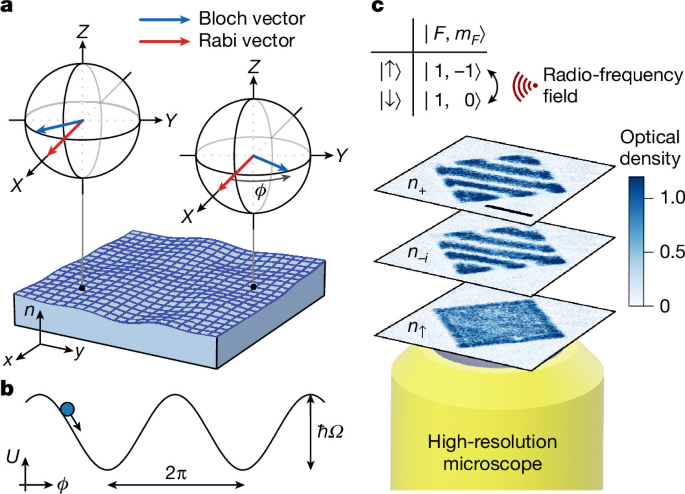
Our simulator is based on a coherently coupled mixture of two miscible hyperfine states of 39K atoms in a two-dimensional optical box trap6,7,45; we denote the two states \(|\uparrow \rangle \) and \(|\downarrow \rangle \), and their individual wavefunctions \({\psi }_{\uparrow ,\downarrow }=\sqrt{{n}_{\uparrow ,\downarrow }}{{\rm{e}}}^{-i{\phi }_{\uparrow ,\downarrow }}\), where n↑,↓ and ϕ↑,↓ are densities and phases of the individual components. In our gas, the two-dimensional total density n = n↑ + n↓ is essentially uniform, but the spin state varies in space (Fig. 1a); on the Bloch sphere, the two compact conjugate variables are the local population imbalance Z(x, y) = [n↑(x, y) − n↓(x, y)]/[n↑(x, y) + n↓(x, y)] and the relative phase of the two components ϕ(x, y) = ϕ↑(x, y) − ϕ↓(x, y). In general, the spin dynamics depend on both the strength of the coherent coupling, given by the Rabi frequency Ω, and the spin-dependent nonlinear interactions. The latter are characterized by a parameter μs that has a similar role to a chemical potential (Methods), for example, setting the spin sound speed c. In the Josephson regime, μs ≫ ħΩ (where ħ is the reduced Planck constant), fluctuations in Z are strongly suppressed, and long-wavelength spin dynamics are dominated by fluctuations in ϕ. At cons