// NATURE NEWS — SPAZIO & SCIENZA
Conservation of the tumour microenvironment across organs and species
Nature
(2026) Cite this article
Current understanding of the host tissue response to solid tumours is largely based on investigations of tumour types in isolation1. Given the breadth and diversity of human tumour pathology and contributions of tumour microenvironment (TME) cells to disease progression, pan-cancer analysis is needed to bridge major themes of stromal and immune cell evolution. To date, however, efforts to compare the TME response across cancers have been limited in scope2,3. Here we conduct a comprehensive pan-cancer analysis by algorithmically screening thousands of publicly available single-cell transcriptomic datasets for stromal and immune signatures across species and tissue types. We demonstrate conserved hallmarks of host cell transcriptional programming in response to malignancy across 42 cancer types in more than 2,000 human and mouse tumour samples. These findings are codified as an interactive web atlas (tmeatlas.stanford.edu) and software package (scTME) that will serve as practical resources for the systematic interrogation of the TME in tumours.
Solid-organ cancers represent a complex spectrum of pathology, with the intricately associated TME having a pivotal role in disease progression and therapeutic response4,5. Within the TME, both stromal and immune cells have emerged as key modulators of tumour growth, invasion and metastasis1,6,7,8,9,10. However, different studies (often in single-organ contexts) have shown conflicting roles for these cells in promoting versus suppressing tumour growth11,12,13,14. The heterogeneity of the TME, both within individual tumours and across tumour types, poses a substantial challenge to understanding the functional diversity of tumour-associated stromal and immune cells3,15,16.
Previous studies have identified distinct cell subpopulations within the TME based on their gene expression profiles, spatial distributions and functional characteristics17,18,19,20,21. However, these findings stem largely from isolated single-cell RNA sequencing (scRNA-seq) studies22,23,24, and subsequent pan-cancer efforts have remained limited in size and scope3,25,26,27,28. To our knowledge, the largest cancer-associated fibroblast atlas to date integrates data from 1,116 samples across 10 tumour types29; the largest tumour endothelial cell atlas includes 575 samples across 19 tumour types30; and no specific tumour mural or nerve atlases have been generated. Pan-cancer immune cell atlases have been larger28, especially those focused on individual immune cell lineages31,32,33; however, these typically have not examined immune cell interactions within the broader TME.
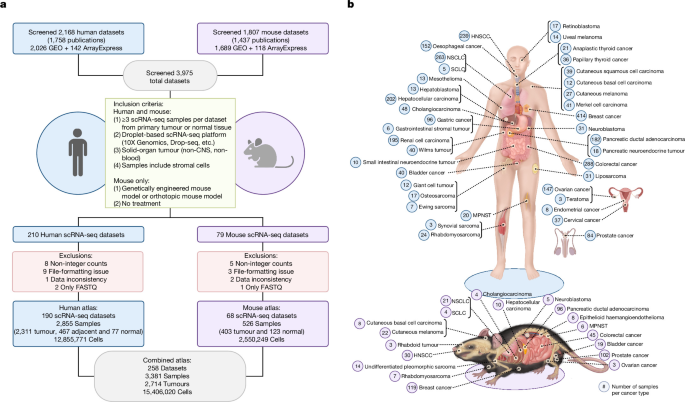
Here we integrated single-cell transcriptomic data from 3,381 human and mouse samples across 42 cancer types and 258 datasets to create a definitive TME transcriptional atlas. By mapping this massive cellular landscape, we resolved the stromal and immune ecosystem of solid tumours. Furthermore, by linking enriched subpopulations to poor clinical outcomes, we identified opportunities for future TME-targeted cancer therapies. Key computational predictions are subsequently validated through in vitro and in vivo experiments. Finally, we have consolidated this work into an interactive web atlas (tmeatlas.stanford.edu) and R software package (scTME) that will serve as practical resources for groups investigating the TME.
To systematically analyse single-cell transcriptomic data, we evaluated every scRNA-seq cancer study published in the public domain between January 2014 and July 2025. Separate queries were evaluated independently for human and mouse datasets within the foundational public repositories for single-cell transcriptomics: the Gene Expression Omnibus (GEO) and ArrayExpress. We screened a total of 3,975 published datasets (Fig. 1a). Studies specific to either blood or central nervous system cancers were excluded from our analysis, as were those failing to meet specific architectural req