// NATURE NEWS — SPAZIO & SCIENZA
Flat-band-induced integer doping and phase transition in monolayer graphene
Nature
(2026) Cite this article
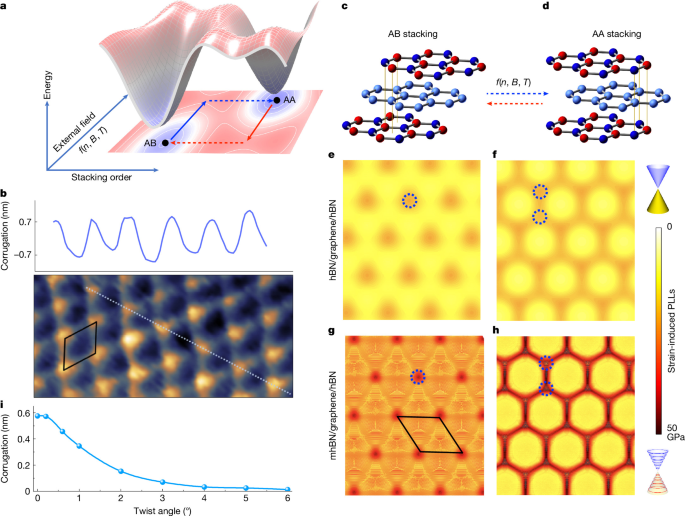
van der Waals heterostructures are stabilized by a delicate balance between van der Waals, elastic and Coulomb energies1,2,3,4. Because the interfaces are not covalently bonded, the constituent crystals can slide, rotate and reconstruct, resulting in several possible competing structural phases2,5,6. However, controlled tuning of this balance, and hence dynamical control over the stacking, has yet to be achieved. Here we report a dynamical heterostructure in which monolayer graphene is doubly aligned to bulk hexagonal boron nitride (hBN) and monolayer hexagonal boron nitride (mhBN) on either side. In such a system, a global structural phase transition, manifested as a change of crystalline symmetry observed by scanning tunnelling microscopy, could be induced by gating, magnetic field or temperature. This structural transition is accompanied by an exotic electronic transition: the doping of graphene switches between discrete levels, corresponding to an exact integer number of electrons or holes per moiré plaquette. We attribute this integer doping to charge trapping in localized, strain-induced pseudo-Landau levels (flat bands in reciprocal space7,8,9,10,11,12), produced by moiré reconstruction (strongly enhanced by the mhBN). Electrical control of coupled structural and electronic phase transitions provides a route to engineering strain-induced flat bands and strain–Coulomb correlations in van der Waals heterostructures.
Unlike covalently bonded heterostructures, van der Waals heterostructures are stabilized by the delicate balance between van der Waals forces, Coulomb interactions and the local strain1,2,3,4. Depending on the relative weight of those energy terms, many different phenomena have been observed: the Hofstadter butterfly depending mainly on the van der Waals coupling13,14,15, commensurate–incommensurate phase transitions driven by van der Waals–strain competition5,6 and flat-band formation that probably involves all three contributions and facilitates superconductivity and correlated insulating phase 16,17,18.
The particular stacking configuration and the atomic registry between neighbouring layers are likewise controlled by the balance of those energies. Varying their relative contributions can switch the system between different atomic arrangements, resulting in structural phase transitions potentially accompanied by the emergence of new electronic phases. This points to a rich underlying phase diagram. Yet experimental platforms that allow controlled exploration of this phase space so far have been lacking.
Here we demonstrate that, by careful tuning of the balance between these competing interactions in a three-layer van der Waals heterostructure, we can reach simultaneous structural and electronic phase transitions, controlled through layer charging, magnetic field or temperature variation. We engineer these transitions in a heterostructure in which monolayer graphene is doubly aligned to bulk hBN and mhBN on either side: mhBN/graphene/hBN. In such heterostructures, strain is greatly enhanced because mhBN, unlike its bulk counterpart, is free to contract and corrugate (the strain amplitude is controlled by the number of hBN layers), leading to strongly enhanced surface reconstruction19,20,21. The van der Waals interaction of this system is likewise enhanced by the double alignment and can be tuned by gate-charging the graphene layer.
In such heterostructure devices, the structural phase transition reveals itself through an abrupt, global and reversible switch of the stacking configuration, which entails a change of symmetry (analogous to the Bernal-to-rhombohedral transition in graphite22,23,24,25) and results in distinct reconstruction modes observed directly by scanning tunnelling microscopy (STM). It is accompanied by a unique electronic phase transition: switching between p-doping and n-doping of graphene. Unlike conventional doping, the do