// NATURE NEWS — SPAZIO & SCIENZA
Rainforest adaptation in late Homo erectus from southern China
Nature
(2026) Cite this article
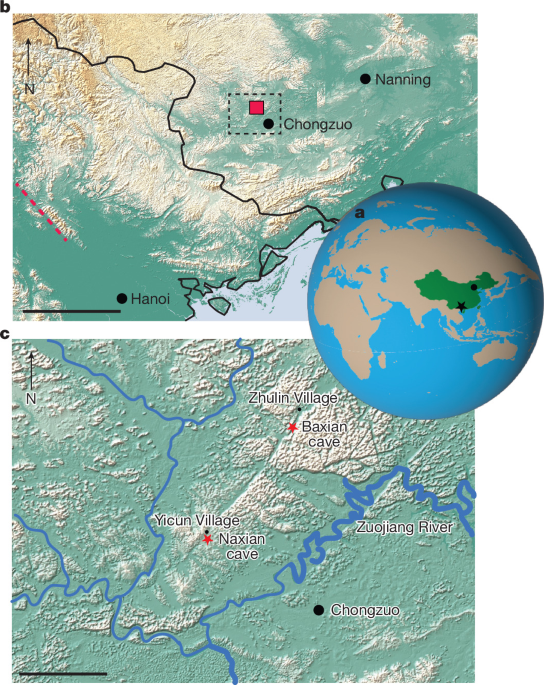
Homo erectus represents one of the longest-persisting hominin species, with a geographic range from Africa to eastern Eurasia from approximately 1.9 million years ago1 to 108 thousand years ago (ka)2. Despite this, there are still large gaps in our understanding of the adaptation capabilities of this species and the extent of its persistence in China. Assumptions over ecological preferences based on the Trinil3, Sangiran4 and Ngandong2 (in Java) open woodland–grassland mosaics have persisted, combined with limited direct stable carbon isotope measurements in Asia. Here we present a rich temporal and environmental context for nine hominin teeth, eight of which were morphologically and genetically identified as H. erectus5, found in two sister caves in Guangxi province, southern China. We modelled 43 radiometric ages from five dating techniques to establish a timeline for H. erectus presence in this region. Stable and clumped isotopes and trace elements from teeth were used to establish the dominant environments and their behavioural responses. We show that H. erectus was present in southern China between 324 and 184 ka, which is substantially more recent than previously established in this region for unequivocally H. erectus fossils at approximately 400 ka. The evidence suggests that they were persisting in closed rainforest ecosystems, thought to be the domain of only Homo sapiens, and were demonstrating long-term mobility and ecological flexibility. This evidence challenges the assumptions over the ecological preferences and behavioural limitations of H. erectus.
Early and late H. erectus finds in East and Southeast Asia represent a key part of the hominin evolutionary history of the Asian region, with China sitting in an important location to understand the dispersal, interactions and adaptations of this species6,7,8. There is a rich fossil record for H. erectus in China in Yuanmou (1.7 million years ago)9,10,11, Gongwangling (1.6 million years ago)12, Zhoukoudian (780–400 ka)13, Nanjing (approximately 650 ka)14 and Hexian (410 ka)15 (Supplementary Information 1). However, most of these sites are located in north and central China, with reliably identified and dated H. erectus fossils being conspicuously rare in southern China, especially during the Middle Pleistocene. This makes it particularly challenging to establish their ecological preferences. Furthermore, evidence of younger H. erectus (less than 400 ka) is almost entirely absent from China. This temporal gap is particularly striking given that H. erectus persisted in Java until 117–108 ka at Ngandong2, raising fundamental questions about the species’ distribution, ecological adaptations and ultimate fate in mainland China.
Establishing the environmental context of H. erectus is essential for understanding the species’ ecological flexibility and adaptive capabilities. The youngest Javanese H. erectus at Ngandong2 persisted in woodland refugia as rainforests expanded across the region, raising questions about whether encroaching closed-canopy forests contributed to the species’ eventual extinction2,16. Yet, there have been very few stable isotope studies on H. erectus evidence, as the material is often limited by diagenetic alteration3. Recent work has debated whether non-H. sapiens Middle Pleistocene hominins possessed the adaptive capabilities to exploit tropical rainforest environments17,18. Studying the forested landscapes of tropical southern China during the Middle and Late Pleistocene19 thus provides a crucial test case for assessing H. erectus ecological adaptations. Furthermore, understanding mobility patterns through techniques such as strontium isotope analysis can reveal how these populations used their landscapes and how they connected with contemporaneous populations across broader regional scales20,21.
Since the Pleistocene, tropical forest and grassland environments in southern China have