// NATURE NEWS — SPAZIO & SCIENZA
Global patterns and drivers of bee richness and endemism on islands
Nature
(2026) Cite this article
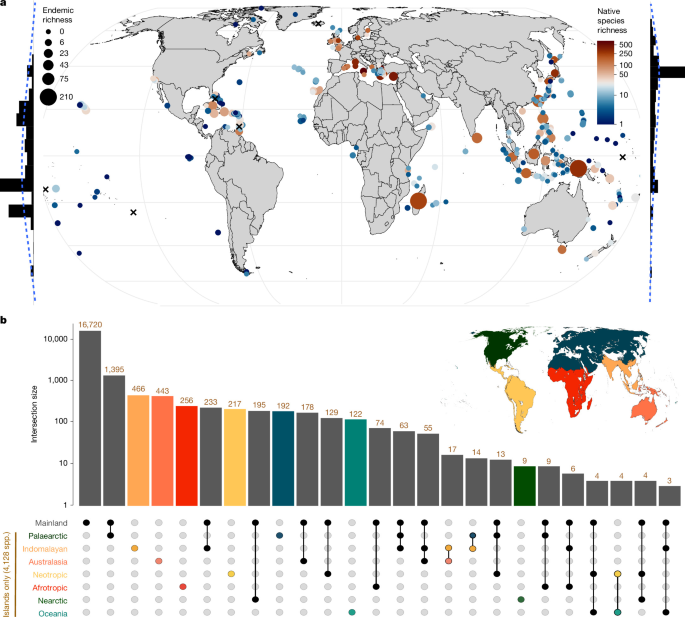
Islands account for a disproportionate share of global biodiversity1, yet insects, including invaluable pollinators such as bees2, remain underrepresented in island biogeography research3. Here we present a global checklist of island bees, recording 4,147 species across 305 islands. Although islands comprise only about 6% of the Earth’s land area, they support around 20% of known global bee diversity, and 42% of insular species are endemic, making up around 8% of all known bee species. Island bee species richness peaks at mid-latitudes (at least in the Northern Hemisphere), mirroring continental trends4. Native richness increases with island area and declines with isolation, consistent with patterns in other taxa5. The strength of island species–area relationships varies among biomes and is steepest in Mediterranean-type systems, which also support disproportionately high bee richness relative to flowering plant diversity. The number of endemic species is highest on large tropical islands, reflecting extensive in situ diversification. Major centres of bee endemism include Madagascar, Malesia (the Greater Sundas and New Guinea) and the Hawaiian islands, where a single large radiation of Hylaeus (Nesoprosopis) dominates6. Among islands that are capable of supporting endemic species, endemism scales strongly with total richness. These findings highlight the need to integrate island bee diversity into global conservation planning and position bees as a model for understanding insect evolution and conservation on islands.
Islands are fundamental for studying patterns of biodiversity in time and space1,7. The isolation and limited opportunities for colonization of remote islands have fostered evolutionarily distinct and highly endemic flora and fauna5,8,9. Consequently, islands have long been central to fundamental questions in macroecology, evolution, community ecology and species conservation10. Yet, despite their ecological and evolutionary importance, major gaps remain in our understanding of island colonization, evolution and diversification across animal taxa, especially arthropods.
Insects, the most diverse of all animal groups, remain underrepresented in global biogeographic studies and conservation assessments3. This gap largely reflects logistical and taxonomic challenges of assembling standardized, high-resolution data for insects across geographically and politically fragmented islands, which results in inadequate understanding of species’ distributions11. Consequently, tests of island biogeography theory have disproportionately focused on vertebrates (especially birds) and land vascular plants, and systematic studies across multiple archipelagos remain scarce both for insects and other invertebrates12,13,14 (but see Proios et al.15 for land snails).
Notable global efforts targeting other insect groups do exist, such as the Global Ant Biodiversity Informatics (GABI) database16, as well as efforts motivated by pest and pathogen spread, such as a global checklist of mosquito distributions17, and of patterns of island invasion by beetles18. Comparable progress has been made for Lepidoptera at regional scales, including recent large-scale analyses of butterfly biogeography across tropical Asian islands19. Nevertheless, comprehensive global syntheses—such as those available for plants20—of insect diversity and endemism across island systems are virtually absent.
There are approximately 21,000 described species of bees worldwide21. They have an important role in global ecosystems, pollinating many wild flowering plants22 and crops23. On continents, bees exhibit a bimodal latitudinal diversity distribution, with peak richness in seasonally xeric mid-latitude regions that support ecosystems with a Mediterranean climate (hereafter referred to as Mediterranean-type ecosystems), as well as in adjacent desert and montane habitats2,4,24. This pattern deviates from the