// NATURE NEWS — SPAZIO & SCIENZA
Injury-induced signalling coordinates immunity and cannibalism in locusts
Nature
(2026) Cite this article
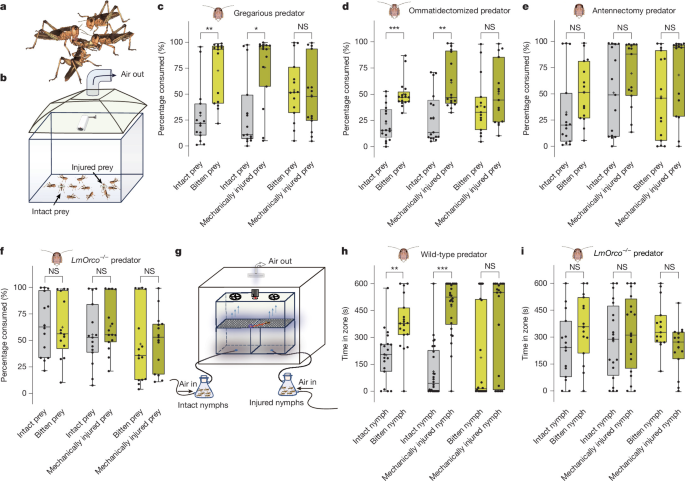
Cannibalism, the consumption of conspecifics, is widespread across the animal kingdom and can profoundly influence individual fitness and population dynamics1,2. Although the ecological and social conditions that favour cannibalism have been well documented2, the molecular signals that trigger cannibalistic attacks have remained poorly understood. Here we show that in Locusta migratoria, guaiacol, a volatile compound with augmented release after injury, attracts gregarious nymphs and induces cannibalistic behaviour. Guaiacol is detected by olfactory receptors LmOR36 and LmOR34, and disruption of either receptor abolishes attraction, thereby impairing induction of cannibalism. Guaiacol is synthesized by haemolymph symbiont Enterobacter hormaechei. Injury promotes bacterial congregation at the wound site, leading to elevated guaiacol production through a clustered set of vanillic acid decarboxylase genes; deletion of this gene cluster abolishes guaiacol production and its behavioural effects. Notably, guaiacol initially functions as a beneficial signal after injury. Guaiacol activates immune-related pathways in wounded locusts, enhancing pathogen resistance and increasing survival following minor injury. However, when guaiacol emission exceeds a threshold determined by injury severity, it functions as an external cue that attracts cannibals. Cannibalistic locusts exploit this immune-related odour to locate severely injured conspecifics, gaining both nutritional resources and immune system benefits. Together, our findings identify a microbial–chemical mechanism that links immune defence with cannibalistic behaviour and provide potential molecular targets for manipulation of cannibalism-dependent population dynamics.
Cannibalism, the consumption of conspecifics, is widespread across the animal kingdom and is often considered to be an adaptive behaviour driven by ecological or social pressures1,2. However, its occurrence is highly context-dependent, and the underlying regulatory mechanisms remain poorly understood. In humans, cannibalism largely disappeared with cultural evolution, partly owing to prion diseases3. Similarly, insects such as crickets rarely engage in cannibalism under normal conditions, but confinement or nutritional deprivation can trigger this behaviour4. These observations highlight the influence of environmental pressures on cannibalism, although its intrinsic regulatory mechanisms remain unclear.
Locusts provide a compelling model for studies of cannibalism because of its important role in collective dynamics5,6. In juvenile migratory bands, the threat of conspecific predation from behind promotes forward movement, reducing cannibalistic risk and contributing to group cohesion5,6. Cannibalism also provides nutritional benefits, allowing locusts to compensate for food deficiencies and potentially enhancing survival and movement capacity7,8. This behaviour is strongly influenced by density-dependent phase polyphenism. At low densities, solitarious locusts avoid conspecifics, whereas increased population density promotes gregarious behaviour and cannibalistic encounters5,7. Nutritional deficiencies further exacerbate cannibalism. Field studies of South American locusts (Schistocerca cancellata) have demonstrated that carbohydrate deprivation promotes cannibalism9, whereas laboratory studies on desert locusts (Schistocerca gregaria) have shown that protein-biased diets reduce movement and increase cannibalistic interactions7. Although these findings establish the ecological importance of cannibalism, its molecular and genetic regulation remains poorly understood.
Chemical cues regulate diverse locust behaviours, including aggregation10,11, oviposition12, mating13 and cannibalism14. Our previous work identified phenylacetonitrile (PAN) as a density-dependent anticannibalistic pheromone that activates specific olfactory receptors and reduces conspecific