// NATURE NEWS — SPAZIO & SCIENZA
Structural and regulatory evolution across the genus Hordeum
Nature
(2026) Cite this article
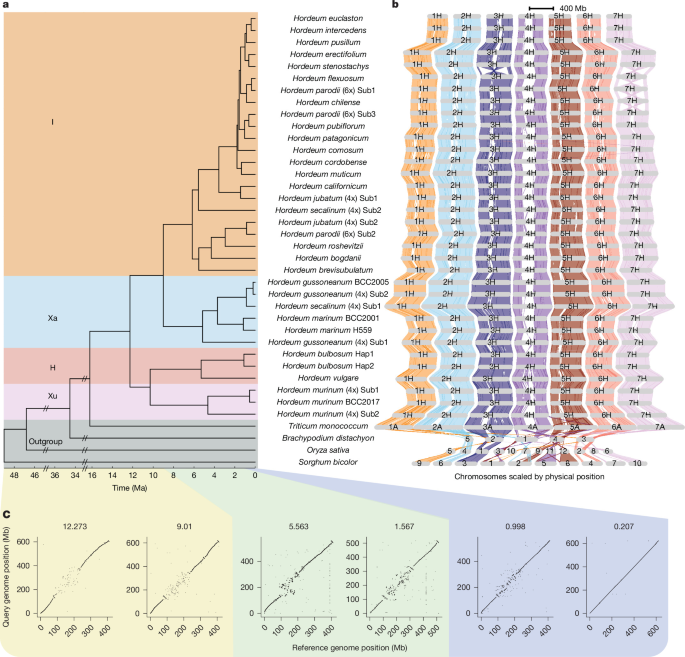
The genus Hordeum comprises cultivated barley and its wild relatives, an evolutionarily, ecologically and agriculturally important group of grasses1,2. Here we generated a chromosome-scale comparative genomic resource comprising all recognized diploid Hordeum species together with representative polyploid lineages. Comparative analyses reveal extensive structural variation, including inversions and chromosomal rearrangements that disrupt proximal collinearity and reflect lineage-specific genome remodelling. Single-copy gene phylogenies identify ancient hybridization, segmental exchange and introgression, revealing pervasive reticulate evolution during Hordeum diversification. We uncover widespread horizontal gene transfer from Panicoideae grasses into Hordeum, with many transferred genes showing evidence of transcription and functional integration. Retrotransposon proliferation explains genome size variation and provides insights into polyploid genome evolution. Whole-genome alignments reveal contrasting evolutionary dynamics: whereas coding sequences remain highly conserved, regulatory elements undergo rapid turnover, providing a rich source of regulatory diversity for phenotypic evolution. Case studies of vernalization and glume development demonstrate how natural variation in regulatory and coding sequences contributes to flowering time and floral morphology. This comprehensive pangenomic framework establishes Hordeum as a model for studying genome evolution, structural variation and the genetic basis of adaptive traits, offering new avenues for barley improvement.
The genus Hordeum comprises approximately 33 species and is widely distributed across the temperate regions of Eurasia and the Americas1,2,3. Hordeum is classified into two subgenera based on cytogenetic evidence: one containing the H and Xu genomes and the other containing the I and Xa genomes4. The basic chromosome number is seven, and, although most species are diploid, tetraploid and hexaploid taxa have also been described. Cultivated barley (Hordeum vulgare) is the best known and most extensively studied species, as it represents one of the earliest domesticated cereal crops. Today, barley is the world’s fourth most important grain, valued for its use in food, animal feed and brewing5. Cultivated barley and its wild progenitor (H. vulgare subsp. spontaneum) constitute a single inter-fertile gene pool, allowing for frequent gene flow between wild and cultivated forms6. This primary gene pool has long been exploited by breeders to introduce desirable traits6. Hordeum bulbosum has contributed valuable disease resistance genes through introgression7,8,9,10 due to its ability to hybridize directly with cultivated barley. The other Hordeum species are not domesticated but have important ecological and agricultural roles in ecosystem stability, environmental adaptation and forage use11,12,13,14,15. Together, Hordeum is both an agronomically important genus and a powerful model for studying crop evolution, environmental adaptation and resistance to biotic and abiotic stresses. Factors such as incomplete lineage sorting, recurrent hybridization and gene flow partly obscure species boundaries, leaving major evolutionary questions unresolved1,2,4,16,17. Recent barley pangenomes have substantially advanced our understanding of genomic variation within cultivated barley and its closest relatives10,18,19. However, these studies were largely confined to two species (H. vulgare and H. bulbosum) and therefore could not resolve genome-wide evolutionary processes operating across the genus, including the origin of large-scale structural variation, ancient hybridization, polyploid genome evolution and the diversification of regulatory loci. Extending comparative genomic analyses to encompass the entire genus is therefore essential to capture the full breadth of diversity within the Hordeum gene pool and to facilitat