// NATURE NEWS — SPAZIO & SCIENZA
Evidence for late Middle Pleistocene Homo erectus in mainland East Asia
Nature
(2026) Cite this article
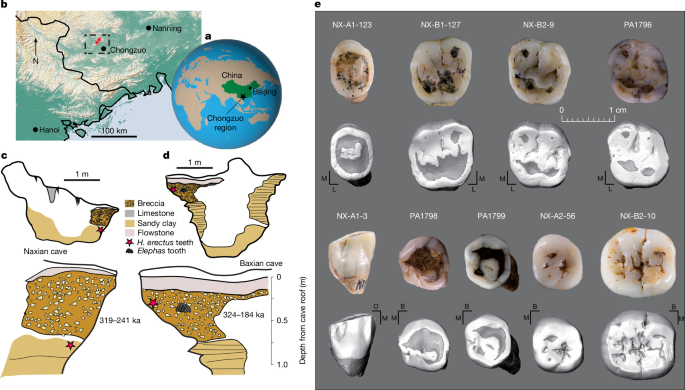
Hominin fossils and genetic evidence indicate that several hominin populations occupied East and Southeast Asia during the Middle and Late Pleistocene epoch1,2,3,4,5,6,7,8,9,10. Homo erectus fossils remain scarce in southern China and mainland Southeast Asia4,8,11. Here we report nine newly discovered late Middle Pleistocene hominin teeth from the Naxian and Baxian caves at the Chongzuo study area, Guangxi Zhuang Autonomous Region, southern China, dated to around 324–184 thousand years ago12. Palaeoproteomics reveals the presence of an endogenous dental proteome in all five hominin teeth studied molecularly. Four teeth contain a derived H. erectus substitution in ameloblastin that to date has been observed only in older Middle Pleistocene H. erectus specimens from China13. The proteomes of these four teeth differ from the previous H. erectus proteomes from China at another ameloblastin position, suggesting that these specimens represent a previously unsampled H. erectus population. Morphometric and geometric morphometric methods support an attribution of these teeth to H. erectus, as well as four additional teeth. This fills a gap in the geographical and chronological distribution of H. erectus in East Asia. The fifth tooth studied proteomically, PA1796, is morphologically distinct from H. erectus, Neanderthals (Homo neanderthalensis) and modern humans (Homo sapiens), and does not contain the H. erectus-derived amino acid sequence. The late survival of H. erectus on mainland East Asia suggests that at least two hominin lineages, H. erectus and Homo longi (Denisovans)6,7, possibly represented by PA1796, were present in the region towards the end of the Middle Pleistocene, with the first documented occurrence of H. sapiens not much later5.
The presence of Homo erectus in Asia has been dated to more than 1.5 million years ago (Ma) (possibly up to 2.1 Ma if the Shangchen stone tools were made by H. erectus14), with fossil evidence coming from over 20 sites and hundreds of specimens distributed from northern China (Zhoukoudian) to Central Java (Sangiran)14,15. At a continental scale, during the Middle Pleistocene, H. erectus overlapped with Denisovans (H. longi)9,16, a hominin population now known by fossils ranging from the Altai mountains (Denisova Cave), the Tibetan Plateau and northern China to southeastern Asia (Penghu channel) and mainland southeast Asia in Laos1,7,9,17,18,19,20,21. The spatiotemporal distribution of H. erectus fossils is heterogeneous, with only a handful of late Middle to early Late Pleistocene specimens known, all located in Island Southeast Asia8,11. The latest occurrence of H. erectus is from the Late Pleistocene sites of Ngandong on Java Island, in Indonesia, dating to 117–108 thousand years ago (ka)8. By contrast, on the mainland, there are no securely dated H. erectus fossils younger than 400 ka. Specimens from the Changyang and Chaoxian caves were attributed to H. erectus, with U–Th dating of faunal remains and carbonates from these sites providing chronological ranges of 196–143 ka and 200–160 ka, respectively, for the hominin-bearing layers11,22,23. However, as these are minimum ages, the Changyang and Chaoxian H. erectus specimens could be substantially older. Moreover, molecular data are available for only a few East Asian H. erectus specimens, all dating to around 420–400 ka (ref. 13), and this limits our understanding of the evolutionary relationships of different H. erectus populations to each other and to other penecontemporary hominin populations. To address these scientific questions, we report molecular data and morphological analysis of hominin teeth from Baxian cave and Naxian cave in Guangxi Zhuang Autonomous Region, southern China (Fig. 1). These hominin teeth were recovered during recent archaeological excavations that revealed the presence of a breccia containing a combined total of over 18,000 mammalian fossils, includin