// NATURE NEWS — SPAZIO & SCIENZA
Evidence for p-wave magnetism in electronic band structure of metallic EuSi
Nature
(2026) Cite this article
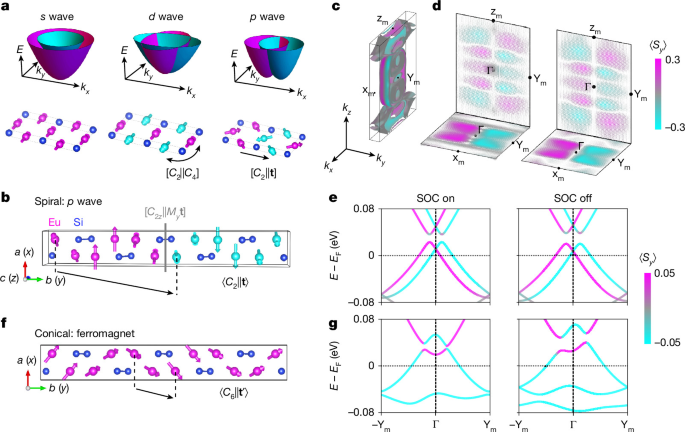
One active frontier of quantum-matter research is the realization of p-wave symmetry-breaking phases in fermionic systems, long exemplified by the A phase of superfluid helium-3 (refs. 1,2,3). Achieving p-wave superconductivity4 and its magnetic analogue5—characterized by a time-reversal-symmetric, p-wave spin-polarized Fermi surface—remains a grand challenge6,7. Despite recent progress in identifying candidate p-wave magnets5,7,8,9,10, spin-resolved spectroscopic evidence for their electronic structures remains limited. Here we report angle-resolved photoemission spectroscopy (ARPES) and spin-ARPES evidence for p-wave magnetism in the near-Fermi-level electronic structure of stoichiometric metallic EuSi, supported by symmetry analysis, first-principles calculations and neutron scattering. Neutron diffraction reveals a chiral spiral phase between 33.4 K and 62 K that fulfils archetypal p-wave magnetism criteria: it preserves the combined symmetry of time reversal and lattice translation, while breaking inversion symmetry. Spin-integrated ARPES reveals a pronounced magnetism-driven reconstruction of the electronic structure, with energy separations exceeding 100 meV, and spin-ARPES resolves Sy polarization in near-Fermi-level spectral features. The extracted Sy exhibits a sign-changing modulation across successive magnetic Brillouin zones and is suppressed near the nodal regions, consistent with the predicted p-wave spin texture and unfolded spin-polarization calculations. Magnetic force microscopy and micro-ARPES further reveal approximately 10-μm chiral magnetic domains. These results identify EuSi as a stoichiometric metallic platform for investigating p-wave magnetism in electronic band structures and spin-symmetry-based functionalities in spintronics10, topological matter7, superconductivity11 and beyond.
Unconventional symmetry breaking in itinerant fermion systems has revealed some of the most remarkable phases of quantum matter. A celebrated example is p-wave superfluidity in helium-3, where odd-parity Cooper pairing generates emergent orders beyond conventional paradigms1,2,3. Its magnetic analogue, the p-wave magnet, is characterized by an odd-parity spin-polarized electronic structure that preserves the combined symmetry of time reversal and lattice translation while breaking inversion symmetry5,6.
Recently, spin group theory has provided a framework for identifying such magnetic states5, extending concepts developed for altermagnets12. Whereas ferromagnets exhibit conventional s-wave-like spin splitting and altermagnets exhibit even-parity d-, g- or i-wave spin order12,13, p-wave magnets are characterized by odd-parity spin polarization associated with commensurate coplanar magnetic order that breaks inversion symmetry while preserving a combined time-reversal and translation symmetry5,14. The resulting electronic structure can exhibit a single symmetry-allowed spin component, symmetry-enforced nodal planes and a characteristic momentum-dependent spin texture. Candidate p-wave magnetism has recently been explored in insulating NiI2 (ref. 8) and metallic Gd3(Ru1−δRhδ)4Al12 (ref. 9). However, spin-resolved spectroscopic evidence for the characteristic odd-parity electronic spin texture remains limited8,9.
Here we present evidence for p-wave magnetism in the near-Fermi-level (near-EF) electronic structure of stoichiometric metallic EuSi by combining symmetry analysis, first-principles calculations, neutron scattering and photoemission spectroscopy. Neutron diffraction reveals a commensurate spiral phase with propagation vector (0, 1/3, 0) below the upper magnetic transition temperature, TN1 ≈ 62 K, followed by a transition to a conical phase at the lower magnetic transition temperature, TN2 ≈ 33.4 K. Magnetotransport measurements indicate strong coupling between magnetism and itinerant electrons. Below TN1, spin-integrated angle-resolved photoemission spe