// NATURE NEWS — SPAZIO & SCIENZA
Transient contacts between filaments impart its elasticity to branched actin
Nature
(2026) Cite this article
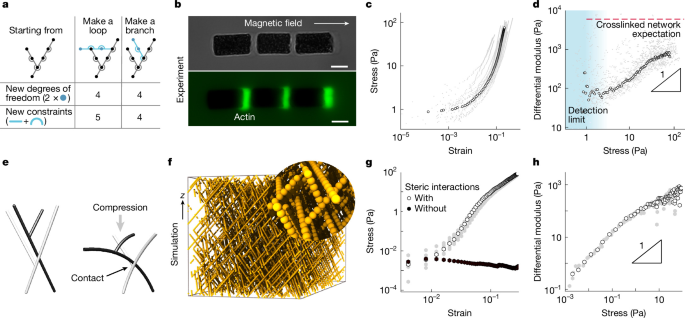
Cells dynamically assemble actin into branched networks to push on their environment during cell migration, endocytosis or the maintenance of cell–cell contact1. These networks are among the stiffest found in the cytoskeleton and can generate large pushing stresses against stationary obstacles2,3,4,5. When grown against a controlled opposing stress in an atomic force microscope6 or inside the cell7, branched networks alter their own architecture to adapt their compressional stiffness to their environment, but the underpinnings of their mechanics and adaptability are unclear. Here we show that their high density and low connectivity place them outside the scope of standard elastic network models for actin. We show that they are instead dominated by the proliferation of interfilament contacts under compression. This places branched actin in the same category as undercoordinated fibrous materials such as sheep’s wool. When the network is grown under force, filaments entangle as if knitted together and trap contacts in their structure. Trapped contacts have a similar role as crosslinkers in rigidifying the network and are thus key to its active adaptive mechanics.
This is a preview of subscription content, access via your institution
Access Nature and 54 other Nature Portfolio journals
Get Nature+, our best-value online-access subscription
Prices may be subject to local taxes which are calculated during checkout
The data for this study can be found in the main paper and the Supplementary Information.
Our simulation code is publicly accessible at GitHub (https://github.com/kazorik/Branched_actin_mec).
Gautreau, A. M., Fregoso, F. E., Simanov, G. & Dominguez, R. Nucleation, stabilization, and disassembly of branched actin networks. Trends Cell Biol. 32, 421–432 (2022).
Article
CAS
PubMed
Google Scholar