// NATURE NEWS — SPAZIO & SCIENZA
Tropical land-use intensification restructures biodiversity
Nature
(2026) Cite this article
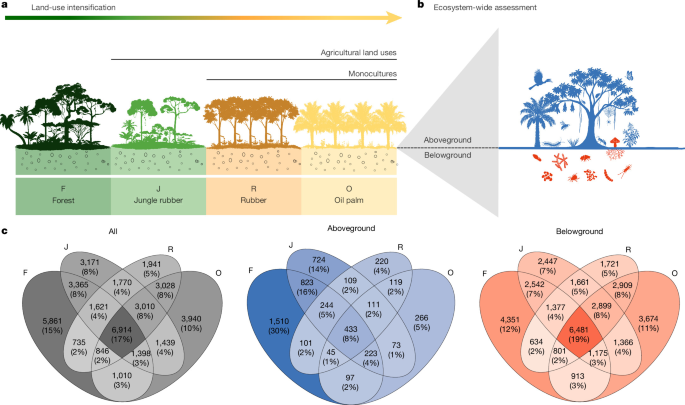
Tropical land-use intensification threatens global biodiversity, yet most assessments of tropical agricultural landscapes focus on local-scale biodiversity, overlooking how land use restructures biodiversity across space and multiple taxa. Here we provide an ecosystem-wide assessment of 24 taxonomic groups across all domains of life—encompassing 40,049 species—along a land-use intensification gradient from lowland forests to intensively managed smallholder cash-crop monocultures in Indonesian landscapes. Despite widespread losses of landscape and local multidiversity1 in monocultures (approximately 78% and 50%, respectively), we found no evidence for consistent community homogenization with land-use intensification. Instead, monocultures exhibit a systematic shift from turnover to nestedness for aboveground taxa. Such patterns of differentiation may mask trajectories towards biotic homogenization via early stages of assemblage simplification. Biotic differentiation has the potential to partly mitigate biodiversity losses by positively affecting γ-diversity. This opens management options, including the conservation of existing remnants of traditional agriculture and the implementation of sustainable management practices2,3,4. Our results demonstrate that tropical land-use intensification restructures biodiversity not only through species loss, but also via a pervasive reorganization of community composition across trophic levels. Conserving tropical biodiversity, therefore, requires a multi-taxon, landscape-scale perspective that explicitly integrates agricultural land uses with the protection of natural and semi-natural habitats to reconcile agricultural production and conservation.
Across many tropical regions, biodiverse old-growth rainforests have been replaced by tree-cash-crop monocultures, including oil palm, rubber, coffee, cacao and timber plantations5. At the same time, both traditional and modern tropical agroforestry systems6—long regarded as reconciling production with ecological sustainability—are being displaced by more intensive agriculture7,8. Such trends in land-use change and land-use intensification pose a substantial threat to the biodiversity and functioning of tropical ecosystems9,10. Quantifying their effects, however, remains challenging owing to the vast effort required to conduct multitrophic inventories of hyperdiverse tropical ecosystems, the often contrasting responses of different taxa, and the scale-dependence of biodiversity11.
The multiple negative effects of land-use change and intensification on tropical biodiversity are increasingly well documented, particularly at the local scale (α-diversity). Previous investigations have shown that α-diversity in tropical agricultural systems is typically substantially lower than in forests, with diminished species diversity linked to declines in ecological functions12,13,14,15. Although protected areas are central to mitigating these negative effects16, the long-term persistence of tropical biodiversity will also depend on conservation beyond reserve boundaries. Designing biodiversity-friendly tropical agricultural mosaic landscapes that sustain regional diversity (γ-diversity) without compromising economic objectives is therefore critical3,8,15. Achieving this goal requires a thorough understanding of how community composition varies among sites (β-diversity)17. β-Diversity arises either from species replacement among sites, with each site hosting a different set of species (turnover), or from species-poorer communities forming subsets of species-richer ones (nestedness)18. Identifying the spatial, environmental and management-related drivers of β-diversity in the context of land-use intensification in hyperdiverse tropical ecosystems may thus guide more effective landscape-scale management19.
An important yet understudied process in this context is biotic homogenization, which has been su