// NATURE NEWS — SPAZIO & SCIENZA
Ferroptosis in cancer cells triggers PGE2 production for tumour immune escape
Nature
(2026) Cite this article
Ferroptosis, a form of cell death induced by overwhelming membrane lipid peroxidation, is a vulnerability of many cancers, including cancers resistant to current molecular and immune-based therapies1,2,3,4,5,6,7. Triggering of ferroptosis therefore provides an opportunity to achieve elimination of difficult-to-treat cancers1,2,3,4,8,9. Studies in mouse cancer models have demonstrated that anticancer immunity, mediated by dendritic cells (DCs) and CD8+ T cells, is essential for effective tumour eradication by ferroptosis-inducing strategies10,11,12,13. However, ferroptotic cells limit this response8,9,10,14, resulting in immune escape and tumour growth through mechanisms that remain unclear. Here we demonstrate that ferroptotic cancer cells activate a molecular program resulting in aberrant production of prostaglandin E2 (PGE2), which limits the stimulation of anticancer CD8+ T cell responses by type 1 conventional DCs (cDC1s), thereby promoting immune escape. In ferroptotic cancer cells, lipid peroxidation-mediated membrane permeabilization enables Ca2+ influx, which activates p38 MAPK signalling and thereby drives PGE2 production. This signalling axis is uncoupled from cancer cell death and can be targeted to selectively interfere with immune-inhibitory PGE2 production while preserving ferroptotic cancer cell elimination. In the context of cancer cell ferroptosis, ablation of PGE2 production or disrupting PGE2 signalling restores cDC1-mediated anticancer CD8+ T cell responses and leads to effective tumour elimination. Our findings identify a key mechanism that limits antitumour immunity and prevents tumour elimination upon ferroptosis induction in cancer cells, which could be exploited for cancer therapy.
Uncontrolled lipid peroxidation is integral to ferroptosis5,15. Cancer cells are commonly protected from unrestrained lipid peroxidation and spontaneous ferroptotic cell death by molecular defence systems such as the system xc––glutathione (GSH)–glutathione peroxidase 4 (GPX4) pathway5,16, in which GPX4 is the key enzyme mediating lipid peroxide detoxification. Strategies to promote ferroptosis by blockade of ferroptosis defence systems, such as GPX4 inhibitors, have been considered promising approaches to achieve tumour elimination in patients with difficult-to-treat cancers8,9. Studies using preclinical mouse models have uncovered that effective tumour elimination by ferroptosis-inducing strategies requires anticancer immunity by DCs10 and tumour-infiltrating CD8+ T cells11,12,13. Yet recent findings have suggested that DC-driven anticancer CD8+ T cell immunity is suppressed in ferroptotic tumours8,9,10,17. Emerging evidence has implicated that the unrestrained generation of membrane lipid peroxides in ferroptotic cells can promote the production and release of molecules that may impact immune cell functions18. However, what causes the suppression of DC-mediated anticancer CD8+ T cell immunity in the context of tumour ferroptosis remains largely unclear.
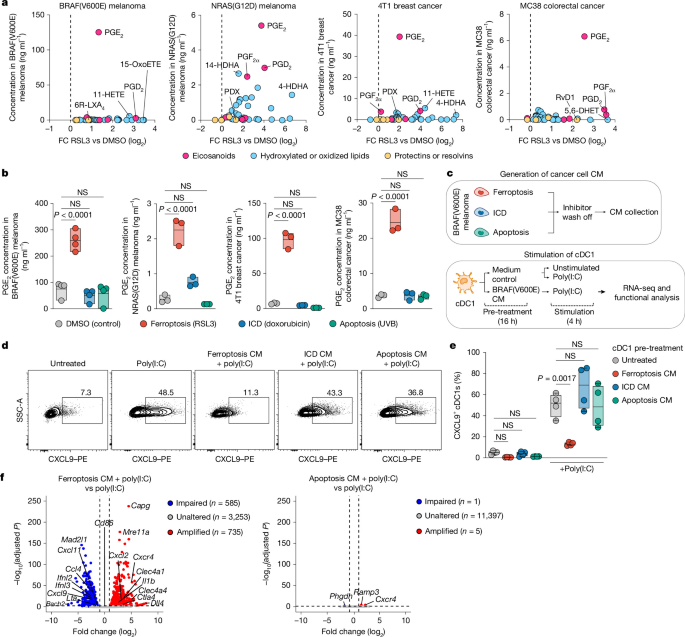
Potentially relevant immunoregulatory factors produced by ferroptotic cancer cells are oxylipins, bioactive lipids generated through peroxidation of polyunsaturated fatty acid-containing membrane lipids, a hallmark of ferroptosis15. To assess ferroptosis-induced oxylipin production and identify key factors, we profiled the oxylipin secretome of mouse BRAF(V600E) and NRAS(G12D) melanoma, 4T1 breast cancer and MC38 colorectal cancer cells following RSL3-induced ferroptosis. Across all these cancer cell lines, RSL3-treated (ferroptotic) cells displayed increased production of oxylipins compared with untreated (non-ferroptotic) controls (Fig. 1a). Of note, in all groups, the eicosanoid PGE2 was by far the most abundant oxylipin upregulated by ferroptosis induction (Fig. 1a). Similar to ferroptosis induction by RSL3 (which inhibits selenoproteins beyond GPX4), we observed strong PGE2 production after genetic ablati