// ARS TECHNICA — GAMING
Mouse fight club might explain why we like to watch violent things
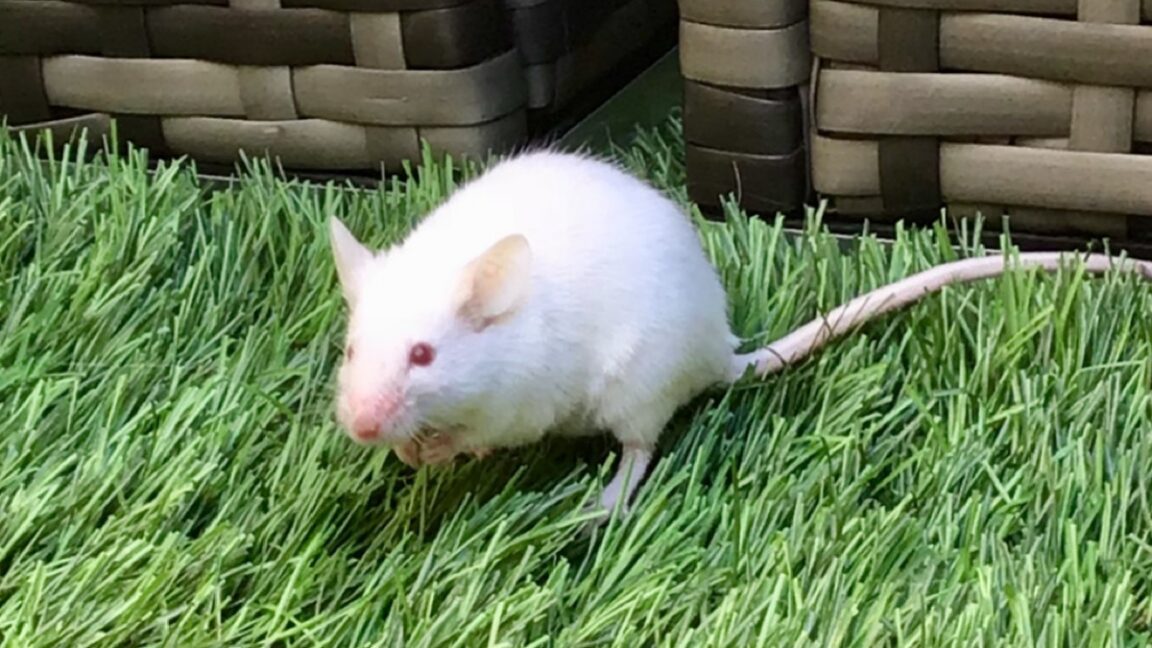
Watching fights wasn’t as good as practical experience, but it got the mice halfway there.
There’s something about watching violent events that broadly appeals to us, whether it’s the latest John Wick movie, a video game, or a live UFC bout. Scientists have debated whether watching violent things could make us more aggressive, but it could also be an adaptive survival strategy. Male mice, for instance, who watch other mice fighting learned enough about how to fight to better protect themselves (compared to mice who didn’t watch fights) when pitted against stronger, more aggressive opponents, according to a paper published in the journal Nature.
The team assigned male mice randomly to three different groups—fighters, spectators, or novices—and then subjected each group to eight days of training involving three 10-minute sessions per day. The novices played with stuffed mice in isolation, while the spectators watched various pairs of fighter mice battle it out from a raised platform behind a transparent barrier—a set-up chosen to let them smell and listen to the fights as well as observe them.
The ninth day was “fight night,” when all the mice had to face a daunting opponent in three 4-minute rounds. Each fight was filmed from above so that the mouse behavior could be analyzed. To monitor corresponding changes in brain activity, the team engineered the rodents’ excitatory brain cells to glow green whenever they were activated, while inhibitory brain cells glowed red. They also implanted tiny optical fibers into 12 interconnected brain regions so they could track changing activity in every brain region simultaneously.
How did they get the mice to fight? “Mice are naturally territorial,” co-author Jorge Iravedra-Garcia of Princeton University told Ars. “A traditional behavioral assay that experimenters use is called resident intruder. You just drop mice that are bred to be slightly weaker, and a little bit more docile, into the home cage of strains we know are more on the aggressive side. Those strains are typically very good at just naturally evoking that behavior.”
So the fights weren’t entirely fair. “We tip the scales in favor of having a clear winner and a clear loser by having the clear winner be at home, be bigger, and be more experienced,” co-author Annegret Falkner, also of Princeton, told Ars. “We really wanted to show that these changes are adaptive in some way. Animals don’t know what the outcome of a fight is before they enter it. So we set up a situation where the outcome is a little bit more uncertain for the mouse.”
The results: the spectator mice ended up being better prepared for fight night—despite being weaker, less aggressive strains—because they watched fighter mice during the training sessions. Specifically, both spectators and fighters spent less time with their backs turned toward opponents than novice mice, and were also quicker to attack. They also used similar moves. Granted, they weren’t quite as skilled as their fighter-mouse brethren; practical experience still mattered. But they learned enough through observation to perform better than the novices.
That behavioral change was mirrored in the neural data: the brains of the spectator mice altered to more closely resemble the brains of the fighting mice across all 12 of the interconnected regions. During training, the spectator inhibitory cells resembled a fighter’s, while the excitatory cells were closer to those of novice mice, but that changed on fight night, when both types of cells more closely resembled those of fighting mice.
“When you’re watching a fight, you’re paying attention to many things at once,” said Iravedra-Garcia. “You’re not just simulating that aggressive behavior in your head, you’re also trying to gauge who’s dangerous, who’s not, who’s actually involved in the fight versus ‘Do I know them? Are they novel to me?’ Witnessing aggression leaves a circuit trace that changes how an animal behaves in its next conflict, and that