// ARS TECHNICA — SPAZIO & SCIENZA
Watching as a giant star swallowed its neighbor and exploded
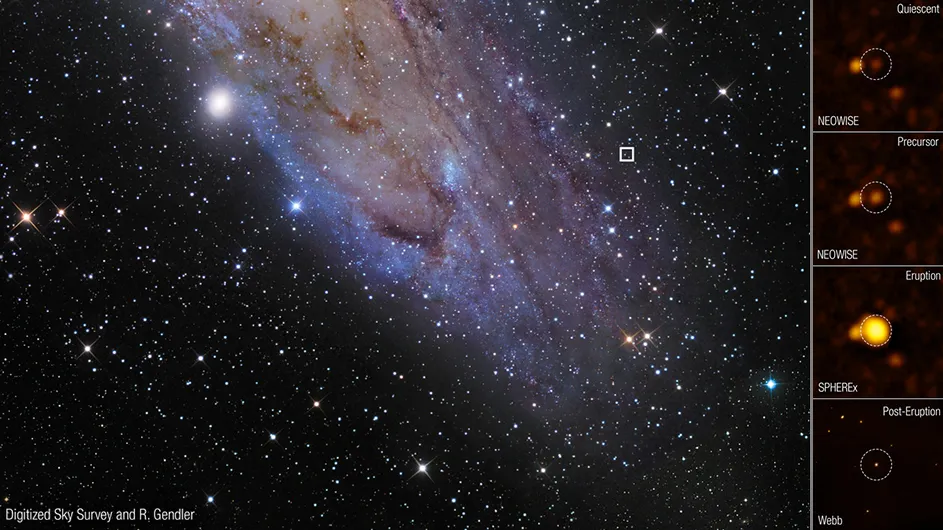
A recent brightening turned out to be from a star orbiting inside another.
In the Andromeda Galaxy, a giant star about seven times as massive as the Sun spent nearly a decade slowly swallowing its much smaller companion. The process, known as common envelope evolution, was proposed in the 1970s to explain how some of the tightest pairs of stars in the Universe form, but no one had ever caught it in the act.
In a new Nature study, astronomers led by Viraj Karambelkar, an astrophysicist at Columbia University, finally witnessed the entire spectacle from the decades before it began to the eruption that ended it in late 2025. “It lasts for a few years, maybe a few decades,” Karambelkar said. “Stars evolve on time scales of millions of years. So, it’s really like a blip on the entire cosmic time scale.”
Some pairs of stars orbit so close to each other that they could not have formed at that distance, so their orbits must have shrunk. Common envelope evolution is the leading explanation for that shrinkage. When one star in a binary grows old, it expands into a giant, and its outer layers can engulf its companion. The two then share a single, loosely bound envelope of gas. As the engulfed star drags through it, it loses orbital energy to friction and spirals inward. Depending on how much of the envelope gets lost, the pair either ends up in a much tighter orbit or merges.
Karambelkar’s team spotted a candidate system where this might be happening while searching Andromeda for stars changing in brightness, using the WINTER infrared telescope at Palomar Observatory and data from NASA’s NEOWISE mission. One giant had been brightening for seven years. “When a star first swallows its companion, it has a very subtle effect on its brightness,” Karambelkar explains. “It slowly brightens, and a lot of light comes out in the infrared.”
In April 2025, Karambelkar’s team published a paper suggesting that this system, named AT 2025abao, was undergoing an engulfment in progress. Back then, though, they couldn’t rule out a competing explanation: a single star with instabilities deep within its core. So, they kept watching.
The researchers reconstructed the history of the system using observations from about a dozen telescopes and surveys, going back to photographic sky plates from 1989. Until 2018, the star barely changed. Modeling those quiet years revealed a giant late in its life, about 350 times wider than the Sun. Its companion was impossible to see, however. “The giant star outshines the smaller star by a factor of about 18,000,” Karambelkar says.
To get around it, the team estimated the mass of the smaller companion based on the amount of dust the system had shed before the engulfment. The estimates suggested a star of roughly 0.7 solar masses.
Between 2018 and early 2025, the giant brightened two- to three-fold in visible light, swelling while its temperature stayed nearly constant. Karambelkar compares the process to a spacecraft reentering Earth’s atmosphere. The companion, skimming through the giant’s outer layers, was gradually seeing its orbit shrink, and the friction was heating up the envelope. The energy released by that drag matched the extra light the team observed.
Then, the star’s visible light dropped by half while its infrared glow kept rising. NASA’s SPHEREx space telescope happened to catch it in July 2025, revealing that the giant had swollen to some 860 times the Sun’s width and wrapped itself in fresh dust.